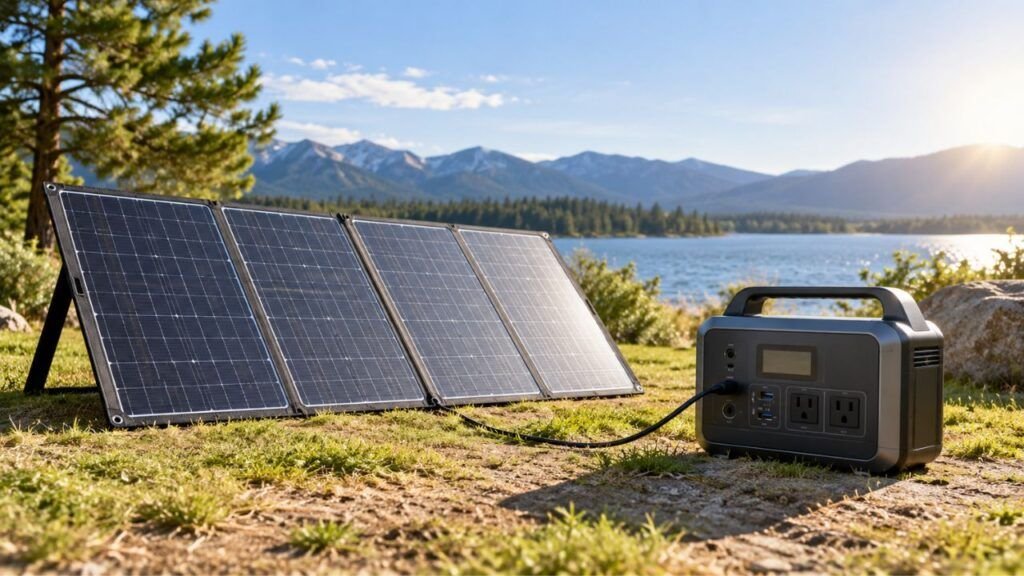
Solar panels usually take about 3 to 8 hours of strong solar charging to recharge a well-matched generator. However, the actual time can range from a few hours to several days. Battery size, panel wattage, sunlight, weather, and solar input limits all matter.
The good news is that estimating your charging time is fairly simple. I’ll show you the math, realistic examples, and the factors that can slow charging.
Key Takeaways
- Most matched solar generator systems need around 3 to 8 good-sun hours.
- Larger batteries need more energy, so they usually take longer.
- Higher solar panel wattage can reduce charging time significantly.
- Solar panels rarely produce their full rated wattage all day.
- Your generator may limit how much solar power it can accept.
- Peak sun hours determine whether charging finishes within one day.
- Clouds, shade, heat, and poor panel positioning can slow charging.
- Using appliances while charging can reduce battery recovery speed.
How Long Do Solar Panels Take to Recharge a Generator?
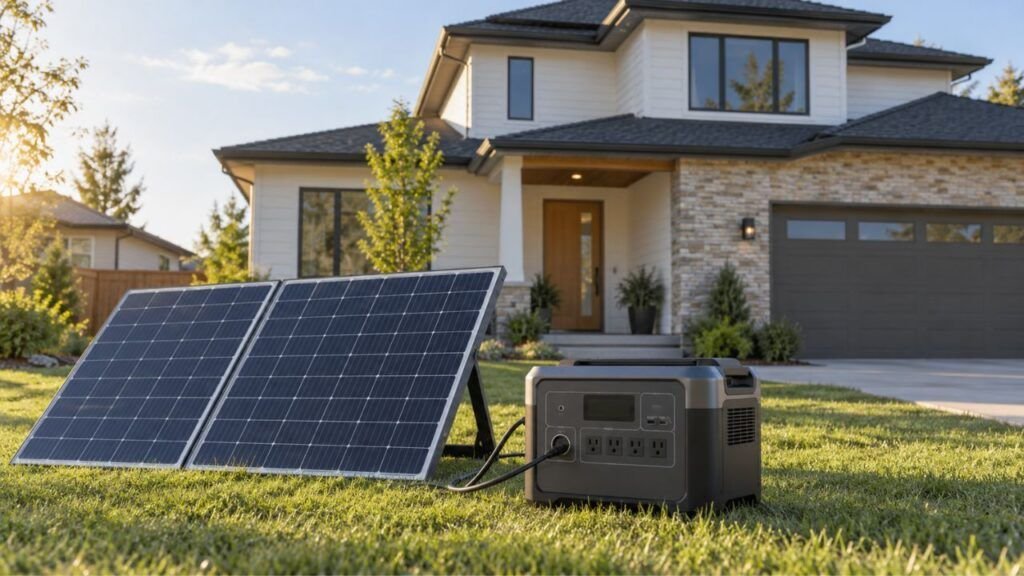
The exact recharge time depends mainly on battery capacity and incoming solar power. A properly sized panel array can often recharge a portable generator during one sunny day.
Here are some useful planning examples.
| Generator Capacity | Solar Panel Wattage | Ideal Charging Time | Practical Good-Sun Estimate |
| 300Wh | 100W | 3 hours | Around 4 hours |
| 500Wh | 100W | 5 hours | Around 6 to 7 hours |
| 500Wh | 200W | 2.5 hours | Around 3 to 4 hours |
| 1,000Wh | 200W | 5 hours | Around 6 to 7 hours |
| 1,000Wh | 400W | 2.5 hours | Around 3 to 4 hours |
| 2,000Wh | 400W | 5 hours | Around 6 to 7 hours |
| 2,000Wh | 800W | 2.5 hours | Around 3 to 4 hours |
| 3,000Wh | 600W | 5 hours | Around 6 to 7 hours |
These numbers assume fairly strong sunlight and reasonable system efficiency.
Real charging may take longer if clouds move overhead. Shade, hot panels, low sun angles, and power usage also matter.
Another important point is daylight availability.
You may calculate six charging hours but only receive four effective peak sun hours. In that case, charging may continue into the next day.
How to Calculate Solar Generator Charging Time
You do not need complicated electrical formulas for a useful estimate. Start with battery energy, then compare it with actual incoming solar power.
Step 1: Find How Much Battery Energy You Need
Start with the generator’s battery capacity in watt-hours.
Suppose you have a 1,000Wh power station.
If the battery is completely empty, you need roughly 1,000Wh replaced.
However, most people begin charging before reaching zero.
If the battery still has 30% remaining, you need about 70%.
Use this simple calculation:
Energy Needed = Battery Capacity × Percentage Being Recharged
For a 1,000Wh battery at 30% remaining:
1,000Wh × 70% = 700Wh
You need to replace roughly 700Wh.
This approach gives you a better estimate than always assuming zero percent.
Step 2: Find Your Actual Solar Input
Next, check how much power the panels are really providing.
A 200W solar panel does not produce exactly 200W every hour.
You might see:
- 185W during excellent midday sun
- 150W under good conditions
- 90W during light cloud cover
- 40W or less during poor conditions
Many modern power stations show solar input on their display.
If yours shows 165W, use 165W in your calculation.
That number is usually more useful than panel nameplate wattage.
Step 3: Calculate Charging Hours
Use this formula:
Charging Time = Energy Needed ÷ Actual Solar Input
Using our earlier example:
700Wh ÷ 165W = about 4.2 hours
That means you need roughly 4.2 equivalent hours at that input level.
However, the sun will not stay perfectly consistent.
Input may climb around noon and fall later.
Because of that, actual clock time can be longer.
If you use the actual input shown by your generator, do not reduce it again by another efficiency percentage. Most losses are already reflected in that measured incoming wattage.
Step 4: Check Whether Charging Can Finish Today
This is where peak sun hours become important.
A useful planning formula is:
Daily Solar Energy = Panel Wattage × Peak Sun Hours × Performance Factor
Suppose you have:
- 400W of solar panels
- 5 peak sun hours
- 80% planning efficiency
The estimate becomes:
400W × 5 × 0.80 = 1,600Wh per day
That array could theoretically collect around 1,600Wh during that day.
If your generator only needs 1,000Wh, you have enough solar potential.
Actual results can still vary with weather and system limits.
Charging Hours vs Peak Sun Hours: Why They Are Different
Charging hours and peak sun hours sound similar, but they are different.
This is where solar charging estimates often become confusing.
Suppose you have a 500Wh generator and a 100W panel.
The ideal math says:
500Wh ÷ 100W = 5 hours
You might assume five daylight hours will completely recharge the battery.
That is not always true.
A 100W panel only reaches near its rated output under favorable conditions.
Morning sunlight may produce much less.
Late afternoon sunlight also produces less.
Clouds and changing sun angles reduce output further.
Peak sun hours combine changing sunlight into an equivalent full-power figure.
You might have ten hours of daylight but only four peak sun hours.
That difference matters when planning a full recharge.
If your setup needs six equivalent charging hours, four peak sun hours probably will not finish the job in one day.
How Much Can Your Panels Recharge in One Solar Day?
You can estimate daily solar production before deciding whether your panel setup is large enough. The following examples use five common peak-sun-hour ranges and an 80% planning factor.
| Solar Array | 3 Peak Sun Hours | 4 Peak Sun Hours | 5 Peak Sun Hours | 6 Peak Sun Hours |
| 100W | 240Wh | 320Wh | 400Wh | 480Wh |
| 200W | 480Wh | 640Wh | 800Wh | 960Wh |
| 400W | 960Wh | 1,280Wh | 1,600Wh | 1,920Wh |
| 800W | 1,920Wh | 2,560Wh | 3,200Wh | 3,840Wh |
| 1,000W | 2,400Wh | 3,200Wh | 4,000Wh | 4,800Wh |
These are planning estimates rather than guaranteed production numbers.
Your location makes a big difference.
Arizona sunshine can produce very different results from a cloudy winter day in the Pacific Northwest.
Season also matters.
A setup that easily recharges during summer may struggle during winter.
That is why I recommend sizing panels with some extra capacity.
What Affects How Fast Solar Panels Recharge a Generator?
Several things can change your solar generator charging time. Understanding them makes it easier to diagnose slow charging.
Battery Capacity and Starting Charge Level
A bigger battery normally takes longer to recharge.
A 2,000Wh battery needs twice the energy of a 1,000Wh battery.
However, starting battery level also matters.
If your 2,000Wh unit still has 70% remaining, you only need around 600Wh replaced.
That could recharge much faster than an empty 1,000Wh battery.
Always consider how much energy actually needs replacing.
Solar Panel Wattage
Higher panel wattage usually means faster charging.
A 100W panel produces less energy than a 400W array.
For example:
A 1,000Wh generator on 100W solar could need many hours.
The same generator on 400W solar may recharge within one good day.
However, more panel wattage only helps when the generator accepts it.
Generator Maximum Solar Input
This is one of the most important limits to check.
Every power station has a maximum solar input.
Suppose your generator accepts only 400W of solar.
Connecting 800W of panels does not mean 800W enters the battery.
The power station may cap input near its supported limit.
Before adding panels, check the generator’s specifications.
Look for maximum PV input wattage.
Solar Input Voltage and Current Limits
Panel wattage is not the only specification that matters.
Your generator also has voltage and current limits.
Check these before connecting several solar panels.
Pay attention to:
- Maximum solar input voltage
- Supported voltage range
- Maximum input current
- Maximum solar wattage
- Recommended series or parallel configuration
This becomes especially important when adding multiple panels.
Do not assume any panel combination will work safely.
Stay within the generator manufacturer’s electrical limits.
Direct Sunlight, Clouds, and Shade
Direct sunlight gives you the best charging performance.
Clouds reduce incoming solar energy.
Heavy overcast conditions can reduce output dramatically.
Shade can create an even bigger problem.
A branch covering part of the panel may reduce output more than expected.
Try to place portable panels in completely open sunlight.
Even temporary shade can slow charging noticeably.
Panel Angle and Direction
Solar panels work best when sunlight reaches them directly.
Portable panels make adjustment easy.
I usually recommend checking them a few times during the day.
A panel positioned well at 10 a.m. may be poorly positioned later.
Small adjustments can improve total daily energy collection.
You do not need to chase the sun constantly.
Just avoid leaving panels facing away from strong sunlight.
Panel and Battery Temperature
Solar panels do not always produce more power when hotter.
High panel temperatures can actually reduce electrical output.
Your power station battery also has charging temperature limits.
Very cold or very hot conditions may slow charging.
Some units may stop charging outside their safe temperature range.
If possible, keep the generator itself in a shaded, ventilated area.
The solar panels still need direct sunlight.
Charging While Using the Generator
You can often use a power station while solar charging.
However, your appliances are consuming some incoming energy.
Suppose solar panels provide 300W.
Your connected devices are using 150W.
Less energy is available for increasing battery charge.
The exact behavior varies by power station.
Still, the basic rule is simple.
Heavy power use while charging usually increases recharge time.
Charge Controller and Conversion Losses
Modern solar generators usually use an MPPT charge controller.
Its job is to manage solar input efficiently.
However, no system transfers every watt without losses.
Cables, electronics, heat, and battery charging all introduce losses.
That is why ideal math often looks faster than real-world charging.
Use ideal calculations as a starting point.
Then allow some extra time for actual conditions.
How Long Does a 100W Solar Panel Take to Charge a Generator?
A 100W solar panel works well with smaller power stations. It becomes much slower when paired with larger battery capacities.
A 300Wh generator has an ideal charging time near three hours.
Realistically, expect around four strong-sun hours.
A 500Wh generator may need six or more good-sun hours.
A 1,000Wh generator can require 12 hours or more of effective solar charging.
That may mean two or three days with one 100W panel.
If your generator supports more solar input, adding panels can help.
For larger backup systems, 100W is usually fairly modest.
How Long Does a 200W Solar Panel Take to Charge a Generator?
A 200W panel is a useful middle ground for portable systems.
A 500Wh battery has an ideal charging time near 2.5 hours.
A more realistic estimate is around three to four good-sun hours.
A 1,000Wh generator may need around six strong-sun hours.
A 2,000Wh generator can need roughly 12 hours or more.
Again, that does not necessarily mean 12 continuous daylight hours.
It may require multiple sunny days depending on your location.
A 200W panel works well for camping and lighter backup needs.
Larger home backup batteries usually benefit from more solar capacity.
How Long Does a 400W Solar Panel Take to Charge a Generator?
A 400W solar array can recharge medium and large power stations much faster.
A 500Wh battery may recharge in around two strong-sun hours.
A 1,000Wh battery may need around three to four hours.
A 2,000Wh battery may need around six to seven hours.
These estimates assume the generator accepts the full solar input.
That part is important.
If the power station only accepts 200W, your 400W array cannot deliver its full potential into the battery.
Always check solar input limits first.
Does Adding More Solar Panels Always Make Charging Faster?
No. Adding more panels only helps until another system limit takes over.
More panels can improve charging speed when:
- The generator accepts the extra wattage
- The input voltage stays within limits
- Input current remains within specifications
- The panels are connected correctly
- Sunlight is strong enough
- The battery can accept the available charge rate
Suppose your power station allows 1,000W of solar.
Moving from 200W to 600W could make a big difference.
Moving from 600W to 1,000W may improve it further.
However, connecting 1,500W will not necessarily make charging faster.
Once the generator reaches its input limit, extra capacity may provide little benefit during strong sun.
More panels can still help during weaker conditions.
But they must remain within safe electrical specifications.
How to Recharge a Solar Generator Faster With Solar Panels
A few simple changes can improve solar charging performance significantly.
- Use more panel wattage when your generator supports it.
- Keep every panel completely clear of nearby shade.
- Face portable panels toward the strongest available sunlight.
- Reposition panels during the day when practical.
- Keep panel surfaces clean from dust and debris.
- Remove snow or leaves blocking solar cells.
- Use proper cables with the correct specifications.
- Avoid unnecessary cable length where practical.
- Reduce heavy appliance use while the battery charges.
- Start charging early during sunny weather.
- Keep the power station shaded and properly ventilated.
- Stay within the generator’s charging temperature limits.
- Use multiple solar inputs when your power station supports them.
- Check panel voltage before creating larger panel arrays.
You do not need perfect conditions.
The goal is simply reducing avoidable losses.
Common Solar Charging Time Mistakes
Solar charging estimates often go wrong because of a few simple assumptions.
- Assuming a 200W panel produces 200W continuously
- Treating daylight hours as peak sun hours
- Confusing watts with watt-hours
- Ignoring the generator’s current battery percentage
- Ignoring maximum solar input limits
- Adding panels without checking voltage
- Forgetting input current restrictions
- Charging while running large appliances
- Expecting identical performance during every season
- Ignoring partial shade across the panel
- Using manufacturer best-case times as guaranteed results
- Counting efficiency losses twice when using measured input wattage
Avoid these mistakes and your estimate becomes much more realistic.
Can Solar Panels Fully Recharge Your Generator in One Day?
Yes, solar panels can fully recharge a generator in one day when the panel array is large enough. You also need enough usable sunlight.
Here is a simple example.
Suppose your generator needs 1,000Wh replaced.
You have 400W of solar panels.
Your location receives five peak sun hours.
Using an 80% planning factor:
400W × 5 × 0.80 = 1,600Wh
Your panels could theoretically collect around 1,600Wh that day.
That gives you enough solar energy for the recharge.
Now compare that with a 100W panel:
100W × 5 × 0.80 = 400Wh
You only collect around 400Wh.
That is not enough to refill a 1,000Wh battery in one day.
You would probably need multiple days.
This is why daily solar production matters more than panel wattage alone.
Is Solar Charging Fast Enough for Your Situation?
The right solar charging speed depends on how you use your generator. Home backup, camping, and off-grid living all have different energy needs.
Emergency Home Backup
For emergency backup, look beyond battery capacity.
You also need to think about recovery.
Suppose your household uses 2,000Wh every day during an outage.
Your panels only replace 1,000Wh daily.
The battery loses another 1,000Wh of stored energy each day.
Eventually, it will run empty.
For longer outages, your solar array should ideally replace your essential daily usage.
That may require more panels than occasional camping use.
RV and Camping
Solar charging works especially well for RVs and camping.
Your daily loads may include:
- Phones
- Laptops
- Lights
- Fans
- Portable refrigerators
- Small kitchen devices
A 200W or 400W portable array can often replace moderate daily use.
However, campsite shade can reduce performance dramatically.
Try to position panels away from trees when possible.
Off-Grid Use
Off-grid systems need careful energy balance.
Your daily energy consumption should not regularly exceed solar production.
For example:
If you consume 1,500Wh daily, your panels should ideally replace at least that much.
Adding some reserve is even better.
Cloudy weather will eventually happen.
A little extra solar capacity gives you more breathing room.
When Solar Charging Takes More Than One Day
There is nothing unusual about solar charging taking several days.
It commonly happens when panel wattage is small compared with battery size.
Weather can also extend charging time.
Common reasons include:
- Large battery capacity
- Small solar panel array
- Winter sunlight
- Heavy cloud cover
- Partial shade
- Poor panel positioning
- Short daylight periods
- High appliance consumption
- Generator solar input restrictions
Suppose your battery needs 1,500Wh.
Your solar setup only produces 500Wh daily.
You need roughly three good solar days.
That does not mean something is wrong.
Your panels simply cannot replace all the energy in one day.
You can reduce this time by adding suitable solar capacity.
Conclusion
So, how long do solar panels take to recharge a generator?
For a properly matched system, expect around 3 to 8 hours of strong equivalent solar charging in many situations. Smaller panels paired with large batteries can take much longer and may need several days.
The easiest estimate starts with battery energy and actual solar input.
Use:
Energy Needed ÷ Actual Solar Input = Estimated Charging Hours
Then compare that result with your available peak sun hours.
Most importantly, check your generator’s solar input limits before adding panels.
A larger array can make charging much faster, but only when the power station can safely accept the extra power.
If your charging seems unusually slow, start with the basics.
Check panel shade, angle, incoming wattage, battery level, and connected loads.
Those simple checks usually explain most charging problems.
Related FAQs
Here are a few quick answers to common solar generator charging questions.
Can a 100W Solar Panel Charge a 1,000Wh Solar Generator in One Day?
Usually not from empty. A 100W panel may only collect a few hundred watt-hours during a typical solar day, so a 1,000Wh battery can require two or more good days.
How Long Does a 200W Solar Panel Take to Charge a 1,000Wh Battery?
The ideal calculation gives about five hours. In real conditions, expect closer to six or seven strong-sun hours, sometimes longer depending on weather and system losses.
How Long Does a 400W Solar Panel Take to Charge a 2,000Wh Generator?
The ideal calculation is about five hours. A practical estimate is closer to six or seven good-sun hours if the generator accepts the full 400W input.
Do Solar Panels Charge a Generator on Cloudy Days?
Yes, solar panels can still produce energy under clouds. Charging usually becomes slower because less sunlight reaches the panel, and heavy cloud cover can reduce output significantly.
Can I Use a Solar Generator While It Is Charging?
Many power stations support charging while powering devices. However, connected appliances use some incoming energy, so the battery may recharge more slowly.
Does Adding More Solar Panels Reduce Charging Time?
Yes, provided the generator can accept the extra solar wattage. You must also stay within its voltage and current limits when adding more panels.
Why Is My Solar Generator Charging Slower Than Expected?
Common causes include cloud cover, shade, poor panel angle, hot panels, low sunlight, dirty panels, high appliance usage, and your generator’s maximum solar input limit.
How Many Peak Sun Hours Do I Need to Recharge My Generator?
That depends on battery energy and panel wattage. Divide the energy you need by your expected daily solar production to estimate whether one solar day is enough.

Austin Parker writes practical generator how-to guides, troubleshooting advice, and buying guides for solar, portable, and fuel-powered generators. His focus is helping readers solve common power problems, understand their options, and choose dependable equipment for real-world use.