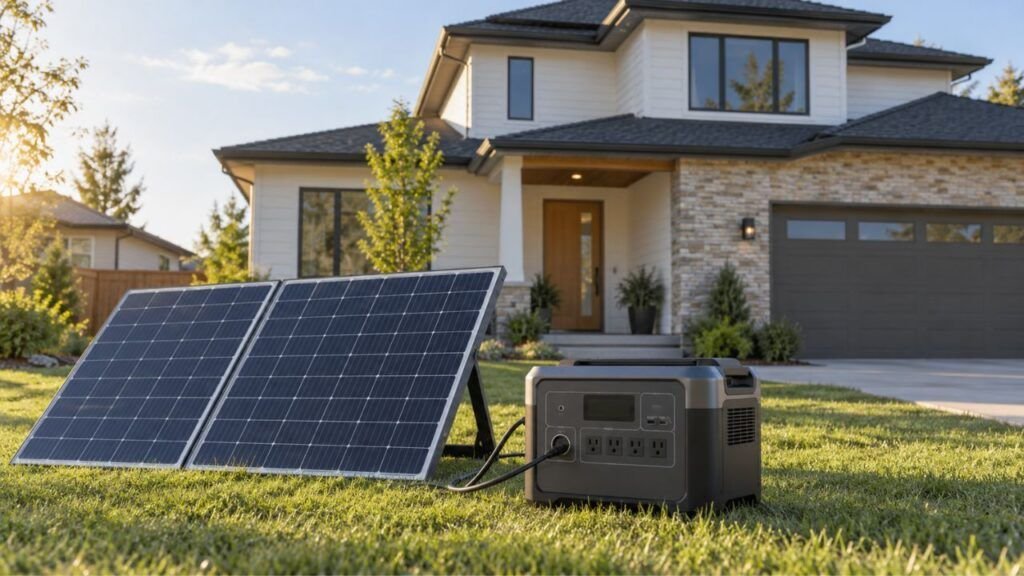
Yes, a solar generator can run a sump pump if it provides enough continuous power and startup surge capacity for the pump. The battery also needs enough storage to keep the pump cycling during the outage.
The important part is choosing the right size instead of relying only on horsepower. I’ll show you how to check your pump, size the solar generator, estimate runtime, and prepare the system before a storm.
Key Takeaways
- A solar generator can run most residential sump pumps when properly sized.
- Startup surge is often much higher than normal running wattage.
- Your generator’s continuous output must exceed the pump’s running demand.
- Battery capacity determines how long the pump can keep operating.
- Sump pumps cycle on and off, so actual runtime can exceed continuous-runtime estimates.
- Heavy rain may make the pump run more frequently and drain the battery faster.
- Solar panels can extend runtime, but cloudy storm conditions reduce charging.
- Always check your actual sump pump label or manual before choosing a generator.
Can a Solar Generator Actually Run a Sump Pump?
A properly sized solar generator can power a standard residential sump pump during a blackout. In many homes, this can be a practical way to keep basement water under control when utility power disappears during a storm.
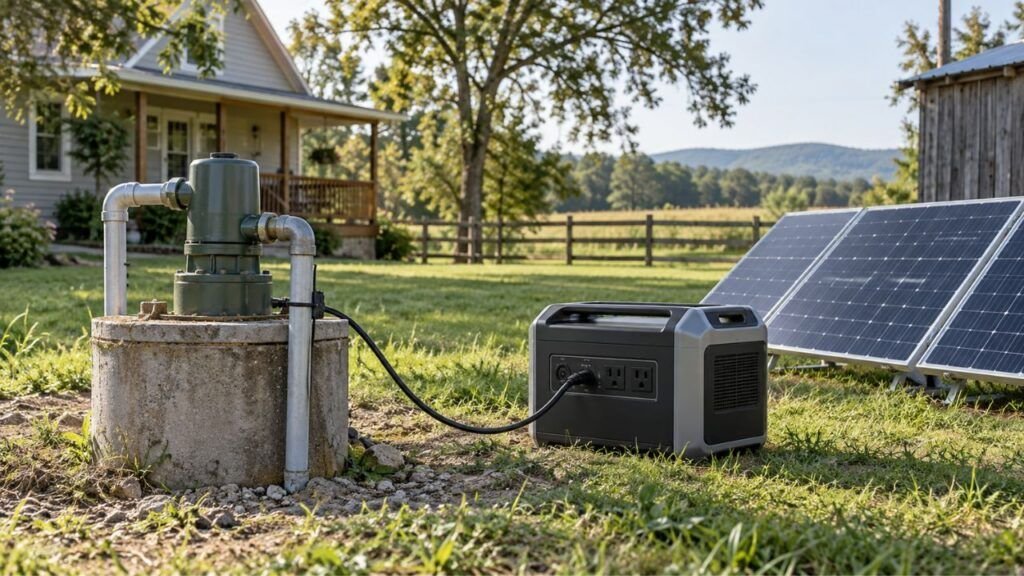
The solar panels are not directly running the pump in most setups. The generator’s battery stores electricity, while its inverter supplies AC power to the sump pump.
That distinction matters.
Your sump pump could operate at night with no sunlight available, provided the battery still has enough stored energy.
For the setup to work, three things need to match:
- The generator must provide the correct voltage.
- Its continuous AC output must support the pump while running.
- Its surge output must handle the motor when the pump starts.
After those requirements are satisfied, battery capacity determines how long your backup can last.
How Much Power Does a Sump Pump Use?
Sump pump electricity use depends on horsepower, motor design, pumping conditions, and the specific model. Horsepower can give you a rough starting point, but your pump’s actual electrical specifications are more reliable.
Running Watts vs. Starting Watts
Running watts are the electricity the sump pump uses after its motor is already operating.
Starting watts are different.
An electric motor briefly needs significantly more power when it starts. This short spike is commonly called startup surge, starting wattage, or inrush current.
For example, suppose your pump normally uses 700 watts.
The motor might require well over 1,000 watts for a moment when it starts. Some models can require considerably more.
This is why a 700-watt sump pump may fail to start on a power station advertised as having 1,000 watts of output.
The battery may be full.
The generator may appear large enough.
But the inverter cannot deliver the short burst of power the motor needs.
Typical Sump Pump Wattage by Horsepower
Use the following numbers as planning ranges rather than exact specifications.
| Sump Pump Size | Typical Running Watts | Possible Starting Watts | General Generator Need |
| 1/4 HP | 400-600W | 800-1,800W | Small to medium power station |
| 1/3 HP | 500-800W | 1,000-2,900W | Medium power station with good surge capacity |
| 1/2 HP | 800-1,050W | 1,300-4,100W | Medium to large power station |
| 3/4 HP | 1,000-1,500W | 3,000-4,500W | Large high-output power station |
These figures can vary considerably between pumps.
A newer efficient pump may use less electricity than another model with the same horsepower. The depth of the sump, discharge height, plumbing restriction, and motor design can also affect operation.
Why You Should Check the Pump Label Instead of Guessing
I would use horsepower only when you need a rough estimate.
Before buying or depending on a solar generator, inspect the pump itself.
Look for:
- Voltage
- Amperage
- Wattage
- Horsepower
- Model number
- Starting current information
- Motor specifications
You can usually find these details on the pump label or inside the owner’s manual.
Do not simply convert horsepower into watts and assume that number represents electrical consumption.
For example, one horsepower equals about 746 watts of mechanical power. That does not mean a 1 HP pump draws exactly 746 electrical watts from the outlet.
Motor losses and electrical characteristics make the real input different.
Checking the manufacturer’s specifications gives you a much safer number to work with.
What Size Solar Generator Do You Need for a Sump Pump?
Sizing a solar generator requires more than comparing the battery capacity with the pump’s wattage. You need to check voltage, continuous inverter output, startup capability, and stored battery energy separately.
Step 1: Match the Pump’s Voltage
Start with voltage.
Most residential sump pumps in the United States operate from a standard 115V or 120V household circuit.
However, you should still verify yours.
A normal portable solar generator usually provides 120V AC power. If your pump requires a different voltage, that power station may not be compatible.
Never assume compatibility based only on horsepower.
Step 2: Check Continuous AC Output
Next, compare the pump’s running power with the generator’s continuous AC output.
Suppose your pump draws 800 watts while operating.
A solar generator rated for only 700 watts of continuous AC output would not be suitable.
A 1,500W or 2,000W inverter gives you much more operating headroom.
Giving yourself extra capacity also helps prevent the generator from constantly operating near its maximum output.
Remember that watts and watt-hours are different.
A generator may have:
- 2,000W AC output
- 2,048Wh battery capacity
The 2,000W rating tells you how much power the inverter can deliver.
The 2,048Wh figure tells you approximately how much energy the battery stores.
Both matter, but they answer different questions.
Step 3: Check Startup or Surge Output
This is often the most important specification for a sump pump.
When the motor turns on, it can briefly demand much more electricity than it uses afterward.
Suppose your pump:
- Runs at 700W
- Requires 2,000W during startup
A generator with 1,500W continuous output could easily handle the running load.
However, if its surge capability is only 1,800W, the pump may still fail to start.
I would avoid sizing your generator exactly at the pump’s theoretical startup requirement.
Some extra headroom gives you a better margin for real-world operating conditions.
Step 4: Choose Enough Battery Capacity
Once the inverter can actually run the pump, battery capacity becomes your next concern.
Battery capacity is measured in watt-hours, or Wh.
A larger Wh rating generally means longer backup time.
For example:
- 1,000Wh is a relatively small emergency battery.
- 2,000Wh gives you considerably more runtime.
- 3,000Wh or more becomes useful during longer outages or frequent cycling.
However, battery size should match how often your sump pump actually operates.
A rarely cycling pump may last many hours on a moderate battery.
A pump running almost continuously during a major storm can drain a large system quickly.
Step 5: Account for Other Appliances
You may want to use the same solar generator for more than your sump pump.
That changes the calculation.
Suppose you also connect:
- Refrigerator
- Freezer
- Internet equipment
- Lights
- Phone chargers
Those devices consume battery energy and use part of the inverter’s available output.
Motor-driven appliances can also create their own startup surges.
If basement protection is your main priority during a serious storm, I would reserve as much generator capacity as possible for the sump pump.
How Long Will a Solar Generator Run a Sump Pump?
Runtime depends on battery capacity, pump wattage, inverter losses, and how often the sump pump cycles. Because most sump pumps do not run continuously, duty cycle is especially important.
Continuous Runtime Formula
For a simple estimate, use:
Runtime = Usable Battery Capacity ÷ Pump Running Watts
You should allow for inverter and system losses instead of assuming every watt-hour stored in the battery reaches the pump.
For planning purposes, let’s use about 85% usable energy.
Suppose you have:
- 2,000Wh solar generator
- 800W sump pump
Estimated usable capacity:
2,000Wh × 0.85 = 1,700Wh
Now divide by the pump load:
1,700Wh ÷ 800W = about 2.1 hours
That means the generator could theoretically support roughly two hours of continuous pumping.
But sump pumps normally cycle.
That can completely change the result.
Why Sump Pump Duty Cycle Changes Runtime
Duty cycle simply describes how much of the time your pump is actually running.
Suppose your 800W pump operates for 15 minutes every hour.
Fifteen minutes represents one-quarter of an hour.
So:
800W × 0.25 hour = 200Wh per hour
Your 2,000Wh power station with approximately 1,700 usable Wh would provide:
1,700Wh ÷ 200Wh = about 8.5 hours
That is much longer than the continuous-runtime calculation.
Now imagine the storm becomes worse.
The pump begins operating for 30 minutes every hour.
Its average hourly pump consumption becomes:
800W × 0.5 hour = 400Wh
Runtime falls to roughly:
1,700Wh ÷ 400Wh = about 4.25 hours
This is why nobody can accurately tell you how long a solar generator will run your sump pump without knowing how frequently the pump cycles.
Estimated Runtime at Different Pump Cycling Rates
Here’s an example using an 800W pump and a 2,000Wh battery.
| Pump Operation | Approximate Pump Energy Used Per Hour | Estimated Backup Time |
| Continuous operation | 800Wh | About 2.1 hours |
| 50% duty cycle | 400Wh | About 4.3 hours |
| 25% duty cycle | 200Wh | About 8.5 hours |
| 10% duty cycle | 80Wh | About 21 hours |
These are simplified planning estimates using about 85% of rated battery capacity.
Actual results can be lower because the inverter itself consumes energy. Temperature, battery condition, pump load, and other connected equipment also affect runtime.
Why Heavy Rain Can Cut Runtime Dramatically
Normal pump behavior does not necessarily tell you what will happen during a severe storm.
Your pump could normally run for two minutes every half hour.
Then several inches of rain arrive.
Suddenly, it may run for ten minutes, twenty minutes, or almost continuously.
Higher groundwater can have the same effect.
Runtime may also suffer when:
- The sump basin fills quickly.
- The discharge pipe is restrictive.
- The pump has to lift water higher.
- A check valve causes additional resistance.
- Several drainage sources feed the sump.
When preparing for outages, calculate for the conditions you are worried about, not only an average dry week.
Can Solar Panels Keep the Sump Pump Running During a Storm?
Solar panels can extend your backup time, but I would not depend on them to provide unlimited sump-pump power during severe weather.
Think of the system this way:
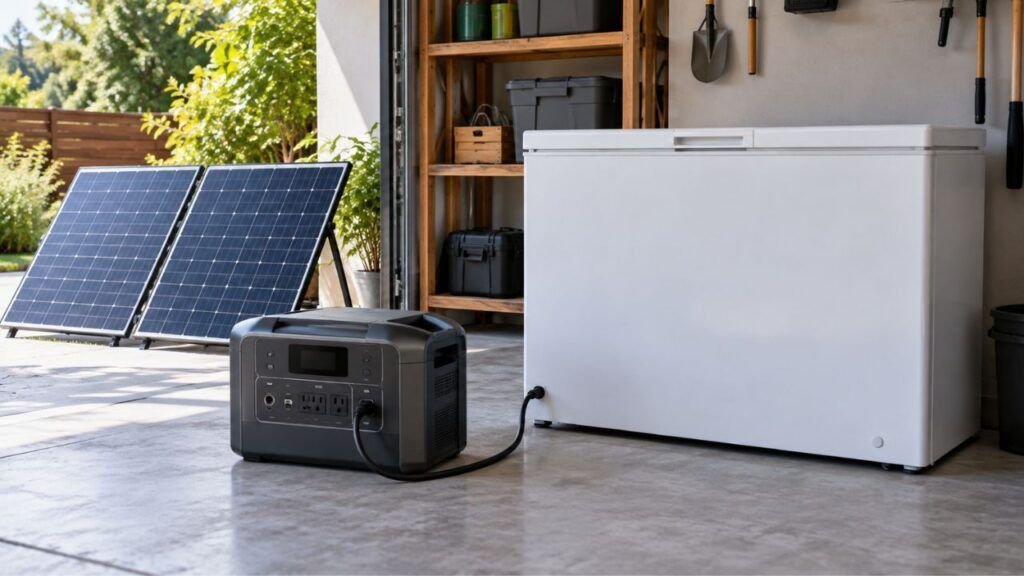
The battery runs your sump pump. Solar panels recharge the battery.
That means your pump can continue operating when the sun disappears, as long as enough stored energy remains.
During sunny weather, panels may replace some or all of the electricity the pump consumes.
Storms are different.
Heavy clouds and rain can greatly reduce solar production. Your pump may also be running more frequently at exactly the same time.
That creates a difficult combination:
Less solar energy is coming in while more battery energy is going out.
A 400W solar array also does not produce 400 watts throughout the entire day. Panel angle, clouds, temperature, shading, and available daylight all influence charging.
I would consider solar charging an excellent way to extend backup duration.
I would not treat it as guaranteed continuous power during several days of bad weather.
How to Check Your Solar Generator and Sump Pump Before a Storm
The best time to find a compatibility problem is before heavy rain arrives. A simple test beforehand can tell you much more than specifications alone.
- Find the sump pump’s model number. Check the label on the pump or owner’s manual.
- Confirm its voltage. Make sure the generator supplies the voltage your pump requires.
- Check running power. Look for rated watts or electrical current information.
- Check startup requirements. Use manufacturer information whenever possible.
- Compare both ratings with the solar generator. Check continuous output and surge output separately.
- Charge the battery completely. Do this before severe weather whenever possible.
- Check AC auto-off settings. Make sure the inverter will remain available while the pump is waiting between cycles.
- Test several normal pump starts. Follow the pump manufacturer’s recommended test procedure.
- Watch generator power consumption. Many stations show real-time watts on their display or app.
- Measure actual cycling. Notice how many minutes the pump runs during wet weather.
- Estimate your real backup time. Use your observed cycling rate instead of relying only on advertised runtime.
Do not run a sump pump dry simply to test your solar generator. Follow the pump manufacturer’s testing instructions and keep enough water in the basin when required.
Should You Use UPS or Pass-Through Mode for a Sump Pump?
A power station can be much more useful when it switches to battery automatically after an outage. However, UPS, EPS, and pass-through behavior varies between solar generators, so you need to understand how your particular model works.
Manual Backup Connection
The simplest setup is keeping a charged solar generator nearby.
When grid power fails, you unplug the sump pump from the wall and connect it to the power station.
That can work perfectly well while you are home.
The problem is obvious when nobody is there.
A storm could knock out electricity while you are sleeping, at work, or traveling. The pump stops until someone manually changes the connection.
For a basement that floods quickly, that delay can matter.
UPS or Automatic Transfer Operation
Some portable power stations provide a UPS or EPS-style function.
The power station stays connected to wall power while your sump pump is connected to the station.
When utility electricity disappears, the battery takes over.
This arrangement can be much more useful for automatic flood protection.
However, check your model carefully.
You need to verify:
- Transfer behavior
- Transfer time
- Maximum UPS output
- Pass-through restrictions
- Battery charging behavior
- AC output settings
- Long-term standby recommendations
Do not assume every power station marketed with a UPS feature is designed for permanent sump-pump backup.
Watch Out for Eco or Auto-Off Modes
This is an easy setting to overlook.
A sump pump may use almost no electricity while waiting for the water level to rise.
Some portable power stations can automatically turn off their AC inverter when they detect little or no load for an extended period.
That feature is useful when you want to conserve battery energy.
It can be a problem for a sump pump.
Your pump may need power twenty minutes later, but the generator’s AC output may already have shut down.
Check whether your station offers:
- Always-on AC mode
- Adjustable auto-off settings
- UPS mode
- Low-load timeout control
Test this before depending on the system during an outage.
Solar Generator vs. Dedicated Sump Pump Battery Backup
A solar generator and a dedicated sump-pump backup system can both protect your basement, but they solve different problems. Understanding that difference can help you build a more reliable backup plan.
| Backup Option | Runs Existing Primary Pump | Protects Against Primary Pump Failure | Automatic Operation | Powers Other Devices | Best For |
| Solar generator | Yes | No | Depends on setup | Yes | Flexible short-term backup |
| Dedicated battery backup pump | Usually separate pump | Yes | Usually | No | Dedicated flood protection |
| Water-powered backup pump | Separate pump | Yes | Usually | No | Homes with suitable municipal water |
| Fuel generator | Yes | No | Depends on system | Yes | Longer outages |
| Standby home generator | Yes | No | Usually | Yes | Automatic long-duration backup |
The important distinction is redundancy.
A solar generator can keep your existing sump pump powered when utility electricity fails.
But what happens if the sump pump itself fails?
Your solar generator cannot fix:
- A seized pump motor
- Broken float switch
- Blocked impeller
- Failed check valve
- Damaged discharge pipe
- Pump that cannot keep up with incoming water
A dedicated secondary sump pump gives you another pump as well as another power source.
If your basement has a history of serious flooding, combining backup power with pump redundancy offers much stronger protection.
When a Solar Generator May Not Be Enough
A solar generator works well for many sump-pump situations, but there are times when I would want another backup option available.
- Your sump pump runs almost continuously. Heavy groundwater flow can drain batteries surprisingly quickly.
- The pump has a very high startup surge. Some motors exceed the inverter capability of portable stations.
- You expect multi-day outages. Poor weather may prevent enough solar recharging.
- The pump uses an unsupported voltage. A standard 120V station cannot directly run every pump.
- Several appliances share the generator. Refrigerators, freezers, and other equipment reduce available runtime.
- Nobody will be home during an outage. Manual connection may provide little protection.
- Flooding would cause severe damage. One pump and one power source may not provide enough redundancy.
- The primary pump itself could fail. Battery power does nothing if the actual pump stops working.
If water can enter your basement quickly, I would build backup layers instead of depending on one solution.
That might mean a solar generator plus a secondary pump, or another emergency power source for longer outages.
Safety Tips for Running a Sump Pump From a Solar Generator
Water and electricity require extra care. A good backup setup should protect both your basement and the people inside the home.
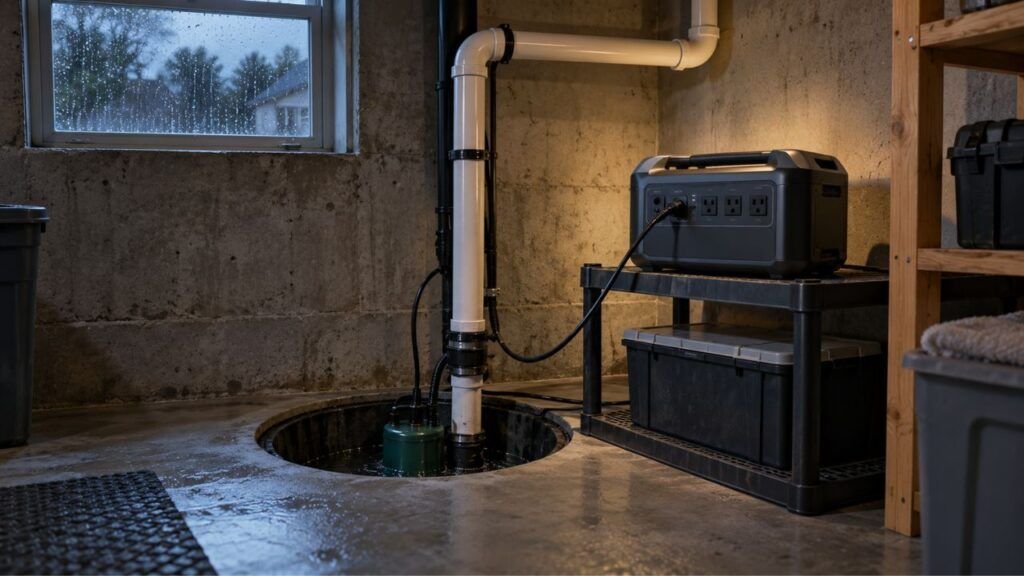
- Keep the solar generator dry and away from the sump basin.
- Place the generator above any area that could flood.
- Never handle plugs while standing in water.
- Keep extension-cord connections away from wet floors.
- Use a properly rated extension cord when one is necessary.
- Follow the sump pump manufacturer’s electrical instructions.
- Follow the power station manufacturer’s grounding instructions.
- Use appropriate GFCI protection.
- Never bypass a GFCI simply because it trips.
- Never backfeed household wiring through a standard wall outlet.
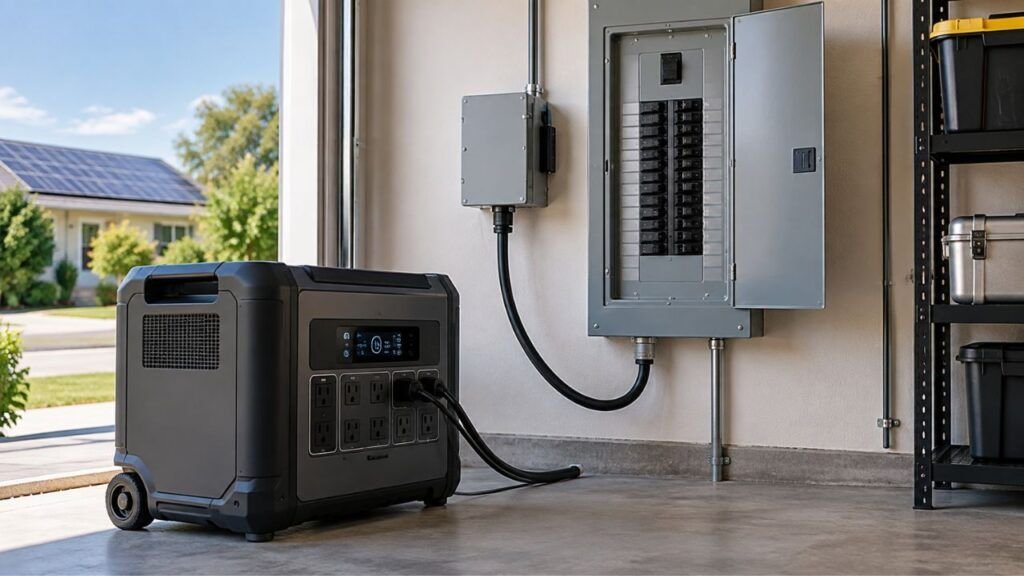
- Use approved transfer equipment for permanent home-circuit connections.
- Keep ventilation openings around the power station clear.
- Inspect cords and plugs before storm season.
- Test the entire backup arrangement periodically.
Also consider where you store the generator.
If your basement itself can flood, placing the power station beside the sump pit defeats the purpose.
Keep it somewhere dry, elevated, accessible, and within the operating conditions specified by its manufacturer.
Final Verdict: Is a Solar Generator Good Backup Power for a Sump Pump?
Yes, a solar generator can be a very useful backup power source for a sump pump, especially during short or moderate outages. The key is sizing it around the actual pump rather than buying based on battery capacity alone.
Start by checking your sump pump’s voltage, running demand, and startup surge. Then choose enough battery capacity for the amount of pumping you expect during bad weather.
For many homes, this creates a quiet and convenient emergency backup.
Just remember that severe storms create the hardest conditions. Your pump may run more frequently while cloudy weather reduces solar charging at the same time.
If basement flooding would cause serious damage, I would not rely on a single pump and battery alone. Combining backup power with a secondary sump pump gives you protection against both power outages and mechanical pump failure.
Related FAQs
Will a 1,000-Watt Solar Generator Run a Sump Pump?
A 1,000W solar generator may run some smaller sump pumps, but its surge rating is equally important. A pump that uses 600W normally may require far more than 1,000W when its motor starts, so check the pump specifications before relying on the generator.
Will a 2,000-Watt Solar Generator Run a 1/2 HP Sump Pump?
A 2,000W solar generator may run many 1/2 HP sump pumps if its continuous and surge ratings match the pump. However, some 1/2 HP motors have startup demands above 2,000W, so do not judge compatibility from continuous wattage alone.
How Long Will a 1,000Wh Solar Generator Run a Sump Pump?
A 1,000Wh solar generator might run an 800W pump for roughly one hour of continuous operation after normal system losses. If the pump only runs for a few minutes each hour, backup time could be several hours longer.
Can a Solar Generator Run a 1/3 HP Sump Pump?
Yes, many appropriately sized solar generators can run a 1/3 HP sump pump. Check the pump’s actual running and startup requirements because wattage can vary considerably between different 1/3 HP models.
Can a Solar Generator Run a 1/2 HP Sump Pump?
Yes, but a 1/2 HP pump generally requires more running power and a stronger startup surge than a smaller pump. Choose the generator based on the manufacturer’s electrical specifications rather than horsepower alone.
Can a Solar Generator Run a Sump Pump Overnight?
Yes, if the battery has enough stored energy for the pump’s overnight cycling. A lightly cycling pump may operate all night from a suitable battery, while a pump running constantly during heavy rain could drain the same battery within a few hours.
Does a Sump Pump Need a Pure Sine Wave Inverter?
A pure sine wave inverter is generally the preferred choice for an AC motor-driven sump pump because it provides electricity similar to normal household utility power. Always follow the pump manufacturer’s electrical requirements when choosing an inverter.
Can I Leave My Sump Pump Plugged Into a Portable Power Station?
You can with certain power stations designed for UPS, EPS, or pass-through operation, but you should verify that your model supports the setup. Also check whether its AC output stays active when the sump pump is idle between cycles.
Can Solar Panels Recharge a Sump Pump Backup During Rain?
Solar panels can still generate some electricity under cloudy conditions, but output may fall significantly during heavy storms. Treat solar charging as a way to extend battery runtime rather than assuming it will replace everything the sump pump consumes.
Is a Solar Generator Better Than a Sump Pump Battery Backup?
Neither option is automatically better. A solar generator can run your existing pump and other appliances, while a dedicated battery backup system often includes a second pump. That secondary pump also protects you if the primary sump pump itself fails.

Austin Parker writes practical generator how-to guides, troubleshooting advice, and buying guides for solar, portable, and fuel-powered generators. His focus is helping readers solve common power problems, understand their options, and choose dependable equipment for real-world use.