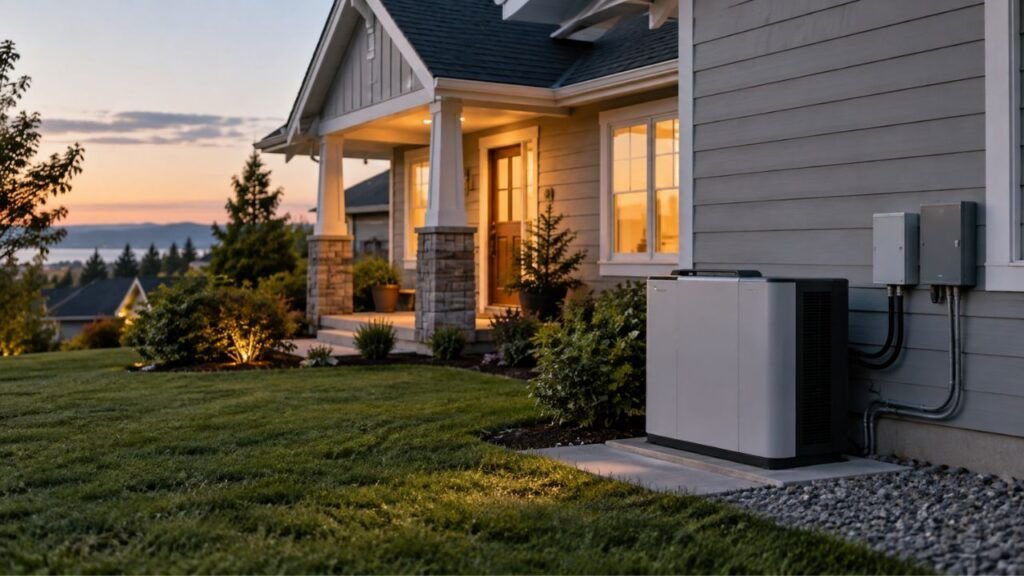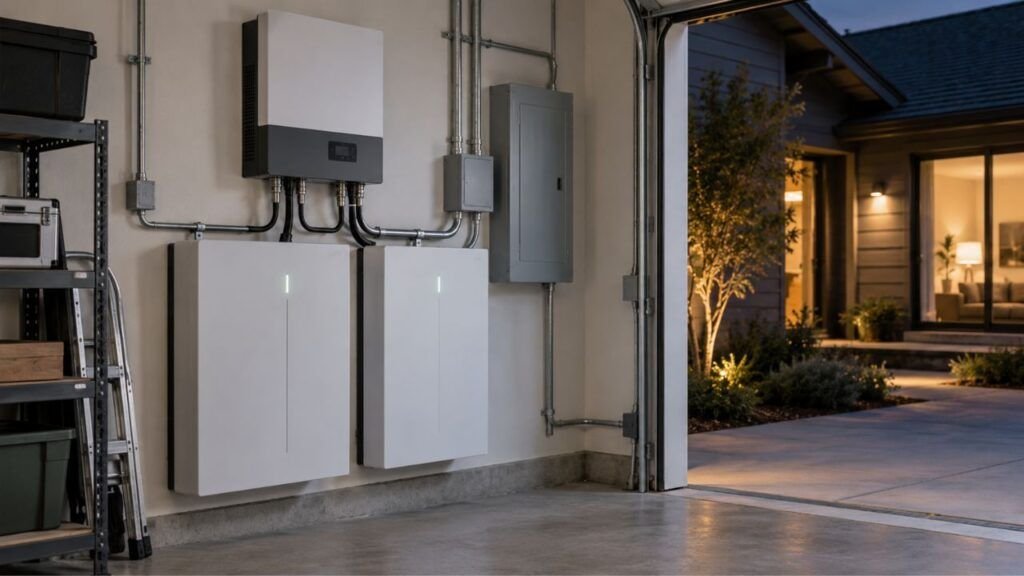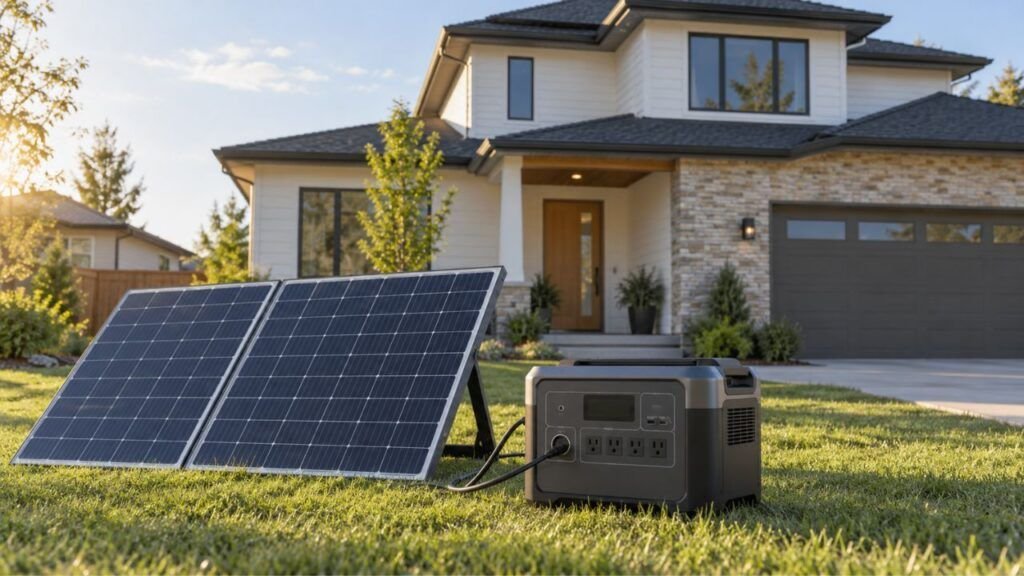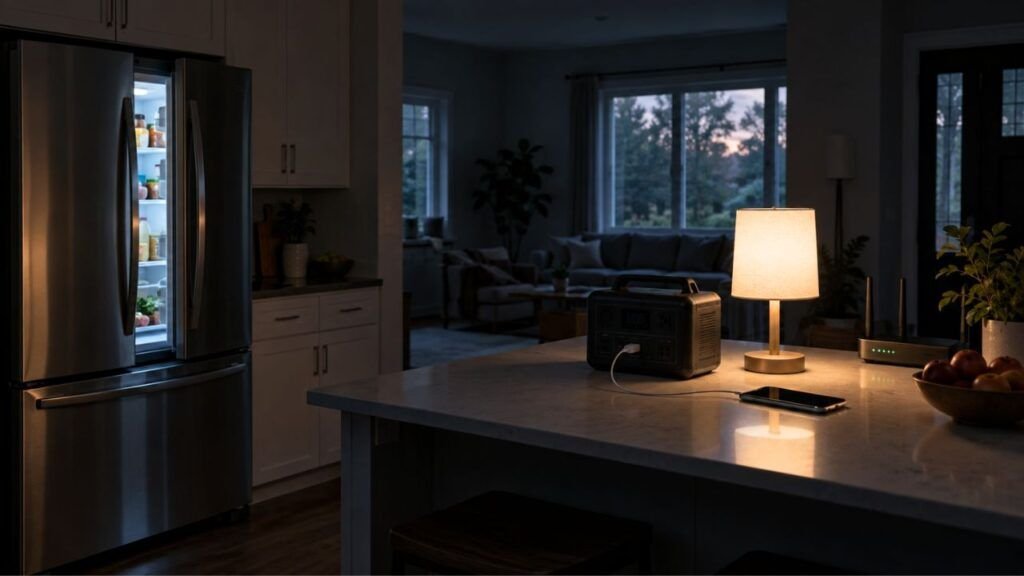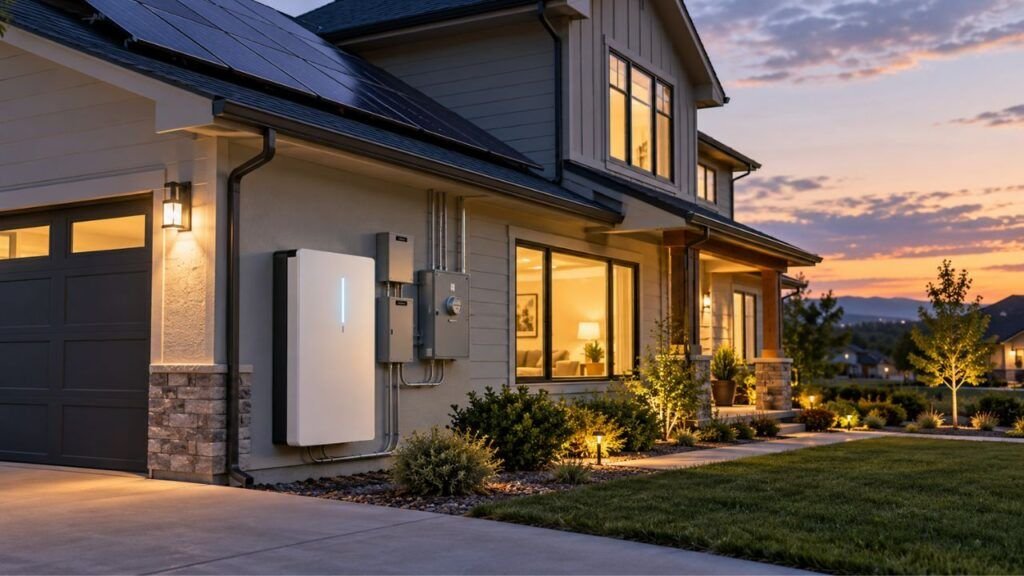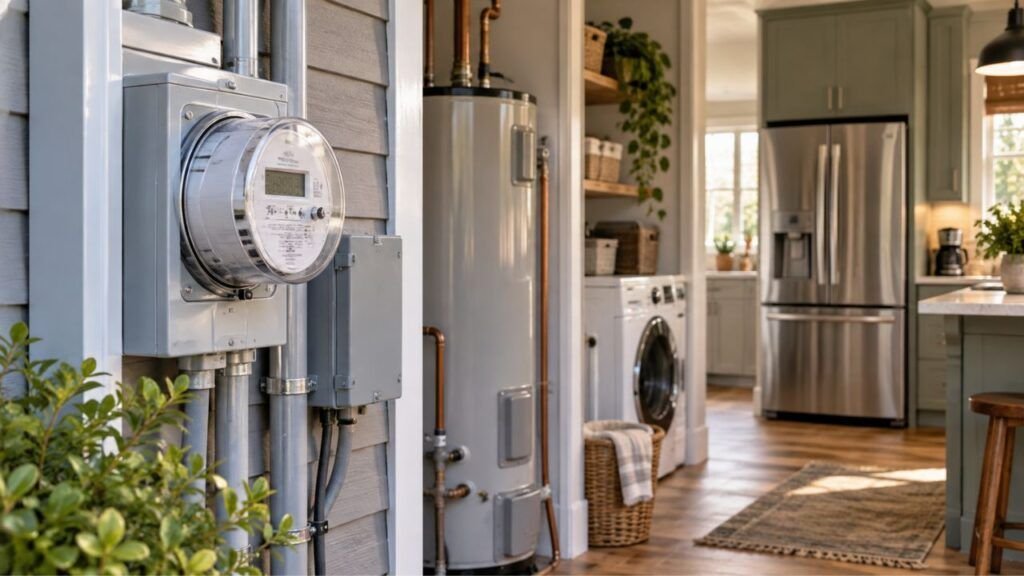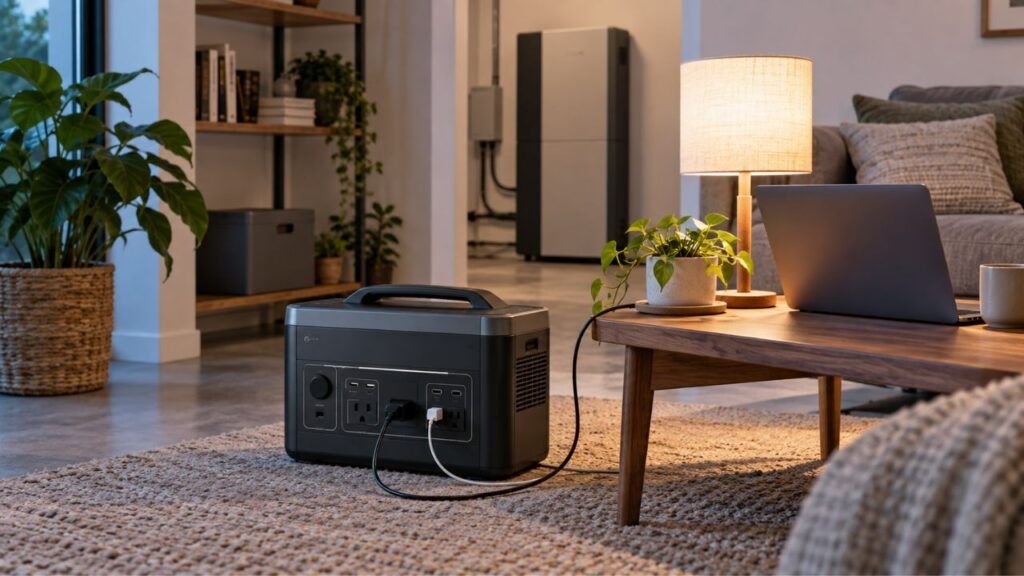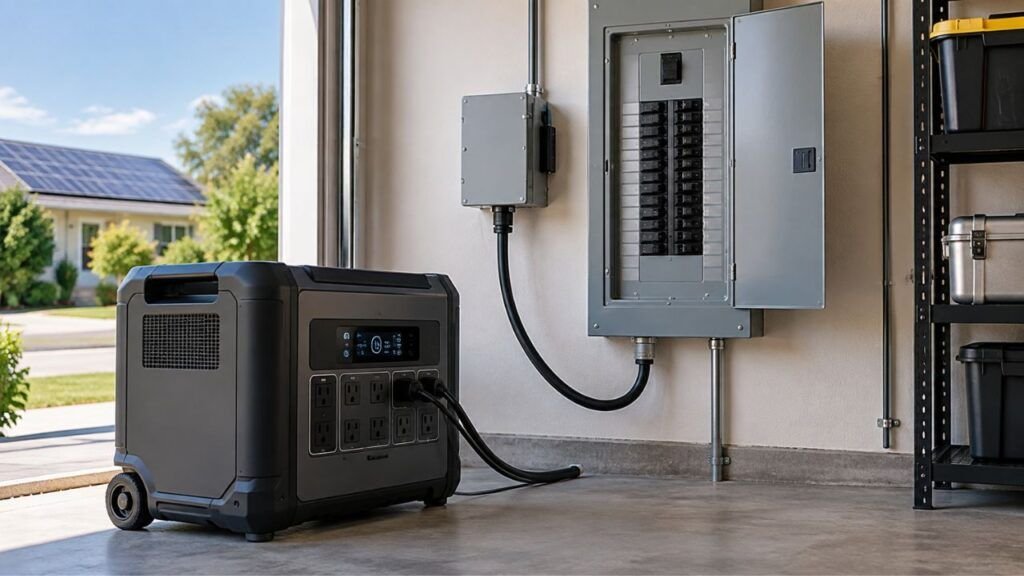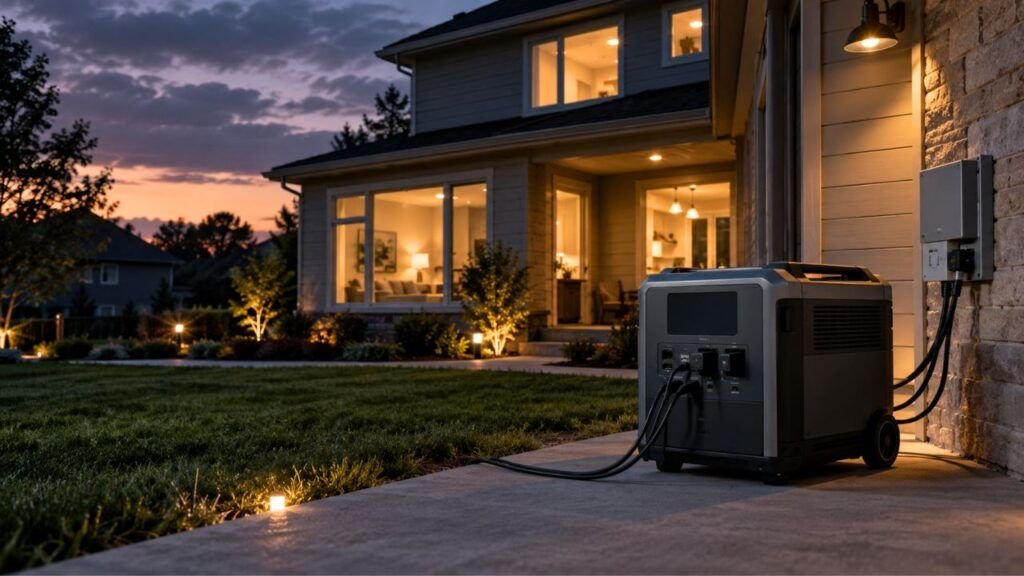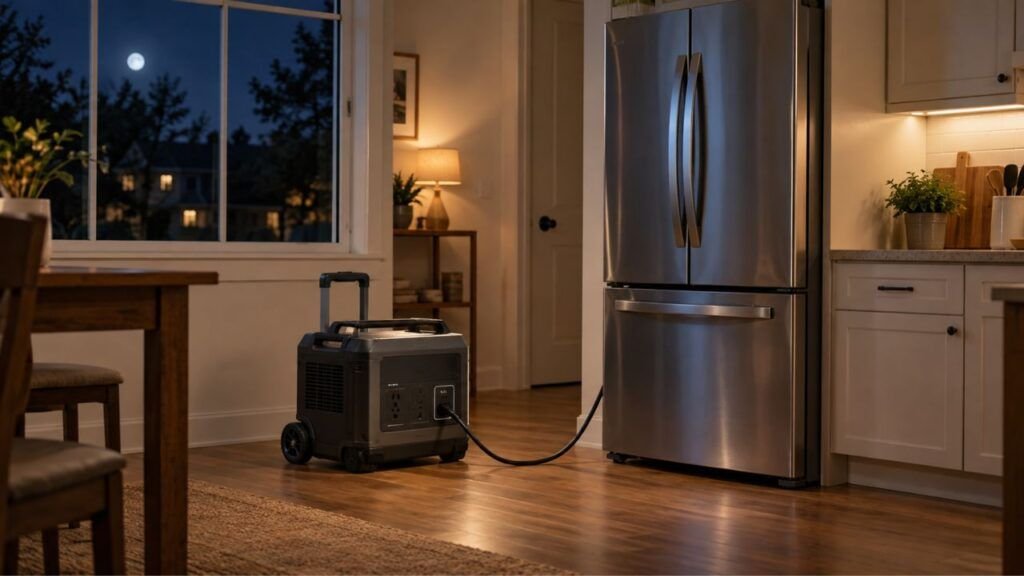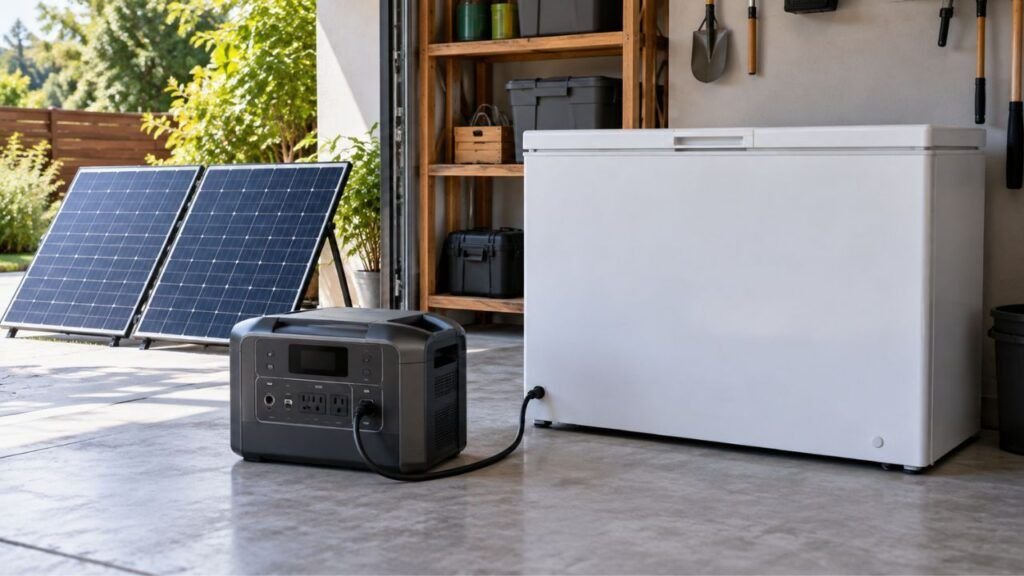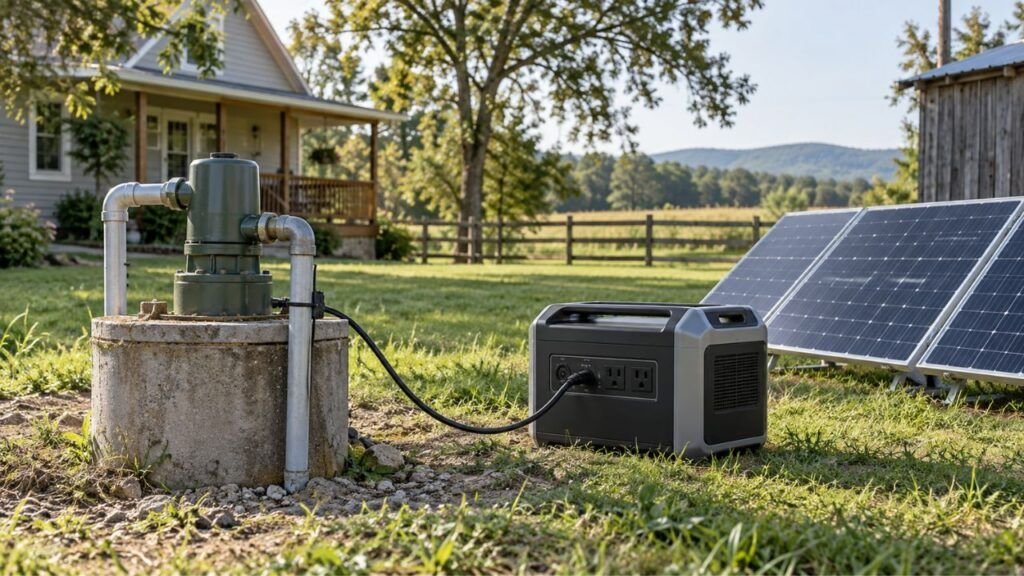
For most U.S. homes, a whole-house solar generator should provide 6,000 to 10,000+ watts of continuous inverter output and 15 to 30+ kWh of usable battery storage. Homes with central AC, electric heating, water heaters, dryers, or other large 240V appliances may need 10,000 to 20,000+ watts and 30 to 60+ kWh of storage.
Your ideal size depends on the appliances you want to run, their startup surge, daily energy use, desired backup duration, and available solar charging capacity.
Key Takeaways
- A 2,000 to 3,000W solar generator normally powers essential appliances, not an entire home.
- Around 6,000 to 10,000+ watts is a practical starting range for many whole-home backup systems.
- Battery capacity of 15 to 30+ kWh can support meaningful whole-house backup.
- High-demand homes may require 30 to 60+ kWh of battery storage.
- Watts determine how many appliances can operate at once.
- Kilowatt-hours determine how long those appliances can operate.
- Central AC, well pumps, dryers, ranges, and water heaters can dramatically increase system size.
- A true whole-home setup often needs 120/240V split-phase output.
- Starting surge can matter just as much as normal running wattage.
- Solar panels must produce enough energy to replace what your home consumes.
- Your actual appliance loads and electricity bills provide better sizing information than home square footage alone.
What Size Solar Generator Do You Need to Run a Whole House?
There is a big difference between keeping a refrigerator and lights running and powering a house almost normally. The table below gives you practical starting ranges based on different backup goals.
| Backup Goal | Continuous Inverter Output | Battery Storage | 240V Support | Typical Coverage |
| Basic essentials | 2–3 kW | 2–5 kWh | Usually not required | Refrigerator, lights, Wi-Fi, TV, chargers |
| Essentials plus comfort | 3–6 kW | 5–15 kWh | Sometimes | Adds microwave, furnace blower, pumps, small AC |
| Near-whole-house backup | 6–10+ kW | 15–30+ kWh | Usually needed | Most normal household circuits with load management |
| Full whole-house backup | 10–20+ kW | 30–60+ kWh | Yes for major loads | HVAC, laundry, cooking, pumps, and most normal home loads |
These are planning ranges rather than exact requirements. Two homes of the same size can have completely different electrical demands.
A house with gas heating and gas cooking may need far less backup power. An all-electric home with central HVAC, electric water heating, a well pump, and an electric range can require much more.
That is why I would never choose your solar generator based on square footage alone.
What Does Running a Whole House Actually Mean?
Before calculating anything, decide what you mean by “whole house.” This one decision can change your required system from 3,000 watts to well over 10,000 watts.
Essential Home Backup
Essential backup means keeping the appliances that protect your food, comfort, safety, and communication running.
That could include:
- Refrigerator and freezer
- Several lights
- Wi-Fi router
- Phones and laptops
- Television
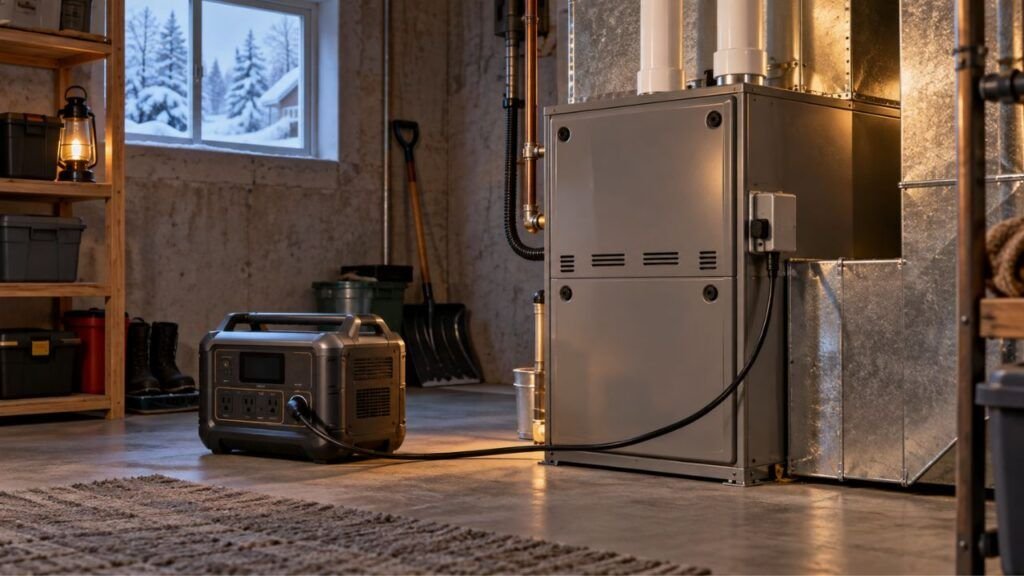
- Furnace blower
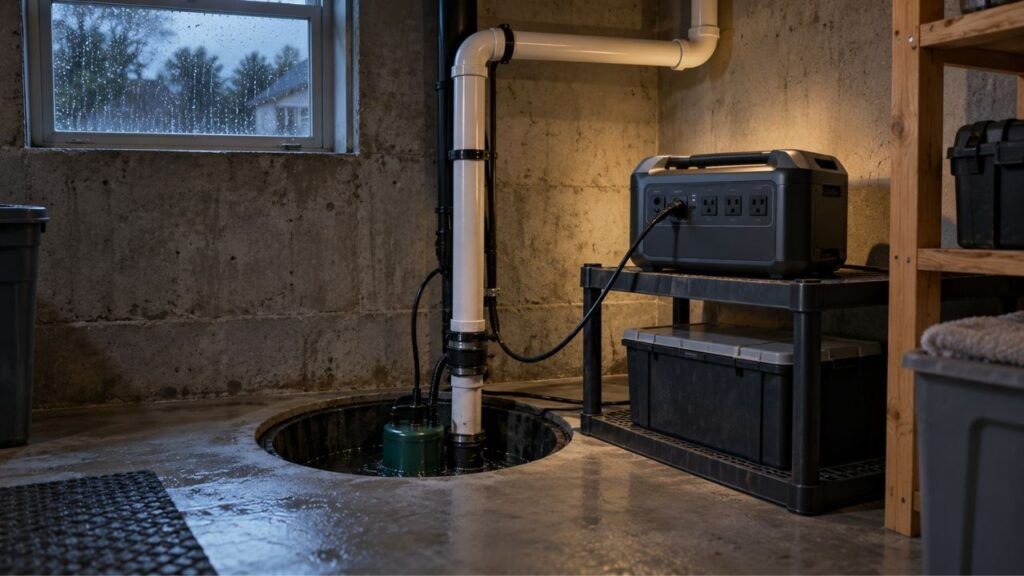
- Sump pump
- Medical equipment
- Selected kitchen appliances
You might have power available throughout several rooms while deliberately leaving major appliances off.
A 2,000 to 5,000W system with roughly 2 to 10 kWh of storage can sometimes handle this kind of backup, depending on your loads.
This is what many homeowners actually need during short outages.
Partial or Near-Whole-House Backup
Partial backup gives you considerably more freedom.
You may be able to use normal outlets, refrigeration, lights, kitchen appliances, pumps, televisions, computers, and selected HVAC equipment.
However, you may still need to manage when high-demand appliances operate.
For example, you might avoid using the microwave while the air conditioner and well pump are running.
A system around 6,000 to 10,000W with 15 to 30 kWh of storage can make this type of backup practical for many homes.
Full Whole-House Operation
True whole-house operation means living much closer to normal grid-powered life.
That could include:
- Central air conditioning
- Electric water heating
- Electric range
- Electric oven
- Clothes washer
- Clothes dryer
- Well pump
- Refrigerator and freezer
- Lighting
- Normal outlets
- Televisions
- Computers
- Other household appliances
This is where system size increases quickly.
Homes with several large electric loads may need 10,000 to 20,000+ watts of inverter capacity and 30 to 60+ kWh of battery storage.
Trying to run absolutely everything without load management can require even more.
The Five Numbers That Determine Solar Generator Size
A whole-house solar generator cannot be sized using one wattage number. You need to understand five separate ratings before you can make a sensible decision.
Continuous Inverter Output in Watts
Continuous output tells you how much power the inverter can provide steadily.
Suppose these appliances operate together:
- Air conditioner: 3,000W
- Refrigerator: 200W
- Well pump: 1,000W
- Lights: 300W
- Television and electronics: 300W
- Microwave: 1,200W
Your simultaneous running load would be around:
3,000 + 200 + 1,000 + 300 + 300 + 1,200 = 6,000 watts
A 3,000W solar generator could not handle that combination.
You would want an inverter rated comfortably above the expected continuous load.
Leaving some headroom also helps when appliances cycle on unexpectedly.
Starting or Surge Power
Some appliances briefly need much more electricity when their motors start.
Common examples include:
- Air conditioners
- Refrigerators
- Freezers
- Well pumps
- Sump pumps
- Furnace blowers
- Certain power tools
A refrigerator might consume only a few hundred watts while running but require considerably more power for a moment when its compressor starts.
Your solar generator must survive these short peaks without shutting down.
When estimating surge requirements, pay particular attention to your largest motor-driven appliance.
You usually do not need to add the full starting wattage of every appliance together. It is unlikely that every compressor and motor will start during the exact same second.
Instead, calculate your normal simultaneous load and make sure the inverter can handle the most demanding realistic startup event on top of it.
Battery Capacity in kWh
Battery capacity tells you how much energy you have stored.
This is one of the most important distinctions in the entire article:
Watts determine what you can run.
Kilowatt-hours determine how long you can run it.
Imagine two solar generators both provide 7,200W of inverter output.
One has a 5 kWh battery.
The other has a 25 kWh battery.
Both may be able to start the same appliances. The 25 kWh system can simply keep them powered much longer.
That is why inverter wattage alone never tells you whether a solar generator is suitable for whole-house backup.
Solar Charging Capacity
Once the battery is empty, you need to put energy back into it.
For a short outage, you may start with fully charged batteries and never need much solar charging.
During a two-day or three-day outage, recharge speed becomes much more important.
Imagine your home consumes 15 kWh each day during an outage.
If your solar array only replaces 4 kWh on a good day, your battery will continue getting emptier.
A sustainable backup system needs enough solar production to replace a meaningful share of your daily consumption.
120V and 240V Output
Most ordinary U.S. wall outlets provide 120V power.
Many large household appliances use 240V.
Examples may include:
- Central air conditioner
- Electric clothes dryer
- Electric range
- Electric oven
- Electric water heater
- Some well pumps
- Some HVAC equipment
This creates an important limitation.
A large 120V portable power station could have plenty of battery capacity and still be unable to operate your central AC or electric dryer.
For genuine whole-house backup, you may need a system that supports 120/240V split-phase power and appropriate home electrical integration.
A large battery does not automatically make something a whole-house solar generator.
How Much Electricity Does an Average U.S. House Use?
Recent U.S. residential electricity data works out to roughly 28 kWh of electricity per day for the average household. However, I would not automatically recommend buying a 28 or 30 kWh battery based on that figure.
Your normal electricity use and your emergency electricity use can be very different.
During normal conditions, you might:
Run the dryer whenever you want. Cook with the electric oven. Keep the house cooler in summer. Use an electric water heater normally. Charge an EV overnight.
During a blackout, you might intentionally reduce those loads.
You could postpone laundry, avoid the oven, raise the AC temperature, reduce lighting, and stop EV charging.
That might cut a home’s backup requirement dramatically.
Your electricity bill gives you a much better starting point than the national average.
Look at several months of usage rather than just one bill. If possible, check summer and winter consumption because heating and cooling can create major seasonal differences.
Then decide how much of that normal usage you actually want your solar generator to support during an outage.
How to Calculate What Size Solar Generator Your House Needs
You do not need to be an electrical engineer to create a useful first estimate. Work through the steps below, and your sizing range will become much clearer.
Step 1: Decide What Must Stay Powered
Start by creating two simple groups:
Must run
and
Can stay off
Your must-run group could contain:
- Refrigerator
- Freezer
- Well pump
- Sump pump
- Furnace blower
- Medical equipment
- Essential lighting
- Wi-Fi
- Selected outlets
Then add comfort appliances if you want them.
Maybe central AC is essential where you live. Maybe it is not.
Perhaps your electric water heater matters more than your oven.
The point is to size the system around your priorities rather than every appliance installed inside the house.
Step 2: Find the Running Watts
Look for the rated power of every appliance you intend to use.
You can usually find this information on:
- The appliance label
- Owner’s manual
- Manufacturer specifications
- An energy monitor
If an appliance gives you volts and amps instead of watts, you can make a basic estimate using:
Watts = Volts × Amps
For example:
120 volts × 5 amps = 600 watts.
For motors, HVAC equipment, and other complicated electrical loads, manufacturer specifications provide a better answer than a simple estimate.
Step 3: Add Your Simultaneous Running Loads
Do not simply add every electrical device inside your home.
Ask yourself what is realistically likely to be operating at the same time.
Suppose your house contains appliances totaling 18,000 watts.
That does not automatically mean you need an 18,000W inverter.
Maybe the dryer, oven, microwave, air conditioner, and water heater rarely operate simultaneously.
Load management can reduce the inverter capacity you need.
For example:
| Appliance | Estimated Running Load |
| Central AC | 3,000W |
| Refrigerator | 200W |
| Well pump | 1,000W |
| Lights | 300W |
| TV and electronics | 300W |
| Microwave | 1,200W |
| Total | 6,000W |
In this example, I would not choose a 6,000W inverter with no extra room.
I would want additional capacity for cycling loads and startup surges.
Step 4: Account for Starting Surge
Now identify your motor-driven appliances.
Find the appliance with the most demanding startup requirement likely to start while other loads are running.
Central air conditioning is often one of the biggest concerns.
Well pumps can also create substantial startup demands.
Your inverter needs enough surge capability to handle that brief spike.
Some HVAC systems can use approved soft-start equipment to reduce startup demand, but compatibility should always be verified for the specific equipment.
Step 5: Calculate Daily Energy Use in kWh
Once inverter size is roughly known, calculate how much stored energy you need.
Use:
Watts × hours used ÷ 1,000 = kWh
For example:
A 1,000W appliance running for three hours uses:
1,000 × 3 ÷ 1,000 = 3 kWh
Do this for every appliance you intend to operate.
Remember that appliances such as refrigerators and air conditioners usually cycle. They do not necessarily draw their rated running wattage continuously all day.
Actual measured energy use is therefore more useful when available.
Step 6: Multiply by Your Desired Backup Time
Suppose your emergency loads use 12 kWh per day.
For roughly one day of battery backup:
12 kWh × 1 day = 12 kWh
For two days:
12 kWh × 2 days = 24 kWh
However, I would not buy a battery bank rated at exactly 24 kWh and assume all 24 kWh will always reach your appliances.
Real systems experience inverter losses and other electrical losses.
Operating conditions can also affect usable capacity.
Building some reserve into the battery estimate gives you much more breathing room.
Step 7: Check Your Solar Recharge Requirement
Now ask the question people often forget:
How will I put those 12 kWh back into the battery tomorrow?
If you consume 12 kWh during a day, ideally your solar system should replace a substantial portion of that energy during usable sunlight.
Otherwise, battery capacity keeps falling during a long outage.
Solar production depends heavily on:
- Location
- Season
- Weather
- Shading
- Panel orientation
- Panel angle
- System losses
- Maximum solar input of the generator
This is why sizing battery storage without sizing solar recharge can create a system that performs well on day one but poorly on day three.
A Realistic Whole-House Solar Generator Sizing Example
Examples make the relationship between watts and kWh much easier to understand. Here are two simplified backup situations.
Example 1: Running Essential Loads During an Outage
Imagine you want to power:
| Appliance | Estimated Daily Energy |
| Refrigerator/freezer | 1.5 kWh |
| Lights | 0.5 kWh |
| Wi-Fi and electronics | 0.5 kWh |
| Furnace blower | 2 kWh |
| Television | 0.5 kWh |
| Microwave | 0.5 kWh |
| Sump pump | 0.5 kWh |
| Miscellaneous loads | 1 kWh |
| Total | 7 kWh/day |
Your peak simultaneous load could still reach several thousand watts because the microwave, furnace blower, and pump may operate together.
A system around 3 to 5 kW of continuous output could potentially handle this load profile, assuming its surge capability is sufficient.
For approximately one full day, I would want more than the calculated 7 kWh available because real systems have losses and unexpected usage.
Something around 8 to 10+ kWh of usable storage provides more breathing room.
This is substantial home backup, but it is not the same as running every household appliance normally.
Example 2: Running Central AC and Major Household Loads
Now add:
- Central air conditioning
- Well pump
- Electric cooking
- Additional lighting
- More household electronics
- Occasional laundry
- Normal refrigeration
Your simultaneous demand could easily move toward 6 to 10 kW or higher.
Daily consumption could reach 15 to 30+ kWh, especially in hot weather.
Now you may need:
- 6,000 to 10,000+ watts of continuous inverter output
- Strong surge capability
- 120/240V support
- 15 to 30+ kWh of battery storage
- Several kilowatts of solar charging capacity
Add electric water heating, resistance heating, a dryer, or EV charging, and the required system can become considerably larger.
This is why I recommend defining your backup lifestyle before choosing equipment.
Which Appliances Increase Solar Generator Size the Most?
Some household appliances can change your system size dramatically. Pay particular attention to these loads:
- Central air conditioning: High running demand plus compressor startup surge can increase inverter size.
- Electric resistance heating: Space heating can consume huge amounts of battery energy.
- Electric water heaters: Conventional tank heaters often draw several thousand watts.
- Tankless electric water heaters: These can create extremely large instantaneous power demands.
- Electric ranges and ovens: Cooking several dishes can use substantial power.
- Electric dryers: Many operate on 240V and have high heating loads.
- Well pumps: Startup surge can be significant, especially with larger pumps.
- Sump pumps: They may cycle frequently during storms when outages are more likely.
- EV chargers: Charging an electric vehicle can consume a large share of stored battery capacity.
- Pool and hot tub equipment: Pumps and electric heaters can add significant continuous energy use.
Notice that these appliances create different problems.
An air conditioner may challenge surge output.
An electric water heater may create a large continuous load.
An EV may consume a huge amount of stored energy.
Whole-house sizing should consider all three.
Do You Need a 240V Solar Generator for a Whole House?
If you want genuine whole-house backup in a typical U.S. home, 240V support is often necessary.
Many everyday devices operate on 120V.
Your refrigerator, lamps, television, Wi-Fi router, computers, and ordinary outlets may all work from 120V circuits.
Major household equipment often uses 240V.
This can include your:
- Central AC
- Electric dryer
- Electric range
- Electric water heater
- Well pump
A 120V portable power station can still provide excellent emergency power.
It simply cannot replace a 120/240V home electrical system by itself.
That is why you should check voltage before getting impressed by a huge battery capacity or inverter rating.
If your goal includes major 240V appliances, choose a system specifically designed to provide the required split-phase output.
How Much Battery Storage Does a Whole House Need?
Battery capacity should be based on how much energy you plan to use before your batteries can recharge. The ranges below can help you set realistic expectations.
Backup for Several Hours
For short outages, you may not need an enormous battery bank.
A 5 to 15 kWh system can provide useful home backup when large electric appliances are limited.
That could keep refrigeration, lights, electronics, pumps, and selected comfort loads working for several hours.
Your actual runtime depends completely on the load.
Drawing 1,000 watts continuously drains a battery much more slowly than drawing 6,000 watts continuously.
Backup for About 24 Hours
For a full day, many households will want roughly 10 to 30+ kWh depending on how aggressively they manage electricity.
A household using only essential loads might stay near the lower end.
A home running central AC throughout a hot summer day could move much higher.
This is why national average electricity consumption should only be treated as context.
Your outage behavior matters more.
Backup for Two Days or Longer
Long outages change the strategy.
You could simply double your battery bank, but that becomes expensive and bulky quickly.
Solar recharging becomes increasingly important.
Suppose you use 15 kWh per day.
Two days without any recharge requires roughly 30 kWh before considering reserve and losses.
Three days requires roughly 45 kWh.
If your solar panels replace 10 or 15 kWh each sunny day, the battery bank does not have to carry the entire multi-day outage by itself.
That is the advantage of thinking about batteries and solar panels as one system.
How Much Solar Do You Need to Recharge a Whole-House Generator?
Your solar array should be sized around how much energy you need to replace each day, not simply the number of panels that fit on a roof.
A useful starting formula is:
Required solar array size ≈ daily energy to replace ÷ usable solar production hours
Suppose you want to replace 15 kWh per day.
If your location and season provide roughly five useful equivalent peak-sun hours, the simple calculation would be:
15 kWh ÷ 5 hours = 3 kW
That suggests around 3,000 watts of panels before accounting for real-world losses.
In practice, you would normally want additional solar capacity because panels rarely produce their nameplate output perfectly for every useful sunlight hour.
Consider:
- Cloud cover
- High temperatures
- Morning and evening sun angles
- Shading
- Panel orientation
- Wiring losses
- Charge-controller losses
- Battery charging losses
- Seasonal changes
Also check the solar generator’s maximum PV input.
Connecting 5,000 watts of panels to a system that only accepts 2,000 watts of solar input will not give you a 5,000W charging rate.
For whole-home backup, maximum solar input deserves just as much attention as battery capacity.
Can a 2,000W, 3,000W, 5,000W, or 10,000W Solar Generator Run a House?
Different wattage classes are suitable for very different levels of home backup. Understanding those limits can stop you from either overspending or expecting too much from a smaller unit.
Can a 2,000W Solar Generator Run a House?
A 2,000W solar generator can run important household appliances, but I would not call it a whole-house system.
It can potentially support combinations such as:
- Refrigerator
- Freezer
- Lights
- Wi-Fi
- Television
- Computers
- Fans
- Small kitchen appliances used individually
The problem appears when you add several large appliances.
A microwave, coffee maker, and refrigerator compressor starting together could already push a small inverter hard.
A 2,000W unit is better viewed as essential household backup.
Can a 3,000W Solar Generator Run a House?
A 3,000W generator gives you more flexibility.
You may be able to run refrigeration, lighting, electronics, furnace equipment, pumps, and selected kitchen appliances.
Depending on the equipment, you might also operate a smaller air conditioner.
However, 3,000 watts is still generally below what I would choose for unrestricted whole-house operation.
It works much better when you actively manage your loads.
Is a 5,000W Solar Generator Enough for a House?
A 5,000W system can provide strong partial-home backup.
It may support many normal household loads when you avoid operating several high-power appliances simultaneously.
At this level, surge capacity becomes especially important.
A 5,000W continuous inverter that cannot start your air conditioner or well pump may be less useful than the rating suggests.
You also need enough battery storage.
A 5,000W inverter paired with only 2 kWh of battery capacity may provide impressive output but very short runtime under heavy loads.
Is a 10,000W Solar Generator Enough for a Whole House?
A 10,000W system can be enough for many homes when loads are planned properly.
It provides far more room for:
- HVAC
- Pumps
- Refrigeration
- Kitchen appliances
- Lighting
- Electronics
- Laundry equipment
However, 10,000 watts still does not automatically mean unlimited whole-house operation.
A large electric range, dryer, water heater, HVAC system, and EV charger running together can exceed that rating.
Battery capacity also remains critical.
A 10,000W inverter paired with 5 kWh of storage can deliver lots of power for a relatively short period.
Pairing that output with 20, 30, or more kWh of battery storage makes whole-home backup much more practical.
Why House Size Alone Does Not Tell You What Generator Size You Need
A common shortcut is choosing generator size based on whether your house is 1,500, 2,000, or 3,000 square feet.
I would only use that as a very rough clue.
Consider these two examples.
House A: 3,000 square feet, gas furnace, gas water heater, gas cooking.
House B: 1,800 square feet, electric heat, central AC, electric dryer, electric water heater, well pump, and electric cooking.
And, House B could easily require the larger electrical backup system.
Your generator does not know how many square feet your home has.
It only sees electrical loads.
That is why your load profile matters more than house size.
Use square footage for early planning if necessary. Use actual appliance requirements when making the final decision.
Portable Solar Generator vs. True Whole-Home Backup System
A portable solar generator can be excellent for emergency power, but it is not automatically the same thing as a whole-home backup system.
Portable systems are usually designed around plug-in loads.
You might connect your:
- Refrigerator
- Freezer
- Television
- Computers
- Lamps
- Small appliances
Larger expandable systems can sometimes integrate with home circuits using compatible equipment.
True whole-home backup usually goes further.
It may include:
- Larger battery banks
- Higher inverter output
- 120/240V split-phase power
- Automatic backup switching
- Dedicated backup panels
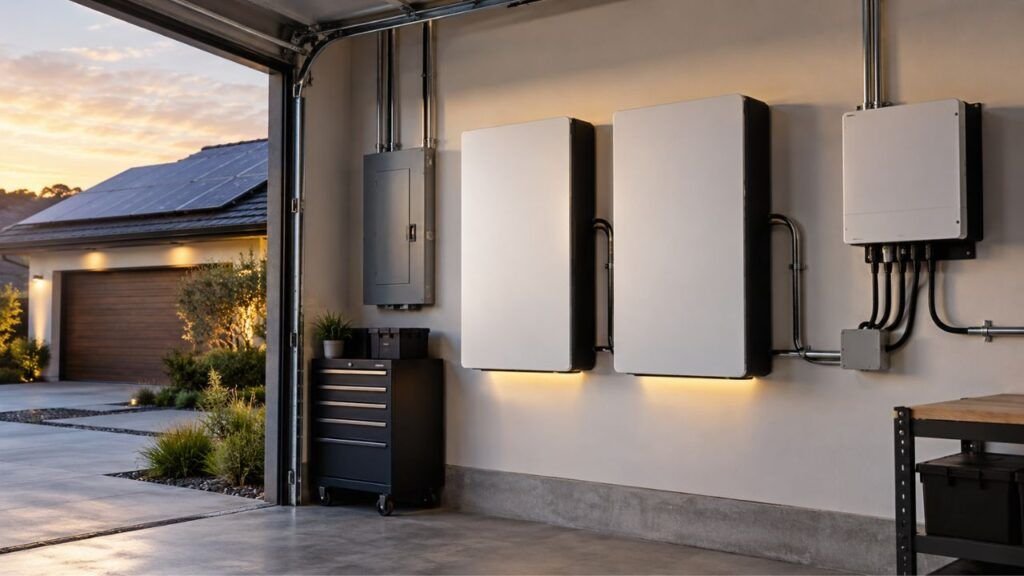
- Whole electrical panel integration
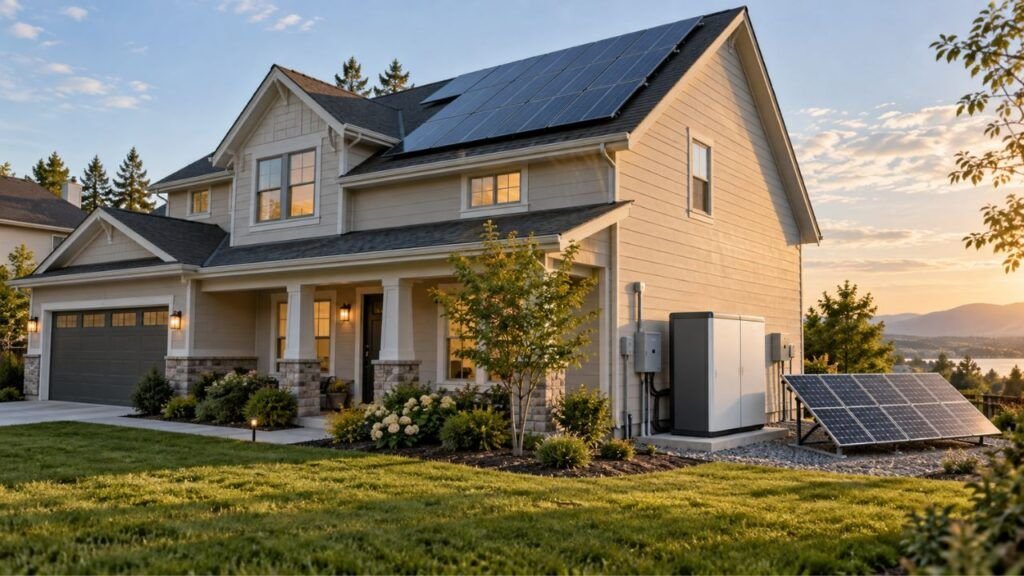
- Permanently installed solar arrays
- Load-management equipment
This distinction is important because the term “solar generator” now covers everything from small portable power stations to expandable home battery systems.
Do not judge them by battery size alone.
Check how the system actually delivers electricity into your home.
How Do You Safely Connect a Solar Generator to a House?
Connecting a solar generator to individual appliances is very different from connecting one to your home’s breaker panel.
If you want panel-level backup:
- Use equipment specifically approved for home backup integration.
- Use the correct transfer or switching equipment.
- Never improvise a connection into household wiring.
- Never create a setup that can backfeed electricity onto utility lines.
- Follow the solar generator manufacturer’s installation requirements.
- Make sure your inverter supports the required household voltage.
- Follow local electrical, building, and fire requirements.
- Have permanent panel-connected systems installed by a qualified electrician.
Backfeeding can create a serious electrical hazard.
It can also expose utility workers and other people to energized wiring they expect to be disconnected.
For whole-home backup, this is one area where professional installation is worth treating as part of the system rather than an optional extra.
Common Whole-House Solar Generator Sizing Mistakes
Avoiding a few common mistakes can save you from buying a system that looks powerful on paper but does not work the way you expected.
- Confusing watts with watt-hours: Watts measure output. Watt-hours measure stored energy.
- Calling essential backup whole-house backup: Running a fridge and lights is very different from powering HVAC and laundry.
- Sizing only by square footage: Electrical equipment matters more than the home’s floor area.
- Ignoring starting surge: Motors and compressors can require extra startup power.
- Ignoring 240V appliances: High inverter wattage does not guarantee 240V compatibility.
- Adding every appliance together: Not every household load normally runs simultaneously.
- Ignoring battery reserve: Real-world usable energy can differ from the advertised capacity.
- Forgetting inverter losses: Some battery energy is lost while converting DC into household AC power.
- Buying too little battery capacity: Huge inverter output is not useful for long if the battery empties quickly.
- Buying too small an inverter: Huge batteries cannot operate appliances the inverter cannot support.
- Ignoring maximum solar input: Your system may limit how quickly panels can recharge it.
- Assuming perfect solar production: Weather, temperature, shading, and seasons affect output.
- Ignoring winter conditions: Solar production may be much lower during shorter winter days.
- Planning to charge an EV normally: EV charging can consume a major portion of stored backup energy.
- Expecting unlimited HVAC use: Heating and cooling often dominate household backup consumption.
Final Verdict
For most U.S. homeowners who want meaningful whole-house backup, I would start the sizing process around 6,000 to 10,000+ watts of continuous inverter output with roughly 15 to 30+ kWh of usable battery storage.
That does not mean every home needs exactly that much.
If you only want refrigeration, lights, internet, pumps, and a few outlets, a smaller 2,000 to 5,000W system with 2 to 10+ kWh of storage may do everything you actually need.
If you want central air conditioning, electric cooking, electric water heating, laundry, pumps, and other large loads operating almost normally, your requirement can climb toward 10,000 to 20,000+ watts and 30 to 60+ kWh of storage.
The easiest way to remember the sizing process is:
Simultaneous watts determine inverter size.
Starting surge determines peak capability.
Daily kWh determines battery capacity.
Backup duration determines how much storage you need.
240V appliances determine voltage requirements.
Daily energy use determines how much solar you need for recharging.
Once you calculate those six things, “What size solar generator do I need?” stops being a guessing game.
Related FAQs
Can a 5,000-Watt Solar Generator Run a Whole House?
A 5,000W solar generator can provide strong partial-home or essential backup, but it may struggle with unrestricted whole-house use. Whether it works depends on your simultaneous loads, startup surge, 240V requirements, and battery capacity.
Is a 10,000-Watt Solar Generator Enough for a House?
A 10,000W solar generator can be enough for many homes, especially when large appliances are managed rather than used simultaneously. High-demand all-electric homes may still require more output, battery capacity, or active load management.
How Many kWh Does It Take to Power a House for 24 Hours?
A typical U.S. home may use around 28 kWh during a normal day, but emergency consumption can be much lower. Many households can reduce backup needs to roughly 10 to 20 kWh per day by limiting HVAC, cooking, laundry, EV charging, and other major loads.
Can a Solar Generator Run Central Air Conditioning?
Yes, a properly sized solar generator can run central air conditioning. You need enough continuous inverter power, sufficient compressor startup surge capability, appropriate 240V output where required, and enough battery capacity to support the AC’s high energy consumption.
Do I Need a 240V Solar Generator for My House?
You usually need 240V capability if you want to operate major household equipment such as central air conditioning, electric dryers, ranges, water heaters, or certain well pumps. A 120V system can still provide excellent essential-circuit backup.
How Many Solar Panels Do I Need to Recharge a Whole-House Solar Generator?
The number depends on your daily energy use, panel wattage, local sunlight, season, shading, and your generator’s maximum solar input. Instead of choosing a fixed panel count, calculate how many kWh you need to replace each day and size the solar array around that requirement.
How Long Will a 20 kWh Battery Run a House?
A 20 kWh battery could theoretically support a 1 kW average load for about 20 hours before accounting for system losses. A home averaging 2 kW would get much less runtime. Actual results depend on usable battery capacity, inverter efficiency, appliance cycling, and household behavior.
Can I Connect a Portable Solar Generator to My Breaker Panel?
Some portable and expandable solar generators support home-panel integration through compatible transfer or switching equipment. Never improvise a connection or backfeed a panel. Use manufacturer-approved equipment and a qualified electrician for permanent household connections.
Can Solar Panels Power My House During an Outage Without a Battery?
Most standard grid-connected solar systems do not provide normal household power when the grid fails because their inverters shut down for safety. Outage operation requires equipment specifically designed for backup power, which commonly includes battery storage and a compatible inverter or isolation system.

Austin Parker writes practical generator how-to guides, troubleshooting advice, and buying guides for solar, portable, and fuel-powered generators. His focus is helping readers solve common power problems, understand their options, and choose dependable equipment for real-world use.