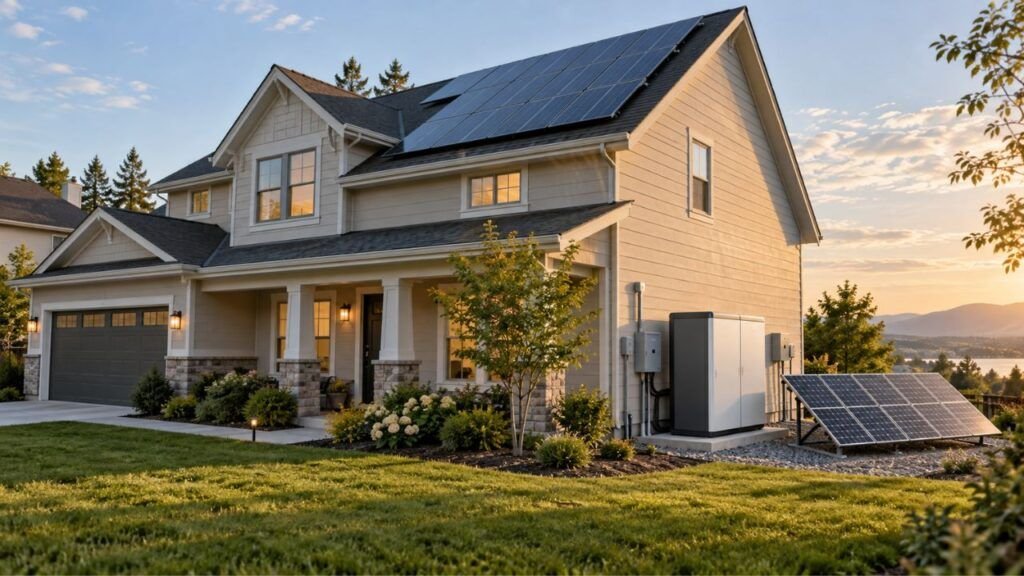
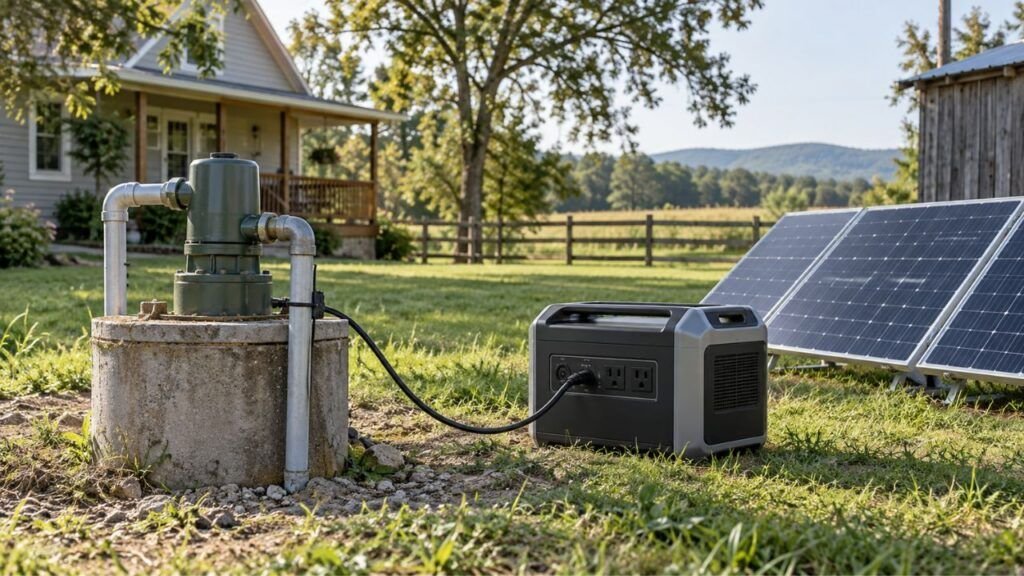
Yes, a solar generator can power a well pump if it supplies the correct voltage, enough continuous power, sufficient startup surge, and adequate battery capacity. Small 120V pumps may work with portable units, while many 240V submersible pumps need a larger home-backup solar generator.
The important part is matching the generator to your actual pump. Below, I’ll show you what to check, how to estimate runtime, and where homeowners commonly make sizing mistakes.
Key Takeaways
- A solar generator can run many residential well pumps when sized correctly.
- Check whether your pump requires 120V or 240V before anything else.
- Running watts tell you what the pump needs after it starts.
- Startup power can be much higher than normal running demand.
- Pump horsepower alone does not tell you exactly what generator you need.
- Battery capacity determines pumping runtime, while inverter output determines whether the pump can start.
- A 240V pump needs a solar generator that genuinely provides compatible 240V output.
- Well pumps normally cycle on and off, so continuous-runtime calculations do not equal total outage time.
- Solar panels can extend runtime but cannot fix an undersized inverter.
- Hardwired well pumps may require proper transfer equipment and professional electrical installation.
Can a Solar Generator Actually Run a Well Pump?
A properly sized solar generator can run a well pump during a power outage or in an off-grid setup. The challenge is that a well pump is much more demanding than something like a television, light, or phone charger.
The pump contains an electric motor. That motor can require a large burst of power every time it starts.
Your solar generator therefore needs to meet four basic requirements: the correct voltage, enough continuous output, enough starting capability, and enough battery capacity.
If even one of those is missing, the pump may not operate correctly.
For example, you could have a solar generator with a huge battery but only 120V output. That battery will not solve the problem if your pump requires 240V.
You could also have the correct voltage but insufficient startup capability. In that case, the generator may shut down as soon as the pump tries to start.
That is why I would never choose a solar generator for a well pump based on battery size alone.
Check These Four Things Before Sizing a Solar Generator
Before comparing generator sizes, find out what your pump actually needs. These four specifications will tell you much more than horsepower alone.
1. Pump Voltage: 120V or 240V?
Start with voltage.
Small shallow-well pumps and some jet pumps may operate on 120V. Others can be wired for either 120V or 240V.
Many residential submersible well pumps use 230V or 240V.
This distinction matters because many portable solar generators provide only standard 120V AC output.
A generator might advertise 3,000 watts or more and still be useless for your pump if it cannot supply the required 240V.
Also, having several 120V outlets does not automatically mean the power station produces 240V.
Look at your pump label, control box, electrical panel, breaker, or owner’s manual. If necessary, search the exact pump model number.
2. Running Power
Running power is the amount of electrical power the pump requires after the motor reaches normal operating speed.
Your solar generator’s continuous AC output needs to comfortably support this load.
However, avoid assuming that horsepower converts directly into one fixed wattage.
Horsepower describes mechanical output. The actual electrical power drawn by the motor also depends on motor efficiency, voltage, load, power factor, and pump design.
That means two pumps with the same horsepower rating can have different electrical requirements.
You may also see volts and amps listed on the pump.
For simple loads:
Volts × Amps = Volt-Amps
However, an AC motor is not a simple resistive load. Volt-amps should not automatically be treated as exact watts.
The safest approach is always to use the electrical specifications supplied by the pump or motor manufacturer.
3. Starting or Surge Requirement
Starting the pump is often harder than keeping it running.
When the motor first starts turning, it can briefly draw much more current than it uses during normal operation.
That initial demand is commonly called starting power, startup surge, inrush current, or locked-rotor current.
You will often hear a general rule that a motor may require two or three times its running power at startup.
That can be a useful rough estimate, but I would not use it as your only sizing method.
Some conventional well motors can demand considerably more current during startup. Other pumps use soft-start electronics or variable-speed controls that significantly reduce the starting demand.
Check the motor documentation whenever possible.
Also look carefully at the solar generator’s surge specification. A large advertised peak number may only be available briefly.
The generator needs to support the pump long enough for the motor to successfully start.
4. Battery Capacity
Once you know the generator can start and run the pump, battery capacity determines how long you can use it.
Battery capacity is usually shown in watt-hours or kilowatt-hours.
For example:
- 1,000Wh = 1kWh
- 2,000Wh = 2kWh
- 5,000Wh = 5kWh
A larger battery does not necessarily mean a more powerful inverter.
That difference is important.
Think of inverter output as determining what you can run.
Think of battery capacity as determining how long you can run it.
You need enough of both.
How Much Power Does a Typical Well Pump Need?
Residential well-pump requirements vary considerably. The following table should be used as a planning guide rather than an exact sizing chart.
| Well Pump Size | Common Residential Voltage | General Power Demand | Startup Demand | Likely Solar Generator Class |
| 1/3 HP | 120V or 240V | Lower | High compared with running load | Medium to large |
| 1/2 HP | 120V or 240V | Moderate | Can be several times normal current | Large |
| 3/4 HP | Often 240V | Moderate to high | Significant | Large 240V-capable system |
| 1 HP | Commonly 240V | High | Significant | High-output 240V system |
| 1.5 HP+ | Usually 240V | Very high | Very high | Large expandable home-backup system |
These ranges help you understand the general direction, but they should not replace your actual pump specifications.
A 1/2 HP pump is not automatically a certain wattage.
Neither is a 1 HP pump.
The pump design, motor efficiency, voltage, control equipment, well depth, and operating conditions all affect electrical demand.
Whenever possible, size your backup system from the motor nameplate or manufacturer documentation.
What Size Solar Generator Do I Need for a Well Pump?
There is no single generator size that works for every well pump. The right size depends mainly on voltage, normal operating demand, startup current, and how long you need water during an outage.
For a Small 120V Well Pump
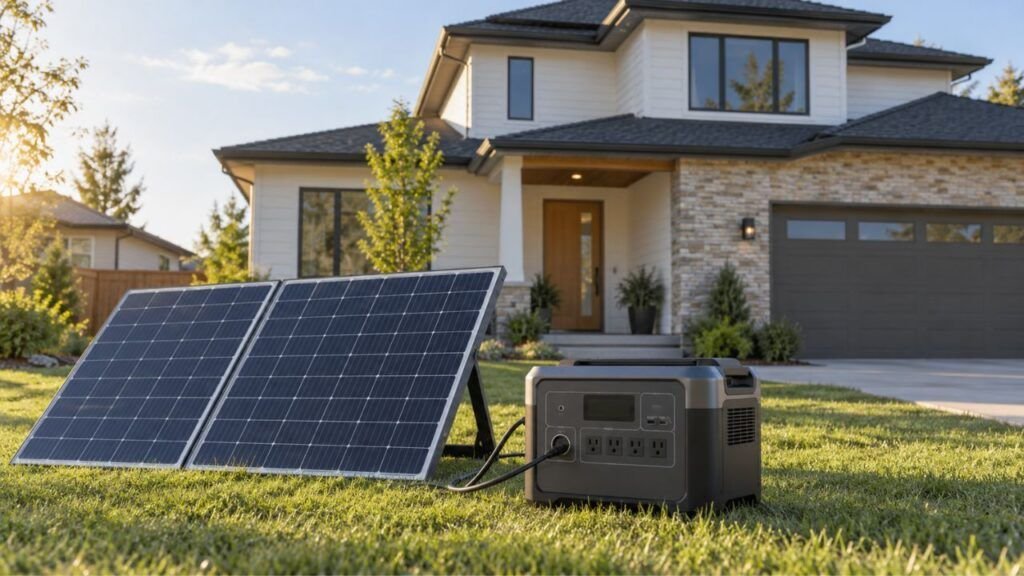
A smaller 120V shallow-well pump may work with a medium or large portable solar generator.
Do not choose solely from battery capacity.
Make sure the unit can provide enough continuous AC output and enough short-term power to start the pump.
A 2,000Wh battery with a weak inverter may be less useful than a smaller battery paired with a stronger inverter.
For a 1/2 HP Well Pump
A 1/2 HP pump can fall into very different electrical categories.
Some operate on 120V. Others use 230V or 240V.
That means one 1/2 HP pump might work with a conventional portable solar generator while another requires a true 240V home-backup system.
Check voltage first.
Then verify the pump’s running amps and startup requirements.
For a 3/4 HP Well Pump
Many 3/4 HP residential well pumps use 240V.
At this point, small portable power stations usually become less practical.
You will generally be looking for a stronger system with proper 240V output and enough inverter headroom for motor startup.
Battery size then depends on how frequently the pump cycles.
For a 1 HP Well Pump
A 1 HP well pump can place a substantial load on a solar generator, especially during startup.
Many 1 HP submersible pumps also operate on 240V.
For this size, I would focus on larger home-backup solar generators rather than small portable units.
The inverter needs enough surge capability to start the motor without entering overload protection.
For a 1.5 HP or Larger Well Pump
A 1.5 HP or larger pump generally pushes you into heavy-duty backup-power territory.
You may need substantial 240V inverter output, expandable batteries, and a properly installed connection to the home’s well circuit.
Large agricultural or irrigation pumps can require considerably more power again.
For those applications, a dedicated solar pumping system or conventional generator may sometimes make more sense than a portable solar generator.
How to Find Your Well Pump’s Actual Power Requirements
Before shopping for anything, gather as much information as possible from the existing pump installation. You do not need to become an electrician, but a few numbers can save you from buying the wrong system.
Look for:
- Pump model number
- Motor horsepower
- Rated voltage
- Single-phase or three-phase operation
- Full-load amps
- Service-factor amps
- Starting-current or locked-rotor information
- Two-wire or three-wire motor
- External control box
- Soft-start controller
- Variable-frequency drive
- Constant-pressure system
- Breaker size
The pump model number is especially useful.
If you can identify the exact motor, you can often find much better electrical information than you would get from a generic horsepower chart.
This also prevents you from overspending.
You might discover that your pump has a relatively gentle startup.
Or you could discover that the startup requirement is much higher than expected.
Either way, you are sizing from real information instead of guessing.
120V vs. 240V Well Pumps: Why Voltage Can Decide Everything
A solar generator’s wattage rating does not tell you its voltage capability.
This catches many homeowners by surprise.
Suppose you have a solar generator rated for 3,000 watts of continuous output.
Your pump only needs 1,500 watts while operating.
It sounds like an easy match.
But if the generator supplies only 120V and the pump requires 240V, those wattage numbers no longer matter. The two pieces of equipment are not directly compatible.
For a 240V pump, look specifically for a solar generator or home-backup system designed to provide compatible 120/240V power.
Some systems provide 240V from one unit.
Others require two compatible power stations connected through specialized equipment.
Read the specifications carefully.
Do not assume that two 120V outlets equal 240V output.
Why Startup Surge Is Usually the Hardest Part
Well pumps are motor loads, and motors behave differently when starting than when already running. Understanding that difference can prevent frustrating overload shutdowns.
Conventional Single-Speed Well Pumps
A conventional pump motor receives full power when the pressure switch calls for water.
The motor must quickly accelerate from a complete stop.
During that moment, electrical current can rise sharply.
A solar generator that comfortably handles the pump while running may still shut down during startup.
That is why continuous watts alone are not enough.
Soft-Start and Constant-Pressure Pumps
Some modern well systems use soft-start electronics or variable-speed controls.
Instead of applying maximum power instantly, the controller increases motor speed more gradually.
This can reduce starting current.
Constant-pressure systems may also vary pump speed based on water demand instead of repeatedly switching between fully on and fully off.
However, do not automatically assume every variable-speed system is easy to power.
The electronic controller itself must also operate correctly from the backup power source.
Why a Generator’s Peak-Watts Rating Can Mislead You
Solar generator marketing often highlights a large surge or peak number.
That number can be useful, but you need more context.
A unit might produce a very high peak for only a fraction of a second.
Your pump may require elevated current for longer than that.
If the generator reaches its protection limit before the motor accelerates, the inverter may shut down.
Whenever the manufacturer provides motor-load guidance, use that information rather than relying only on a headline peak-watt number.
How Long Will a Solar Generator Run a Well Pump?
Battery runtime depends on battery capacity, pump power consumption, inverter losses, pump cycling, water usage, and incoming solar energy. A simple calculation can still give you a useful starting estimate.
Use:
Estimated continuous runtime = usable battery energy ÷ pump running watts
For an easy planning estimate, you can assume around 85% of the battery’s rated energy reaches the AC load after conversion losses.
That gives us:
Battery Wh × 0.85 ÷ Pump Watts = Estimated Continuous Runtime
Here are some examples:
| Battery Capacity | 500W Pump | 1,000W Pump | 1,500W Pump |
| 1,000Wh | About 1.7 hours | About 0.85 hours | About 0.57 hours |
| 2,000Wh | About 3.4 hours | About 1.7 hours | About 1.13 hours |
| 3,000Wh | About 5.1 hours | About 2.55 hours | About 1.7 hours |
| 5,000Wh | About 8.5 hours | About 4.25 hours | About 2.83 hours |
Remember that these figures represent continuous pumping time.
Your well pump usually does not run continuously for hours.
That means a 2,000Wh battery providing 1.7 hours of continuous pump operation might support normal household water use for considerably longer than 1.7 clock hours.
Actual results depend on how much water your household uses.
Why Your Well Pump Usually Doesn’t Run Continuously
Most conventional home well systems use a pressure tank.
When pressure drops below a certain point, the pressure switch turns the pump on.
The pump sends water into the pressure tank and increases system pressure.
Once the upper pressure setting is reached, the pump shuts off.
You then use water stored under pressure until the pressure falls enough for the pump to start again.
The cycle looks like this:
Water use → pressure drops → pump starts → tank refills → pressure rises → pump stops
That changes how you should think about battery runtime.
Imagine your pump uses 1,000 watts while running but only operates for 15 minutes during every hour of normal household use.
It would consume roughly:
1,000W × 0.25 hours = 250Wh per hour
At that duty cycle, a battery could support your water system far longer than a calculation based on continuous pumping would suggest.
Your real pump cycle will depend on tank size, pressure settings, household water use, pump performance, and system condition.
Can Solar Panels Keep the Well Pump Running?
Solar panels can greatly extend your available backup time, but they do not replace a properly sized inverter or battery. Think of the panels as your energy source and the battery/inverter as the equipment that actually delivers usable power to the pump.
Panels Do Not Replace Adequate Inverter Output
Suppose your pump requires a large startup surge.
Adding more solar panels will not make an undersized inverter suddenly capable of supplying that surge.
The inverter still has to start the motor.
Likewise, additional panels will not turn a 120V-only generator into a 240V power source.
Solar Input Can Extend Battery Runtime
Solar panels become valuable after you already have a compatible generator.
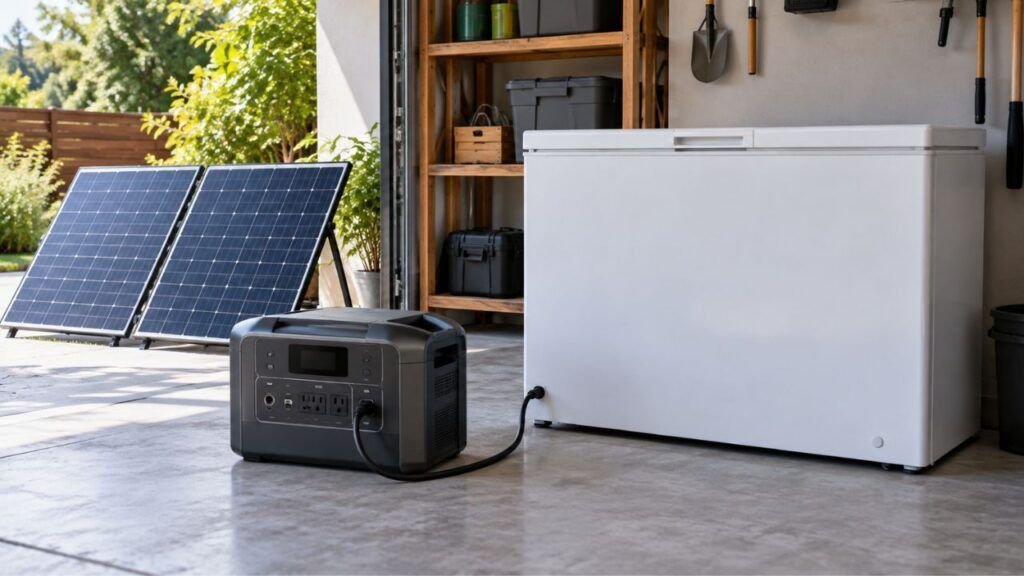
During sunny conditions, the panels can recharge the battery while the pump is not running.
Some systems can also accept solar charging while supplying AC loads.
This can significantly increase backup duration during multi-day outages.
Why Panel Wattage Isn’t Equal to Daily Energy
A 1,000-watt solar array does not continuously produce 1,000 watts from sunrise to sunset.
Actual solar output changes because of:
- Cloud cover
- Shade
- Panel orientation
- Temperature
- Time of day
- Season
- Panel condition
- Charge-controller limits
- Generator solar-input limits
- Conversion losses
This is why I would avoid simple statements such as, “A 1,000-watt pump needs five 200-watt panels.”
Solar sizing is based on energy collected over time, not just matching one wattage number to another.
Can You Run a 240V Well Pump From a Portable Solar Generator?
Yes, but only when the solar generator system genuinely produces the voltage and power your pump requires.
Many compact portable power stations only provide 120V AC.
Those units generally cannot directly operate a standard 240V well pump.
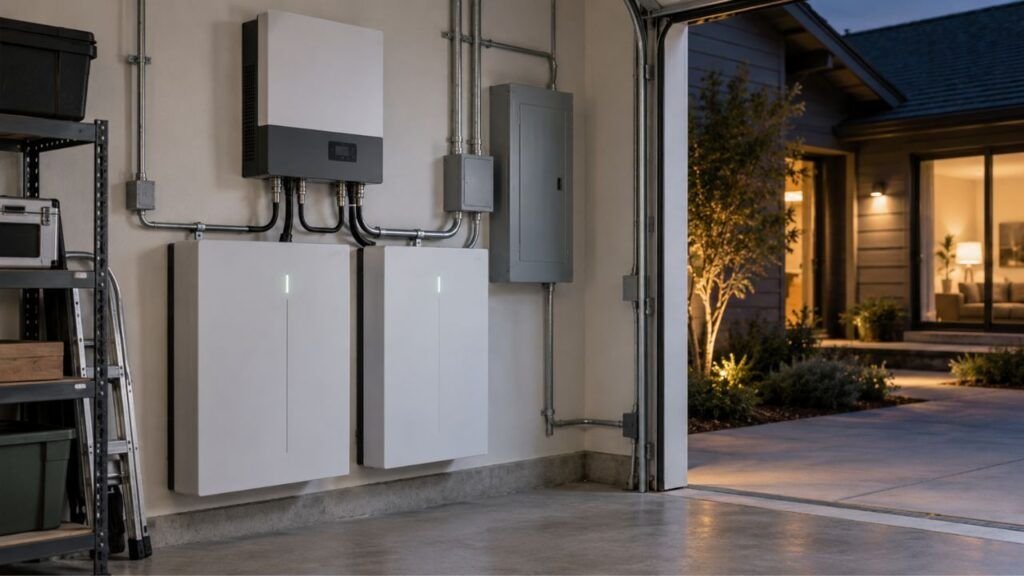
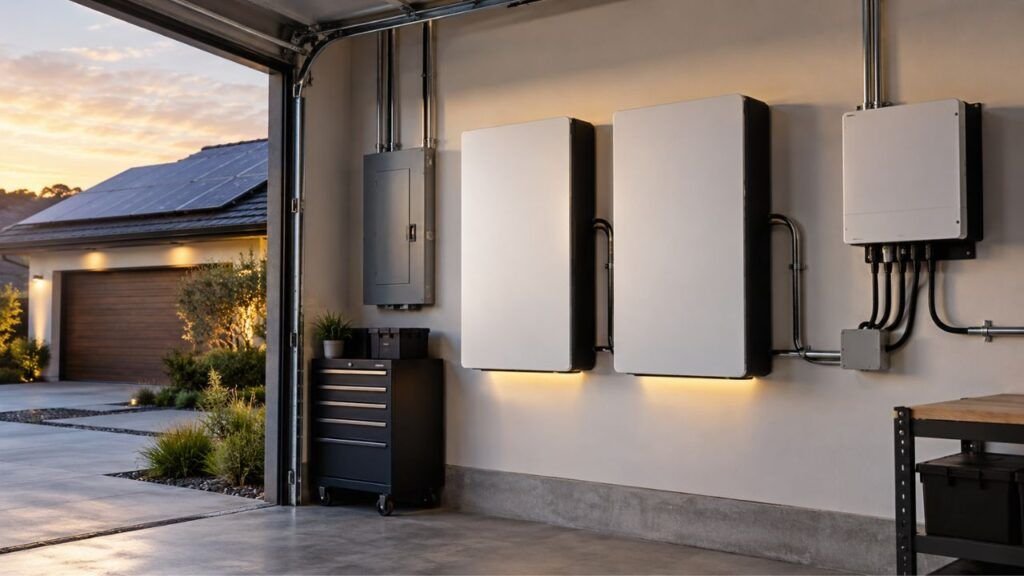
Larger home-backup solar generators increasingly support 120/240V output.
Some produce 240V directly. Others create it through paired units or dedicated accessories.
Pay close attention to the specifications.
Also consider the physical connection.
A 240V submersible pump is often hardwired into the home’s electrical system rather than plugged into a standard outlet.
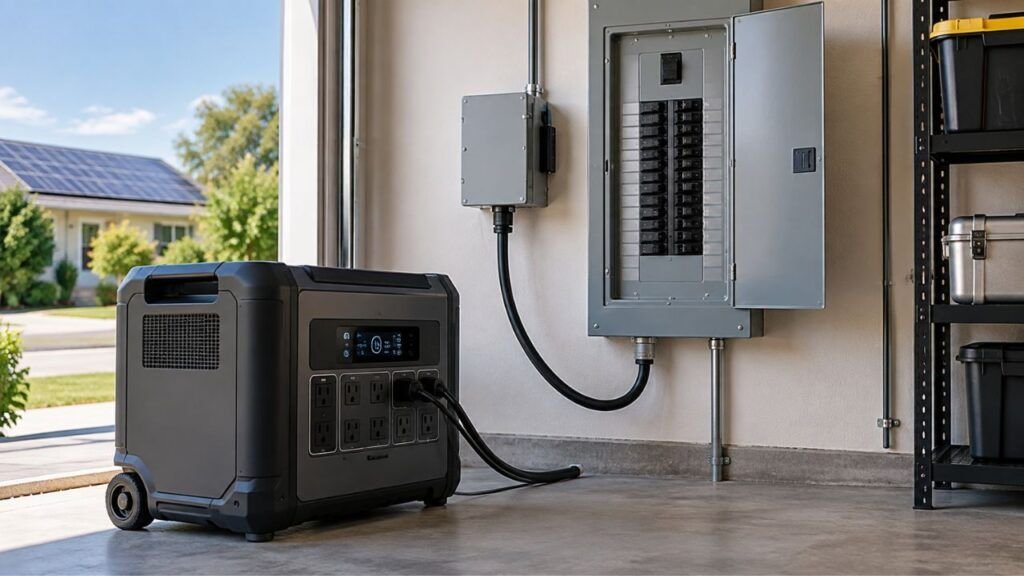
That means powering it safely may require more than simply carrying a solar generator into the basement.
How Do You Connect a Solar Generator to a Well Pump?
How you connect the generator depends heavily on the pump installation. A portable plug-in pump is relatively simple, while a hardwired household well pump may require dedicated electrical equipment.
Cord-and-Plug 120V Pumps
Some above-ground pumps connect through a standard plug.
If the voltage, current, startup demand, outlet rating, and cord requirements all match, powering one can be relatively straightforward.
Avoid long undersized extension cords.
Voltage drop can make motor startup more difficult and cause unnecessary heating.
Hardwired 120V or 240V Well Pumps
Submersible household pumps are commonly wired directly into the home’s electrical system.
A properly designed backup arrangement may involve:
- A generator inlet
- Transfer equipment
- An interlock system where permitted
- Appropriate breakers
- Correct wiring
- Proper grounding and bonding
- A dedicated backup circuit
This is an area where professional installation is worth considering.
You are combining a high-current motor load with household wiring and an alternate power source.
Never Backfeed the House
Never connect a solar generator or conventional generator to household wiring through an improvised connection.
Improper backfeeding can energize wiring that should be isolated.
It can create serious shock, fire, and equipment hazards.
For a hardwired well pump, use approved transfer equipment and have the installation evaluated by a qualified electrician.
Which Types of Well Pumps Are Easier to Run From Solar Generators?
Some pump systems are naturally easier to support with battery backup than others. Voltage, startup behavior, and motor size make the biggest difference.
Shallow-Well Jet Pumps
Small shallow-well jet pumps can be relatively manageable.
Some models operate at 120V, while others can be configured for either 120V or 240V.
If you have a modest 120V pump with reasonable startup current, a large portable solar generator may be enough.
Submersible Well Pumps
Submersible pumps sit inside the well and commonly serve deeper residential wells.
Many use 230V or 240V motors.
These systems can require much stronger backup equipment because both voltage and startup current become important.
They are still very practical to run from solar battery systems.
You simply need the right class of equipment.
Constant-Pressure or Variable-Speed Pumps
Variable-speed pumps can have an advantage because some systems start the motor gradually.
That can reduce the sudden electrical demand.
They can also adjust speed to maintain relatively stable household water pressure.
However, the pump controller or drive becomes part of the electrical system.
Make sure the backup source is compatible with the complete pump system, not just the motor horsepower.
When a Solar Generator May Not Be the Right Choice
Solar generators work very well for many residential wells, but they are not automatically the best answer for every pumping job.
You may want to consider another solution when:
- Your pump has extremely high starting current.
- You have a large agricultural pump.
- Irrigation requires several hours of continuous pumping.
- Your solar generator cannot provide 240V.
- The inverter cannot handle the pump startup.
- You need continuous operation through several cloudy days.
- Other large household loads must run at the same time.
- Adding enough battery capacity becomes too expensive.
- Safe integration with the existing electrical system becomes impractical.
In those situations, a dedicated solar pumping system, larger stationary battery system, propane generator, or conventional fuel generator may be more practical.
Solar Generator vs. Gas Generator for a Well Pump
Both technologies can keep your water flowing during an outage. The better choice depends on the pump, outage duration, fuel availability, noise concerns, and how much maintenance you want.
| Factor | Solar Generator | Gas or Propane Generator |
| Fuel | Stored battery energy and solar charging | Gasoline or propane |
| Noise | Very low | Noticeably louder |
| Exhaust | No combustion exhaust from the battery unit | Produces hazardous exhaust |
| Indoor use | Battery power station can generally operate indoors | Engine generator must remain safely outdoors |
| Runtime | Depends on battery and charging | Can continue while fuel is available |
| 240V availability | Available on compatible larger systems | Common on larger generators |
| Motor startup | Depends heavily on inverter capability | Strong on properly sized models |
| Solar recharging | Yes | No |
| Maintenance | Relatively low | Engine and fuel-system maintenance required |
| Multi-day outages | Best with enough solar and battery storage | Easy to extend with stored fuel |
A solar generator makes sense when you value quiet operation, low maintenance, indoor battery use, and renewable charging.
A fuel generator may be easier when you have a very large pump or need heavy power for days regardless of sunlight.
Neither choice is universally better.
Common Mistakes When Powering a Well Pump With a Solar Generator
Most compatibility problems come from overlooking one specification rather than choosing a battery that is slightly too small.
Avoid these common mistakes:
- Choosing the generator by horsepower alone
- Looking only at running watts
- Forgetting to check 120V versus 240V
- Assuming every motor starts at exactly twice its running power
- Ignoring locked-rotor or startup-current information
- Treating advertised peak watts as guaranteed motor-starting capability
- Confusing inverter watts with battery watt-hours
- Assuming the pump runs continuously when estimating outage duration
- Expecting rated solar-panel wattage all day
- Ignoring other appliances running from the same generator
- Using undersized extension cords
- Improvising connections to a hardwired pump
- Assuming two 120V outlets automatically provide 240V
- Ignoring soft-start or variable-speed control equipment
- Buying equipment before identifying the actual pump model
A few minutes spent checking the pump label can save you a very expensive sizing mistake.
A Simple Well-Pump Solar Generator Sizing Example
A worked example makes the difference between inverter power and battery capacity easier to see.
Suppose you have a 240V well pump using 1,000 watts during normal operation.
You have already confirmed that your chosen solar generator supplies compatible 240V power and can handle the motor’s actual startup requirement.
Now suppose the generator contains a 2,048Wh battery.
Using 85% as a simple planning estimate for usable AC energy:
2,048Wh × 0.85 = 1,740.8Wh
Now divide that by the pump’s running power:
1,740.8Wh ÷ 1,000W = about 1.74 hours
That gives you roughly 1.74 hours of continuous pumping.
But your pump will probably not operate continuously.
Suppose it actually runs for about 15 minutes each hour because the pressure tank supplies water between pump cycles.
That equals a 25% duty cycle.
Your average hourly pump energy consumption would then be approximately:
1,000W × 0.25 hours = 250Wh
Under those simplified conditions, the same battery could theoretically support several hours of normal water use.
Real results will vary.
Heavy showers, laundry, irrigation, large families, pressure-tank size, and incoming solar power can all change the result.
What to Check Before You Buy or Connect Anything
Before choosing a solar generator, work through this checklist. It will give you a much better chance of getting the system right the first time.
- Identify the exact pump model.
- Check pump horsepower.
- Confirm 120V or 230/240V operation.
- Check whether the motor is single phase.
- Find running or full-load amps.
- Look for starting-current information.
- Check whether the system uses a soft starter.
- Identify any variable-frequency drive or control box.
- Check generator continuous AC output.
- Check generator surge capability.
- Find out how long surge output is available.
- Confirm genuine 240V support when required.
- Check battery capacity in Wh or kWh.
- Estimate your household water demand.
- Check maximum solar-input wattage.
- Consider expected sunlight during outages.
- Include other appliances sharing the generator.
- Determine how the well circuit will connect.
- Use proper transfer equipment for hardwired installations.
If those items all line up, you can choose your backup system with much more confidence.
Final Verdict: Can a Solar Generator Power a Well Pump?
Yes, a solar generator can absolutely power many residential well pumps. The key is choosing it from the pump’s actual electrical requirements rather than looking only at horsepower or battery capacity.
Start with voltage. Then confirm continuous power and motor-starting requirements. After you know the inverter can successfully operate the pump, choose enough battery capacity for the amount of water service you want during an outage.
For a small 120V pump, a large portable solar generator may be enough. For a conventional 240V submersible pump, you will usually need a more capable 120/240V home-backup system.
And if your pump is hardwired, don’t overlook the connection itself. Proper transfer equipment and electrical installation are just as important as having enough watts.
Related FAQs
Can a 2,000-Watt Solar Generator Run a Well Pump?
A 2,000-watt solar generator may run some smaller well pumps, but its wattage rating alone is not enough to confirm compatibility. Check the pump’s voltage, continuous load, startup requirement, and the generator’s actual surge capability before using it.
Can a Solar Generator Run a 1/2 HP Well Pump?
Yes, many solar generators can run a 1/2 HP well pump when correctly sized. However, some 1/2 HP pumps operate on 120V while others require 230V or 240V, so always check the actual pump specifications first.
Can a Solar Generator Run a 1 HP Well Pump?
Yes, but a 1 HP well pump generally requires a fairly powerful system. Many residential 1 HP pumps use 240V and can have substantial startup current, making a large 240V-capable solar generator a more suitable choice.
Can a Solar Generator Run a 240V Well Pump?
Yes, a solar generator can run a 240V well pump if it genuinely provides compatible 240V output and has enough continuous and startup power. A standard 120V-only portable power station cannot directly run a 240V pump.
How Many Watts Does a Well Pump Need to Start?
There is no single startup-watt number for every well pump. Starting demand depends on the motor size, design, voltage, controller, and whether the pump uses soft-start technology, so manufacturer startup or locked-rotor data is more reliable than a universal multiplier.
How Long Will a 2,000Wh Battery Run a Well Pump?
A 2,000Wh battery supplying a 1,000W pump might provide around 1.7 hours of continuous pumping after allowing for typical conversion losses. Actual household backup time can be much longer because most well pumps cycle rather than run continuously.
Can Solar Panels Run a Well Pump Without a Battery?
Yes, specially designed direct-solar pumping systems can operate without battery storage during suitable sunlight. However, that setup is different from using a conventional household AC well pump with a solar generator, where the battery helps provide reliable power and motor startup capability.
Do I Need a Transfer Switch for a Well Pump?
A plug-in 120V pump may not require a transfer switch when powered directly from a compatible generator outlet. A hardwired household well pump usually requires an approved method of isolating and supplying its circuit, so professional electrical guidance is recommended.
Can I Run My Well Pump and Refrigerator From the Same Solar Generator?
Yes, if the generator can handle the combined running loads and any overlapping startup surges. You also need enough battery capacity, and a 240V pump requires a system that provides the correct voltage while powering the other appliances.
Is a Solar Generator Better Than a Gas Generator for a Well Pump?
A solar generator is quieter, requires less routine maintenance, and can recharge from sunlight. A fuel generator may be easier for very large pumps or extended cloudy-weather outages, so the better option depends on your pump size and backup requirements.

Austin Parker writes practical generator how-to guides, troubleshooting advice, and buying guides for solar, portable, and fuel-powered generators. His focus is helping readers solve common power problems, understand their options, and choose dependable equipment for real-world use.