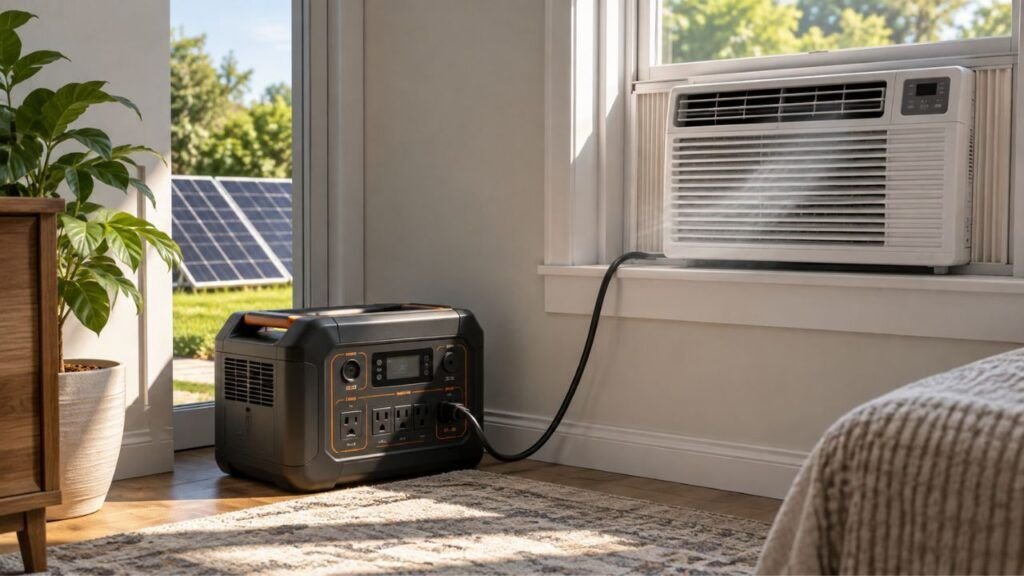
Yes, a solar generator can power many window air conditioners if its inverter handles the AC’s running and startup watts. You also need enough battery capacity for the runtime you want. Smaller 120V window AC units and modern inverter models are usually the easiest to run.
The important part is matching the generator to your specific air conditioner. I’ll show you how to check wattage, choose the right generator size, estimate runtime, calculate solar needs, and avoid the common problems that stop an AC from working.
Key Takeaways
- Many 5,000 to 12,000 BTU window AC units can run on solar generators.
- Continuous inverter output must exceed the AC’s normal running demand.
- Compressor startup can require significantly more power than normal operation.
- Battery watt-hours determine how long your window AC can keep running.
- Inverter window air conditioners are generally easier on battery systems.
- Solar panels can extend runtime, but they may not fully replace AC consumption.
- Always check voltage because some larger window units require 230V or 240V power.
Can a Solar Generator Run a Window Air Conditioner?
Yes, and window air conditioners are actually among the more practical AC systems to run from a solar generator. Most smaller units use a standard 115V or 120V household outlet and consume much less electricity than central air conditioning.
However, simply seeing a large wattage number on a solar generator does not guarantee compatibility.
Your setup needs to satisfy four things at the same time:
- Enough continuous inverter output
- Enough startup surge capability
- Enough battery capacity
- The correct voltage and outlet
There is one distinction I want you to remember throughout this guide.
Inverter watts tell you whether the air conditioner can run. Battery watt-hours tell you how long it can run.
A 3,000Wh battery attached to a weak inverter may still fail to start your compressor. Likewise, a powerful 3,000W inverter paired with a small battery may start the AC easily but run it for only a short time.
What Size Solar Generator Do You Need for a Window AC?
Window AC size gives us a useful starting point, but I would never choose a solar generator using BTUs alone. Two air conditioners with the same cooling capacity can have noticeably different electrical demands.
Use the following numbers as planning ranges, then confirm the specifications of your actual unit.
| Window AC Size | Typical Running Watts | Possible Conventional Startup Demand | Practical Inverter Range |
| 5,000–6,000 BTU | 400–700W | 800–1,500W+ | 1,000–1,500W+ |
| 8,000 BTU | 600–900W | 1,200–2,500W+ | 1,500–2,000W+ |
| 10,000 BTU | 700–1,100W | 1,500–3,000W+ | Around 2,000W+ |
| 12,000 BTU | 900–1,400W | 1,800–3,500W+ | 2,000–3,000W+ |
| 14,000 BTU | 1,100–1,600W | Model dependent | Around 3,000W+ |
These are not guaranteed requirements. Your AC nameplate, manufacturer specifications, and actual measured power consumption should always take priority.
A modern inverter-driven 12,000 BTU unit may be easier to power than an older conventional 8,000 BTU model with a hard compressor startup.
The Four Specifications That Decide Whether Your AC Will Work
Before buying anything, compare four specifications between your window AC and solar generator. Looking at only one of them is how people end up with a power station that appears powerful enough but shuts down when the compressor starts.
Continuous Inverter Output
Continuous output is the amount of AC power the solar generator can deliver during normal operation.
Suppose your window air conditioner normally consumes 750W.
Technically, an inverter capable of 800W may appear sufficient. I would not size your setup that tightly, though.
Your AC may temporarily consume more power under difficult conditions. You may also want to operate a fan, router, light, or refrigerator from the same station.
Giving yourself reasonable headroom makes the system much more dependable.
For a 700–800W AC, I would generally feel more comfortable using something in the 1,500W class rather than choosing an inverter sitting right at the appliance’s normal load.
And remember:
1,500W inverter output and 1,500Wh battery capacity are completely different specifications.
Startup Surge Capacity
This is where conventional window air conditioners cause the most trouble.
When the compressor starts, it can demand considerably more electricity than it uses while running normally.
For example, an AC may settle around 700W after startup but briefly demand 1,500W, 2,000W, or more while starting the compressor.
If the solar generator cannot deliver that short burst, several things may happen:
- The generator shuts off.
- An overload warning appears.
- The AC fan runs but the compressor never starts.
- The compressor attempts to start repeatedly.
- The entire AC switches off.
Avoid assuming every compressor has exactly a 2X or 3X startup surge. Actual startup behavior varies substantially between models.
If possible, check manufacturer information or measure the startup demand.
Battery Capacity in Watt-Hours
Once you know the inverter can operate the AC, battery capacity determines your runtime.
Battery capacity is normally expressed in watt-hours, or Wh.
For example:
- 1,000Wh is relatively small for extended air conditioning.
- 2,000Wh can provide several hours with a smaller unit.
- 4,000–5,000Wh becomes much more practical for longer cooling periods.
But you cannot normally use every advertised watt-hour at the AC outlet.
Some energy is lost through the inverter, wiring, battery management system, and conversion process.
That is why realistic runtime calculations should include system losses.
Voltage and Outlet Compatibility
Don’t overlook voltage while focusing on watts.
Many smaller window air conditioners in the United States use standard 115V or 120V power.
However, some larger units require approximately 208V, 230V, or 240V.
A solar generator offering only 120V AC output cannot operate a 230V window unit simply because the generator has enough watts.
Check:
- AC operating voltage
- Plug configuration
- Outlet rating
- Solar generator output voltage
Do this before worrying about battery size.
How to Find Your Window AC’s Actual Power Requirements
You don’t need to become an electrician to size your setup correctly. A few specifications from the AC itself can tell you much more than the BTU number printed on the front.
Check the AC Nameplate and Manual
Look around the side, rear, or inside edge of your window AC.
You may find information such as:
- Voltage
- Amperage
- Rated input power
- Frequency
- Compressor specifications
- Model number
If watts are listed directly, use them.
If your owner’s manual provides maximum electrical demand or starting information, that is even better.
Measure the AC With a Power Meter
For runtime planning, actual measurements are extremely useful.
A compatible plug-in electricity meter can show what your AC really consumes instead of making you depend entirely on estimates.
Ideally, measure the unit during hot weather.
Record:
- Normal compressor-running watts
- Startup peak if your meter can capture it
- Total watt-hours consumed over several hours
That last measurement is especially useful.
Your AC might consume 800W while the compressor is running but average only 500W over several hours because the compressor cycles on and off.
Average consumption gives you a much better runtime estimate.
Don’t Assume BTU Equals Electrical Wattage
BTU tells you how much cooling capacity an air conditioner provides.
It does not tell you exactly how much electricity the unit consumes.
For example, two 8,000 BTU window air conditioners may cool similar rooms but consume different amounts of electricity.
Age, design, compressor technology, fan efficiency, and overall energy efficiency all affect electrical demand.
So avoid converting BTU directly into electrical watts and using that number to size your generator.
Where CEER Helps and Where It Doesn’t
CEER is useful when comparing the efficiency of room air conditioners.
A higher-efficiency model can usually provide the same cooling while consuming less electricity over time.
That matters when battery runtime is important.
However, CEER should not replace actual electrical specifications when you are checking whether your solar generator can start the AC.
For generator sizing, I would prioritize:
- Manufacturer electrical specifications
- Actual measured running watts
- Actual or documented startup demand
- Efficiency ratings for estimating long-term consumption
Why Inverter Window Air Conditioners Are Easier to Run on Solar Generators
Inverter window air conditioners can be especially attractive when you plan to rely on battery power.
A traditional compressor commonly operates more like an on/off switch. The compressor starts, runs at full output, shuts down when the room reaches the target temperature, and starts again later.
Those repeated startups can create significant power spikes.
An inverter or variable-speed compressor works differently.
Instead of repeatedly jumping between completely off and maximum output, it can adjust compressor speed according to the cooling demand.
Once the room becomes comfortable, the unit may reduce its power considerably.
That can give you several advantages:
- Lower average electricity consumption
- Gentler compressor startup
- Fewer severe startup events
- Longer battery runtime
- More stable room temperature
That doesn’t mean every inverter AC has no startup surge. You should still verify your particular unit.
But if you’re specifically planning battery-powered cooling, an efficient variable-speed window AC can make the entire setup easier.
How Long Will a Solar Generator Run a Window Air Conditioner?
Runtime depends much more on battery watt-hours and the AC’s average consumption than on the inverter wattage advertised on the generator. Once you know those two numbers, you can make a reasonable estimate.
Use This Runtime Formula
A simple planning formula is:
Estimated runtime = Battery capacity × 0.85 ÷ Average AC watts
The 0.85 represents approximately 85% usable AC energy after allowing for common conversion losses.
It is only a planning estimate.
Some systems may perform better. Others may perform worse depending on temperature, battery condition, inverter efficiency, and operating load.
Here are a few examples.
| Battery Capacity | 500W Average Load | 750W Average Load | 1,000W Average Load |
| 1,000Wh | About 1.7 hours | About 1.1 hours | About 0.9 hours |
| 2,000Wh | About 3.4 hours | About 2.3 hours | About 1.7 hours |
| 3,000Wh | About 5.1 hours | About 3.4 hours | About 2.6 hours |
| 4,000Wh | About 6.8 hours | About 4.5 hours | About 3.4 hours |
| 5,000Wh | About 8.5 hours | About 5.7 hours | About 4.3 hours |
These figures assume a fairly constant average electrical load.
Real air conditioners usually cycle or vary compressor speed.
Why Your Real Runtime May Be Longer or Shorter
Runtime can change dramatically depending on conditions.
Factors include:
- Outdoor temperature
- Indoor starting temperature
- Thermostat setting
- Room insulation
- Window exposure
- Direct sunlight
- Humidity
- AC efficiency
- Compressor duty cycle
- Battery temperature
- Other appliances sharing the generator
Imagine your AC consumes 800W whenever its compressor is operating.
If the compressor runs constantly, that is roughly an 800W load.
But if it operates only 60% of the time, average consumption would be closer to 480W, ignoring the smaller fan load for simplicity.
That difference can substantially increase battery runtime.
During extreme heat, however, the compressor may run almost continuously.
I would size an emergency cooling setup for difficult conditions rather than assuming perfect cycling.
Can a Solar Generator Run a Window AC Overnight?
Yes, but overnight operation requires much more battery capacity than simply getting the AC to start.
Suppose your air conditioner averages around 500W.
Running it for eight hours requires roughly:
500W × 8 hours = 4,000Wh
And that’s energy delivered to the appliance.
Once you account for conversion losses and battery reserve, I would want more than exactly 4,000Wh of rated battery capacity.
An efficient inverter window AC can change the situation considerably.
After cooling a well-insulated bedroom, its average consumption may fall substantially below its maximum rated draw.
That is why measuring several hours of actual consumption is so useful if overnight cooling is your goal.
A 1,000Wh portable station might successfully start your AC but still be unsuitable for keeping your bedroom cool until morning.
How Many Solar Panels Do You Need to Run a Window Air Conditioner?
Solar panels can dramatically extend runtime during the day, but panel wattage should not be treated as guaranteed continuous output. Think of solar production as reducing how quickly the battery drains.
Solar Panels Offset the AC’s Battery Drain
Here’s an easy way to think about it.
Suppose your window AC averages 700W.
Your panels are currently delivering 400W into the solar generator.
The battery must supply approximately the remaining:
700W − 400W = 300W
Instead of draining at around 700W, your battery is now draining at roughly 300W.
That can make a huge difference.
If solar production temporarily exceeds AC consumption, the battery may even begin charging.
Panel Rating Is Not Continuous Real-World Output
A 400W solar panel does not normally produce exactly 400W from sunrise until sunset.
Actual production changes throughout the day.
Factors include:
- Sun angle
- Time of day
- Location
- Clouds
- Shade
- Panel orientation
- Panel temperature
- Seasonal conditions
This matters especially for air conditioning because the hottest days often create difficult solar conditions too.
Panels become hot, clouds can appear, and the air conditioner may be operating near maximum capacity.
If you want something approaching sustained daytime cooling, plan more solar capacity than the AC’s typical average load instead of trying to match the numbers exactly.
Check the Solar Generator’s Input Limit
Before adding panels, check what your generator can actually accept.
Look for:
- Maximum solar input watts
- MPPT voltage range
- Maximum current
- Maximum open-circuit voltage
- Connector requirements
For example, connecting 1,000W worth of panels does not mean a station limited to 500W of solar input will suddenly accept 1,000W.
You also cannot ignore voltage and current limits just because the total panel wattage looks acceptable.
Can You Run the Window AC While the Solar Generator Is Charging?
Many modern solar generators can operate appliances while receiving power from solar panels.
That means you may be able to run your window AC during the day while the panels simultaneously replace part of the electricity being consumed.
However, don’t assume every power station works identically.
Check whether your model supports:
- Simultaneous charging and AC output
- Full inverter output while charging
- Solar charging under heavy loads
- Pass-through operation
- Adequate thermal management
Some power stations may impose different power limits during certain charging modes.
If your plan depends on continuous operation, verify those limits before the next outage rather than discovering them during a hot afternoon.
What If the Solar Generator Starts the Fan but Not the Compressor?
If the fan runs but the compressor does not start, the system is getting some electricity but probably cannot satisfy the compressor’s starting requirements. Several issues can cause this behavior.
Check these possibilities:
- The compressor startup surge exceeds inverter capacity.
- Another appliance is already using part of the inverter output.
- Battery charge is very low.
- The power station is overheating.
- The AC requires a different voltage.
- The generator has entered overload protection.
- A long or undersized extension cord causes excessive voltage drop.
- The compressor has just stopped and is trying to restart too quickly.
First, test your AC from a normal household outlet.
If it works normally from the wall but fails consistently from the solar generator, your power setup is probably the problem.
If it also struggles from grid power, the air conditioner itself may need attention.
Can a Soft Starter Help a Window AC Run on a Smaller Solar Generator?
A compatible soft-start device can reduce startup demand on some conventional compressor air conditioners.
That can make a difficult compressor easier for an inverter to start.
However, I would not treat a soft starter as a universal fix.
Installing one on a window AC may involve opening the unit and accessing compressor wiring.
You also need enough physical room inside the cabinet and a device compatible with that specific compressor.
Improper installation can create electrical or warranty problems.
If you are considering this approach, check compatibility with both the AC manufacturer and the soft-start manufacturer first.
For many people, choosing an adequately sized inverter or a modern variable-speed AC is simpler.
How to Make a Window AC Run Longer on Battery Power
Once your generator can reliably operate the AC, improving room efficiency becomes the easiest way to stretch battery runtime.
Try these practical changes:
- Cool one closed room instead of several connected rooms.
- Close curtains or blinds before afternoon heat arrives.
- Seal gaps around the window AC installation.
- Pre-cool the room while grid electricity is available.
- Raise the thermostat a few degrees during an outage.
- Use Eco or Sleep mode when appropriate.
- Add a small fan to circulate cool air through the room.
- Keep unnecessary lights and appliances off.
- Avoid running microwaves, kettles, and other high-wattage loads simultaneously.
- Recharge from solar during the strongest sunlight.
- Keep the solar generator ventilated and out of direct sunlight.
The room itself is part of your backup system.
A poorly sealed room forces the compressor to keep running. A shaded, insulated room allows the AC to cycle down sooner and preserve battery energy.
Safety Tips for Running a Window AC From a Solar Generator
Battery-powered solar generators are much easier to use indoors than fuel generators, but electrical safety still matters. Follow a few simple rules whenever you operate a high-wattage appliance.
- Plug the AC directly into the generator whenever practical.
- Avoid cheap adapters and overloaded power strips.
- Never daisy-chain extension cords.
- Use an extension cord rated for the AC’s current if one is necessary.
- Keep the power station dry.
- Keep its cooling vents unobstructed.
- Avoid placing the generator in direct summer sunlight.
- Keep the unit away from AC condensation and dripping water.
- Never use a male-to-male cord to backfeed a household outlet.
- Use proper transfer equipment if integrating backup power into home wiring.
Also remember that expansion batteries increase energy storage, not necessarily inverter power.
If your generator cannot start the compressor, adding another battery usually will not fix the problem unless the system architecture specifically increases output capability.
When a Solar Generator Is Not a Practical Choice for Your Window AC
A solar generator works well for many single-room cooling setups, but there are situations where it becomes impractical.
For example, a 120V-only station is not suitable for a 230V window AC.
A very old compressor with a severe startup surge may also require more inverter power than a small portable station can provide.
Battery size can become another problem.
Running a large conventional AC continuously through a multi-day outage can consume many kilowatt-hours each day.
That quickly moves the project away from a small portable solar generator and toward a much larger home battery and solar setup.
Solar generation matters too.
If your available solar input replaces only a small portion of daily AC consumption, your batteries will eventually run down regardless of how many panels are theoretically advertised with the system.
For emergency cooling, I often prefer a simpler goal:
Keep one important room comfortable instead of trying to cool the entire home.
That makes battery backup much more practical.
A Simple 3-Step Check Before You Plug In
You can avoid most compatibility problems by checking your AC, generator, and expected runtime separately. Don’t rely on a single advertised wattage number.
Step 1: Check Your Air Conditioner
Write down:
- Voltage
- Running watts or amps
- Compressor type
- Startup information if available
If possible, measure actual energy consumption during hot weather.
Step 2: Check Your Solar Generator
Confirm:
- Continuous AC output
- Surge capability
- Battery watt-hours
- Output voltage
- Outlet rating
- Solar input capacity
Make sure every major requirement is compatible.
Step 3: Calculate Your Runtime
Use:
Battery Wh × usable-energy factor ÷ average AC watts
Then compare that result with the number of hours you actually need cooling.
Finally, test the full setup before relying on it.
Run the AC on a hot day, allow the compressor to cycle several times, and watch the battery level.
A successful real-world test tells you much more than specifications alone.
Final Verdict
Yes, a solar generator can power a window air conditioner, and many smaller 120V window units are realistic loads for modern portable power stations.
The key is matching the system correctly. Your inverter needs enough continuous and startup power for the compressor, while the battery needs enough watt-hours for your desired runtime.
For the easiest setup, an efficient inverter-style window AC paired with a generously sized pure sine wave solar generator works particularly well. Measure your actual power consumption when possible, leave some inverter headroom, and think of solar panels as a way to extend battery runtime rather than guaranteed unlimited cooling.
Related FAQs
Can a 1,000W Solar Generator Run a Window Air Conditioner?
A 1,000W solar generator may run a small window AC if the unit’s running demand stays below the inverter limit and its compressor startup surge also fits within the generator’s capability. Many conventional AC units can exceed this during startup, so check your exact model rather than relying only on running watts.
Can a 2,000W Solar Generator Run a Window AC?
Yes, a 2,000W solar generator can run many small and medium 120V window air conditioners. The generator still needs enough surge capability to start the compressor, and its battery capacity determines whether you get one hour of cooling or several.
What Size Solar Generator Do I Need for an 8,000 BTU Window AC?
Many 8,000 BTU window units consume roughly 600–900W while running, so a 1,500–2,000W inverter is a comfortable starting range for many models. However, conventional compressors may have substantially higher startup demand, so confirm the specific AC before choosing your generator.
How Long Will a 2,000Wh Solar Generator Run a Window Air Conditioner?
A 2,000Wh solar generator may run a window AC for roughly two to four hours depending on average consumption. A 500W average load could approach 3.4 hours using an 85% usable-energy estimate, while a 1,000W load may last closer to 1.7 hours.
Can a Solar Generator Run a 12,000 BTU Window AC?
Yes, some solar generators can run a 12,000 BTU window AC, but these units generally need more inverter power and battery capacity. Check whether the AC uses 120V or higher voltage and pay particular attention to compressor startup demand.
Can a Solar Generator Run a Window AC All Night?
Yes, but overnight cooling usually requires several thousand watt-hours of battery capacity. An AC averaging 500W for eight hours needs about 4,000Wh delivered to the load, so you would want additional rated capacity to account for inverter and battery losses.
Will a Solar Generator Damage a Window Air Conditioner?
A properly sized solar generator with stable pure sine wave AC output should not normally damage a compatible window air conditioner. Problems are more likely when voltage is incorrect, the inverter is undersized, poor adapters are used, or the compressor repeatedly attempts to start under inadequate power.
Do I Need a Pure Sine Wave Inverter for a Window AC?
A pure sine wave inverter is the preferred choice for a window air conditioner because compressors, motors, and electronic controls are designed for clean household-style AC power. Most reputable modern solar generators intended for appliances already use pure sine wave output.
Can I Use Solar Panels While the Window AC Is Running?
Yes, many solar generators allow solar charging while powering the AC. Incoming solar energy can reduce battery drain and sometimes replace most of the AC’s consumption during strong sunlight, but actual performance depends on panel production and the generator’s maximum solar-input capability.
Does an Inverter Window AC Use Less Battery Power?
An inverter window AC can often use less battery energy because its variable-speed compressor adjusts output instead of repeatedly operating only at full power. Once the room reaches the target temperature, consumption may drop considerably, which can extend solar-generator runtime.

Austin Parker writes practical generator how-to guides, troubleshooting advice, and buying guides for solar, portable, and fuel-powered generators. His focus is helping readers solve common power problems, understand their options, and choose dependable equipment for real-world use.