LiFePO4 is usually the better battery chemistry for home backup. It offers stronger thermal stability, longer cycle life, and excellent long-term value. NMC batteries store more energy in less space, but that advantage matters less when your battery stays permanently installed at home.
Still, battery chemistry is only part of the decision. I’ll walk you through safety, lifespan, temperature, cost, usable capacity, backup runtime, and installation factors so you can choose confidently.
Key Takeaways
- LiFePO4 is generally better suited for stationary home backup systems.
- LiFePO4 normally provides much longer cycle life than NMC.
- NMC offers higher energy density and needs less physical space.
- LiFePO4 has greater thermal stability during abnormal operating conditions.
- Battery capacity determines runtime more directly than battery chemistry does.
- Inverter power determines which large appliances your system can operate.
- BMS quality, certification, and installation remain important with either chemistry.
- Existing NMC systems do not automatically need replacement with LiFePO4.
LiFePO4 vs NMC Batteries at a Glance
Both chemistries can store electricity for your home. However, they prioritize very different things. This table gives you the main differences before we dig deeper.
| Feature | LiFePO4 / LFP | NMC | Better for Home Backup |
| Full name | Lithium Iron Phosphate | Nickel Manganese Cobalt | — |
| Thermal stability | Higher | Lower | LiFePO4 |
| Cycle life | Generally longer | Generally shorter | LiFePO4 |
| Energy density | Lower | Higher | NMC |
| Size and weight | Larger and heavier per kWh | Smaller and lighter per kWh | NMC |
| Frequent cycling | Very well suited | More wear over repeated cycling | LiFePO4 |
| Hot-weather tolerance | Generally stronger | More heat-sensitive | LiFePO4 |
| Cold charging | Often restricted near freezing | Also temperature-limited | System-dependent |
| Cobalt in cathode | No | Yes | LiFePO4 |
| Lifetime value | Usually stronger | Depends heavily on use | LiFePO4 |
| Best application | Stationary energy storage | Space-sensitive applications | LiFePO4 |
For most homeowners, LiFePO4 wins where home backup matters most. NMC mainly holds an advantage when compact size becomes critical.
What Are LiFePO4 and NMC Batteries?
LiFePO4 and NMC are both lithium-ion battery chemistries. The difference comes from the materials used inside their cathodes. Those materials influence safety, lifespan, weight, heat tolerance, and performance.
What Is a LiFePO4 Battery?
LiFePO4 stands for lithium iron phosphate. You will also see manufacturers shorten the name to LFP.
This chemistry uses iron and phosphate rather than nickel and cobalt. Its chemical structure remains relatively stable during charging, discharging, and high-temperature conditions.
That stability is a major reason LFP has become popular. It works especially well for solar storage and stationary home batteries.
LFP batteries also tolerate repeated charging and discharging very well. That matters when your battery cycles almost every day.
The main disadvantage is lower energy density. You normally need more physical battery volume for the same stored energy.
For a wall-mounted or floor-mounted home battery, that trade-off is often acceptable.
What Is an NMC Battery?
NMC stands for nickel manganese cobalt. Different battery designs use different ratios of these three materials.
NMC’s biggest strength is high energy density. It can store considerable energy without becoming excessively large or heavy.
That characteristic made NMC especially useful for electric vehicles. Weight and physical size are extremely important inside a car.
NMC has also been used in home batteries and portable power systems. High-quality NMC systems can still provide dependable home backup.
However, NMC usually sacrifices some lifespan and thermal stability for higher energy density.
Are LiFePO4 and NMC Both Lithium-Ion Batteries?
Yes. LiFePO4 and NMC are both types of lithium-ion batteries.
Think of lithium-ion as the larger battery family. LFP and NMC are different members within that family.
That distinction matters when reading product specifications. A manufacturer stating only “lithium-ion” does not always reveal the exact chemistry.
When possible, check whether the specification specifically says LFP, LiFePO4, or NMC.
LiFePO4 vs NMC: Which Is Safer for Home Backup?
LiFePO4 generally provides the stronger thermal-safety margin. However, chemistry alone cannot make a battery system completely safe. System design, protection electronics, certification, and installation remain equally important.
Thermal Stability and Thermal Runaway
Thermal runaway happens when a battery cell becomes extremely hot. Internal reactions can then create additional heat faster than the cell releases it.
That process can cause venting, smoke, fire, or propagation between cells.
LiFePO4 has a chemically stable iron-phosphate structure. It generally requires more severe conditions before thermal runaway develops.
NMC contains a more reactive cathode chemistry. It can release more heat during severe internal failures.
That does not mean every NMC battery presents a serious danger. Properly designed NMC systems include several layers of protection.
Likewise, LiFePO4 batteries should never be described as fireproof. Severe abuse, manufacturing defects, external fires, or electrical faults can still create dangerous conditions.
The better way to think about the difference is simple.
LiFePO4 gives you a larger thermal-safety margin, not absolute immunity.
For something permanently storing significant energy inside or near your home, that extra margin is valuable.
Why the BMS and Battery Design Still Matter
Battery chemistry receives plenty of attention, but the BMS matters too. The battery management system watches conditions inside your battery continuously.
A properly designed BMS can monitor:
- Individual cell voltage
- Overall battery voltage
- Battery temperature
- Charging current
- Discharging current
- Cell balancing
- Overcharge conditions
- Excessive discharge
- Short circuits
- Abnormal temperature conditions
The BMS can reduce power or disconnect the battery when necessary.
Cooling design, cell spacing, enclosure construction, electrical protection, and firmware also influence system safety.
That is why I would never choose a home battery based only on chemistry.
A well-engineered complete system matters more than one impressive specification.
What U.S. Homeowners Should Check
When comparing home backup systems in the United States, look beyond the chemistry label.
Check for:
- UL 9540 system listing where applicable
- Appropriate battery and inverter certifications
- Available UL 9540A fire-test information
- Manufacturer-approved installation locations
- Required wall and equipment clearances
- Indoor or outdoor installation restrictions
- Local building and electrical requirements
- Local fire-code requirements
- Permit requirements in your city or county
- Installation by qualified professionals
Your local Authority Having Jurisdiction may impose additional requirements.
A certified system installed correctly is always preferable to an unknown battery with impressive marketing claims.
Which Lasts Longer: LiFePO4 or NMC?
LiFePO4 generally lasts longer when repeatedly charged and discharged. This makes LFP especially attractive for homes using solar storage every day. But cycle ratings need some explanation before comparing numbers.
Cycle Life Explained in Plain English
A battery cycle represents the equivalent of using its full capacity once.
You do not necessarily need one continuous full discharge.
For example, using 50% today and another 50% tomorrow can equal one full cycle.
Manufacturers often rate batteries until they retain a certain percentage of original capacity.
A battery reaching that point does not instantly stop working.
It simply stores less energy than when it was new.
Suppose your battery originally stores 10 kWh of usable energy. Later, degradation may reduce that available storage noticeably.
It can still function. Your outage runtime simply becomes shorter.
LFP commonly handles far more repeated cycling than NMC. That difference becomes valuable when the battery works every day.
Why Published Cycle Numbers Vary So Much
You may see wildly different cycle-life numbers while researching batteries.
That does not automatically mean somebody is lying.
Cycle life depends on several operating factors:
- Depth of discharge
- Average battery temperature
- Charging rate
- Discharge rate
- Maximum state of charge
- Minimum state of charge
- Cell design
- Cooling system
- BMS programming
- Manufacturer testing conditions
- Capacity remaining at the rated cycle count
This is why comparing two batteries using cycle count alone can mislead you.
Look at the warranty terms alongside the cycle-life claim.
Calendar Aging Matters Too
Batteries also age while sitting unused.
This process is known as calendar aging.
A homeowner might buy a battery strictly for emergencies. The system may experience relatively few full cycles during several years.
The battery still becomes older during that time.
High temperatures and extended periods at unfavorable charge levels can accelerate aging.
This means a claimed 6,000-cycle battery may never actually reach 6,000 cycles inside your home.
Its age, environment, and operating conditions also determine useful life.
That is another reason warranty coverage matters more than impressive laboratory numbers.
Depth of Discharge and Battery Life
Depth of discharge describes how much stored energy you use before recharging.
Using 80% of the battery represents an 80% depth of discharge.
Repeatedly pushing batteries toward extreme charge limits can increase wear.
Modern home batteries usually manage this automatically through their BMS.
The manufacturer may reserve some capacity that you cannot access.
My advice is simple: follow the manufacturer’s recommended operating range instead of applying generic battery rules.
Does LiFePO4 or NMC Give You More Usable Capacity?
Battery chemistry does not automatically tell you usable capacity.
A battery might advertise 10 kWh while providing slightly less usable energy. Manufacturers sometimes reserve capacity to protect battery longevity and maintain performance.
This creates two useful specifications.
Nameplate capacity describes the battery’s total rated storage.
Usable capacity tells you approximately how much stored energy you can actually access.
Two 10 kWh systems can therefore provide different usable capacity.
Battery reserve settings can reduce available outage energy further.
For example, you might configure the system to maintain 20% reserve. That energy remains available for emergencies instead of normal daily use.
When comparing LFP and NMC systems, focus on usable kWh rather than chemistry alone.
It tells you far more about actual backup capability.
Energy Density, Size, and Weight: Where NMC Still Wins
NMC has one clear physical advantage: higher energy density.
It can store more energy within a smaller, lighter battery package.
That is extremely useful in electric vehicles. Every extra pound affects efficiency and vehicle range.
The same benefit matters less inside most homes.
Your battery normally stays attached to one wall or mounting surface. Nobody carries it around during an outage.
A somewhat larger battery may therefore create little practical inconvenience.
However, NMC can still make sense when installation space is unusually tight.
Perhaps your garage has very limited usable wall area. Maybe installation requirements restrict where equipment can be mounted.
In those situations, energy density deserves greater consideration.
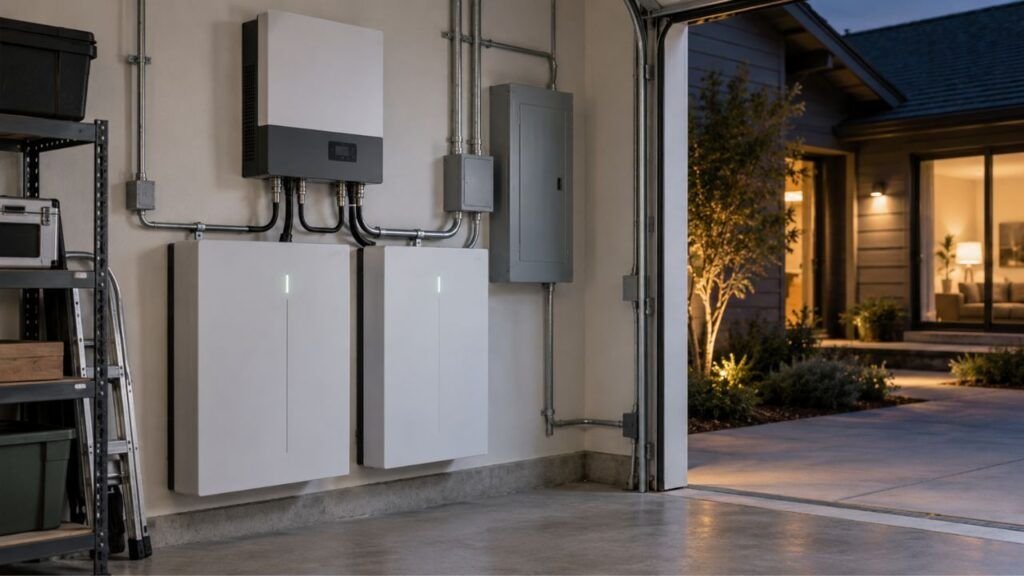
Weight also affects mounting requirements regardless of chemistry. Large home batteries require proper structural support and approved mounting hardware.
So NMC definitely wins this category.
It just happens to be a category that matters less for many stationary systems.
How Do LiFePO4 and NMC Perform in Hot and Cold Weather?
Temperature affects every lithium battery. Neither chemistry should be installed without considering its approved temperature range. LFP generally handles heat better, while cold-weather charging deserves special attention.
Hot Weather
Heat speeds up chemical reactions inside lithium batteries.
Unfortunately, it can also accelerate battery degradation.
LiFePO4’s stable chemistry generally gives it an advantage under warmer conditions.
That makes LFP attractive for places experiencing long, hot summers.
Still, an LFP battery should not bake in direct sunlight simply because its chemistry handles heat well.
Always follow the manufacturer’s ambient-temperature limits.
Outdoor batteries need an enclosure designed for outdoor installation.
Garage installations also deserve consideration in hot southern climates. An enclosed garage can become significantly warmer than the outside air.
Temperature management therefore remains important regardless of battery chemistry.
Cold Weather
Cold conditions create a different problem.
Lithium batteries can usually discharge in colder temperatures than they can safely charge.
LiFePO4 charging is commonly restricted near or below freezing.
Charging an excessively cold LFP battery can damage the cells.
NMC batteries also have low-temperature limits. Their limits simply differ depending on cell design and thermal management.
Do not choose NMC simply because somebody says LFP “doesn’t work in winter.”
Modern home battery systems can use thermal controls to manage cold conditions.
Check three specifications:
- Minimum charging temperature
- Minimum discharging temperature
- Recommended operating temperature
Those figures tell you more than general chemistry comparisons.
Heated Batteries and Climate-Controlled Systems
Some battery systems include integrated heating.
Others use active cooling, heating, or climate-managed enclosures.
These systems help keep cells inside an acceptable temperature range.
That can make a major difference in northern states.
If your battery will sit outdoors through winter, ask specifically about cold-weather charging.
You should also check whether heating consumes stored battery energy.
The best cold-weather system is not necessarily the chemistry with the best laboratory numbers.
It is the complete system designed for your actual climate.
LiFePO4 vs NMC Cost: Upfront Price or Lifetime Value?
Battery cost should be evaluated over the complete ownership period. An inexpensive battery does not automatically provide better value if it degrades sooner. Likewise, chemistry alone does not determine the installed price.
Upfront Battery Cost
Home battery pricing includes much more than the cells.
Your total project may include:
- Battery modules
- Inverter
- Backup gateway
- Transfer equipment
- Electrical panel work
- Monitoring hardware
- Mounting equipment
- Wiring
- Permits
- Installation labor
This makes direct chemistry-based pricing difficult.
One LFP system might cost more than one NMC system. Another LFP system may cost less because of different equipment and installation requirements.
Compare complete installed quotes whenever possible.
Cost Per Cycle
Cost per cycle provides one way to compare long-term value.
The simple idea looks like this:
Battery cost ÷ useful cycles = approximate cost per cycle
Because LFP usually provides more cycles, its lifetime cost can look very attractive.
However, this method has limitations.
Your battery may reach calendar-age limits before completing every rated cycle.
Maintenance, electricity costs, efficiency, warranty coverage, and system replacement expenses also matter.
Use cost per cycle as one comparison tool, not the entire decision.
Lifetime Energy Throughput
Lifetime energy throughput can provide an even more useful comparison.
Think of it as the total amount of energy a battery may deliver during useful service.
A simplified calculation looks like this:
Usable battery capacity × useful equivalent cycles = potential lifetime energy throughput
Again, actual results depend on operating conditions.
Some warranties also specify total energy throughput.
That warranty figure can provide a more meaningful comparison than advertised cycle life alone.
For a frequently cycled solar home, LFP’s durability often creates excellent lifetime value.
Does Battery Chemistry Affect Home Backup Runtime?
Not as much as many homeowners assume.
This distinction is extremely important.
When somebody says LiFePO4 “lasts longer,” they usually mean battery lifespan across many years and cycles.
They do not necessarily mean one charge powers your refrigerator longer.
Backup runtime depends mainly on:
- Usable battery capacity
- Household electrical load
- Inverter efficiency
- Standby consumption
- Battery reserve settings
- Temperature
- Solar production during the outage
Imagine two batteries each provide 10 kWh of usable energy.
One uses LiFePO4. The other uses NMC.
If both systems have similar efficiency and power identical loads, their outage runtime can be quite similar.
The LFP battery may survive more years of repeated use.
That is different from lasting longer during one outage.
Remember this simple distinction:
Cycle life tells you how long the battery may serve you.
Usable capacity tells you how long one charge may serve your home.
Does Battery Chemistry Affect How Much Power Your Home Can Run?
Chemistry alone does not determine which appliances your system can operate.
This is another common misunderstanding.
A 15 kWh battery may store plenty of energy. However, its inverter might still limit how much power it delivers simultaneously.
You need to consider two different measurements.
kWh measures stored energy.
kW measures power delivered at one time.
Suppose your battery holds enough energy for several hours.
Your air conditioner may still fail to start if the inverter cannot handle its startup surge.
The same issue can affect:
- Central air conditioners
- Heat pumps
- Well pumps
- Electric water heaters
- Electric dryers
- Large refrigerators
- Electric ranges
- Workshop equipment
When comparing home backup systems, check continuous output and surge output.
Also confirm whether the system provides 120V and 240V service.
Larger loads sometimes require additional battery modules or larger inverter capacity.
This matters much more than choosing LFP versus NMC alone.
Inverter, BMS, and Solar Compatibility Matter More Than You May Think
A battery is only one part of your home energy system. It needs to communicate and operate correctly with everything around it. Before combining equipment, check compatibility carefully.
Important compatibility points include:
- Battery nominal voltage
- Inverter voltage range
- Battery-to-inverter communication
- Approved battery list
- Charging profile
- BMS communication protocol
- Solar charge compatibility
- AC-coupled or DC-coupled design
- Expansion battery compatibility
- Backup gateway compatibility
- Firmware requirements
Do not assume you can replace NMC cells with LFP cells directly.
The voltage may appear similar while charging behavior remains different.
A mismatched system can cause poor charging, reduced capacity, shutdowns, or equipment damage.
Use batteries approved for your inverter whenever possible.
If you own a proprietary home battery system, replacement choices may be limited to approved modules.
LiFePO4 vs NMC for Different Home Backup Situations
Different homes create different priorities. LFP wins most stationary applications, but there are situations where NMC’s strengths deserve consideration.
| Home Backup Situation | Better Choice | Why |
| Daily solar cycling | LiFePO4 | Long cycle life suits frequent charging |
| Frequent power outages | LiFePO4 | Strong durability and thermal stability |
| Whole-home stationary backup | LiFePO4 | Size and weight matter less |
| Limited installation space | NMC may help | Higher energy density |
| Occasional emergency use | Either | Whole-system quality matters more |
| Existing working NMC system | Keep existing system | Chemistry alone does not justify replacement |
| Hot climate | Usually LiFePO4 | Better thermal stability |
| Cold outdoor installation | System-dependent | Heating and operating limits matter |
| Portable backup battery | Either | NMC’s weight advantage can matter |
| Solar self-consumption | LiFePO4 | Frequent cycling favors LFP |
For a completely new stationary installation, I would normally start by comparing LFP systems.
That does not mean automatically rejecting every NMC option.
Compare the entire system, warranty, capacity, power, certification, and installer support.
Should You Replace an Existing NMC Home Battery With LiFePO4?
Usually, no.
If your existing NMC system works properly, replacement solely because of chemistry rarely makes financial sense.
A professionally installed NMC home battery can still provide reliable backup.
Replacement makes more sense when:
- Capacity has degraded substantially
- Your backup needs have increased
- The battery has reached warranty limits
- Replacement parts are unavailable
- The inverter needs upgrading
- You want greater expansion capability
- Your existing system develops reliability issues
I would not remove a healthy NMC battery simply because LFP technology has become more popular.
Use the system you already own until an upgrade provides a meaningful benefit.
When replacement eventually becomes necessary, LFP will often make an excellent next choice.
Do not mix battery chemistries unless the system manufacturer specifically supports that configuration.
What to Check Before Buying Either Battery
Choosing a home battery becomes easier when you know which specifications matter. I recommend comparing complete systems using the same checklist.
Look for:
- Battery chemistry
- Total battery capacity
- Usable battery capacity
- Continuous inverter output
- Surge or peak output
- 120V and 240V capability
- Cycle-life rating
- Cycle-rating test conditions
- Warranty period
- Warranted energy throughput
- End-of-warranty capacity
- Maximum depth of discharge
- Charging temperature range
- Discharging temperature range
- Integrated heating where needed
- Indoor or outdoor rating
- Appropriate system safety listings
- Fire-test information
- Inverter compatibility
- Solar integration
- Expansion options
- Monitoring features
- BMS protections
- Local installer support
- Manufacturer service availability
- Replacement-part availability
Do not let one huge cycle-life number dominate your decision.
A better battery is one that fits your home’s actual electrical needs.
It should also come from a manufacturer that can support the product later.
Final Verdict: LiFePO4 or NMC for Home Backup?
For most new home backup installations, LiFePO4 is the better overall choice.
Its long cycle life makes sense for daily solar storage. Its greater thermal stability also suits stationary residential applications well.
NMC still offers one meaningful advantage: higher energy density.
If installation space or weight becomes unusually important, NMC deserves consideration.
However, most homeowners do not move their home batteries once installed.
That makes NMC’s strongest advantage less important than it would be inside an electric vehicle.
I would therefore start with a reputable LFP system when building a new backup setup.
Just remember that chemistry does not replace proper system design.
A well-engineered NMC system can be better than a poorly engineered LFP system.
Check usable capacity, inverter output, certifications, warranty, BMS protection, and installation quality.
Those details determine whether your battery actually works when the grid goes down.
Related FAQs
Is LiFePO4 Better Than NMC for Home Backup?
LiFePO4 is generally better for stationary home backup because it offers longer cycle life and stronger thermal stability. NMC remains useful when compact size and lower weight are especially important.
Is LiFePO4 Safer Than NMC?
LiFePO4 generally has greater thermal stability than NMC and is less prone to aggressive thermal runaway. However, neither chemistry is completely risk-free, so proper BMS protection and installation remain essential.
How Many Years Does a LiFePO4 Home Battery Last?
A LiFePO4 home battery can often provide many years of service, especially under moderate temperatures and controlled cycling. Actual lifespan depends on usage frequency, depth of discharge, operating temperature, battery design, and warranty conditions.
How Many Cycles Does an NMC Battery Last?
NMC batteries generally provide fewer cycles than comparable LiFePO4 batteries. The exact number varies significantly with cell design, temperature, discharge depth, charging speed, and the manufacturer’s end-of-life definition.
Can LiFePO4 Batteries Catch Fire?
Yes, LiFePO4 batteries can catch fire under severe failure conditions, although their chemistry is generally more thermally stable than NMC. Electrical faults, physical damage, overheating, or external fires can still create hazards.
Does NMC Perform Better Than LiFePO4 in Cold Weather?
NMC can sometimes maintain certain performance advantages in colder conditions, but both chemistries have temperature limits. The battery’s thermal-management system and manufacturer specifications matter more than broad chemistry claims.
Can You Charge a LiFePO4 Battery Below 32°F?
Many LiFePO4 batteries restrict charging around or below 32°F unless heating or thermal protection is available. Always follow the manufacturer’s charging-temperature limits instead of using one universal rule.
Can I Replace an NMC Battery With LiFePO4?
Not automatically. LiFePO4 and NMC batteries can use different voltage ranges, charging profiles, BMS communication, and inverter requirements. Only make the change when your battery system and inverter officially support it.
Can LiFePO4 and NMC Batteries Be Connected Together?
You generally should not connect LiFePO4 and NMC batteries together unless the system manufacturer specifically approves the configuration. Their different voltage behavior and charging requirements can create balancing and safety problems.
Does LiFePO4 Need a Special Inverter?
LiFePO4 does not always require a unique inverter, but the inverter must support the battery’s voltage, charging profile, BMS communication, and operating limits. Always confirm compatibility before connecting equipment.
Which Battery Holds Its Charge Longer When Not Being Used?
Both chemistries have relatively low self-discharge compared with older lead-acid batteries. Actual storage performance depends on temperature, BMS standby consumption, battery age, and the system’s electronics rather than chemistry alone.
Which Battery Is Better for Solar Storage, LFP or NMC?
LiFePO4 is generally better for solar storage because solar batteries may charge and discharge frequently. LFP’s strong cycle durability makes it especially suitable for regular solar self-consumption.
Is NMC Still a Good Choice for Home Battery Backup?
Yes. A properly designed, certified, and installed NMC battery can provide reliable home backup. LiFePO4 is usually preferred today, but NMC is not automatically a poor choice.
Does LiFePO4 Provide Longer Backup Time Than NMC?
Not necessarily. Backup time depends primarily on usable battery capacity and household load. LiFePO4’s main lifespan advantage means it can survive more repeated cycles, not automatically provide more hours from one charge.

Austin Parker writes practical generator how-to guides, troubleshooting advice, and buying guides for solar, portable, and fuel-powered generators. His focus is helping readers solve common power problems, understand their options, and choose dependable equipment for real-world use.