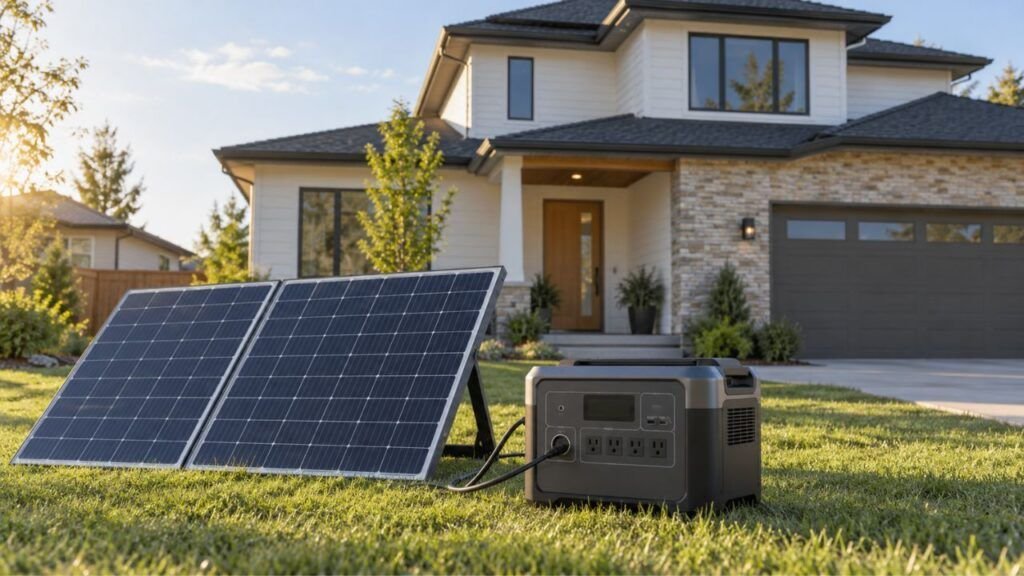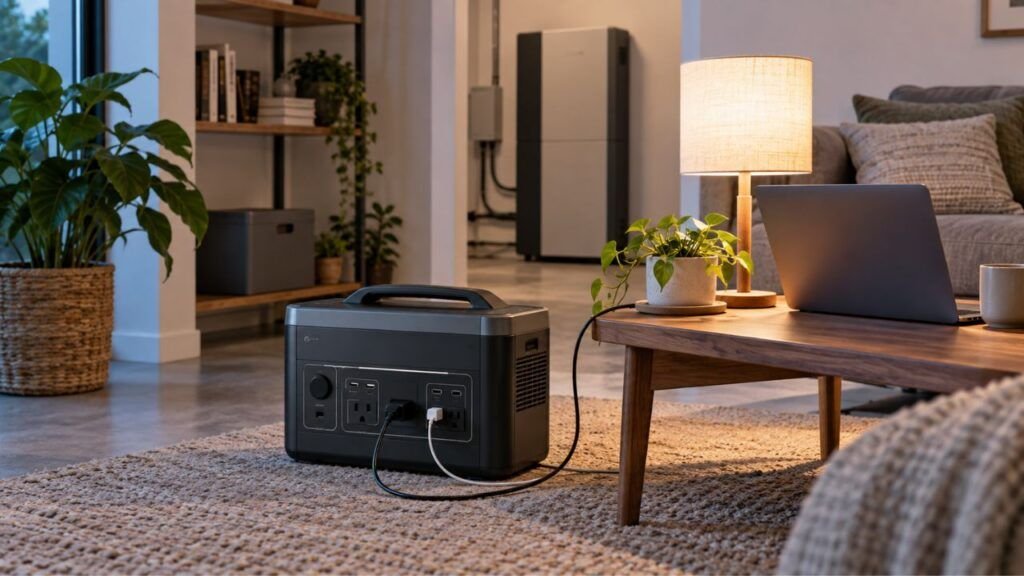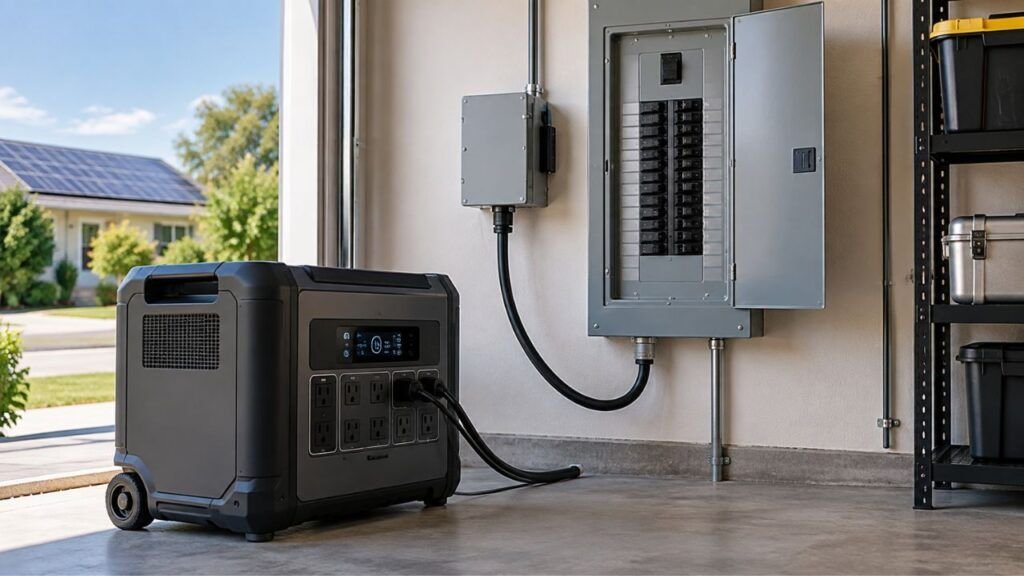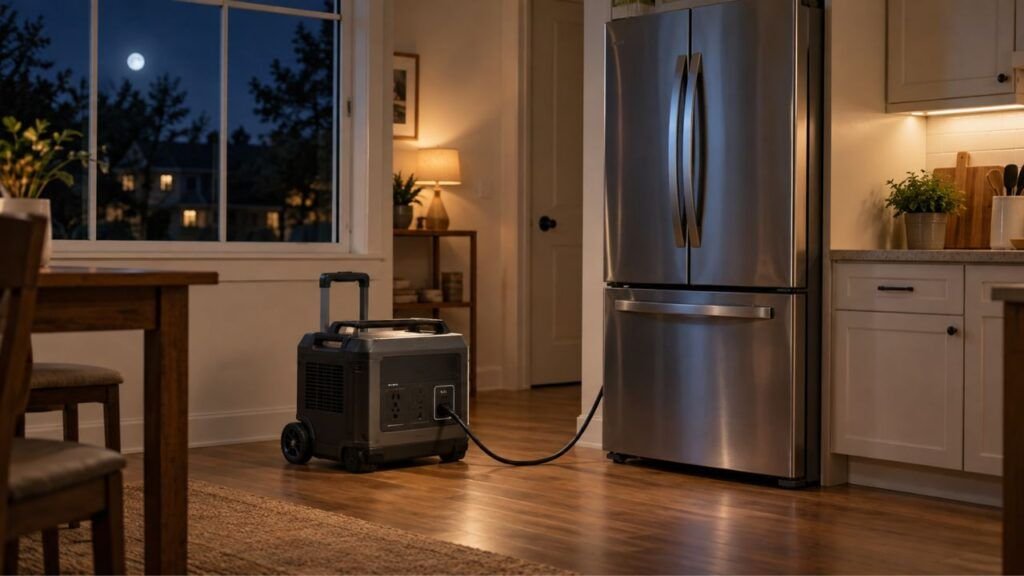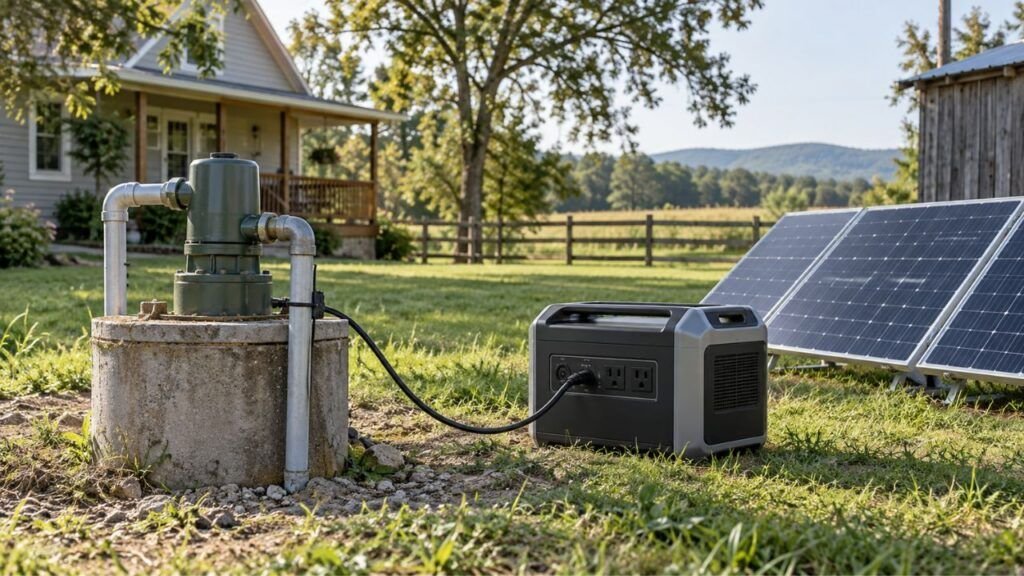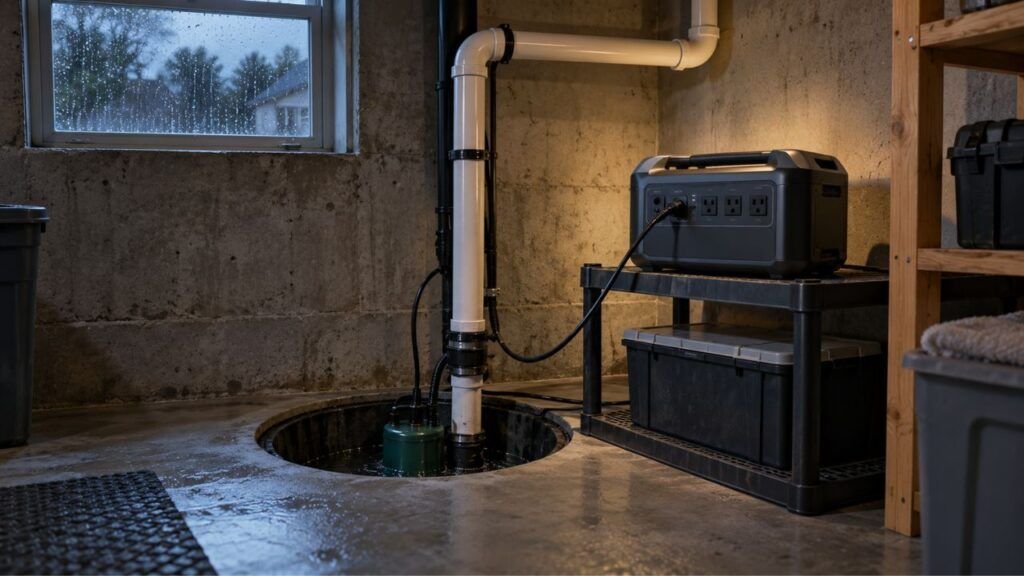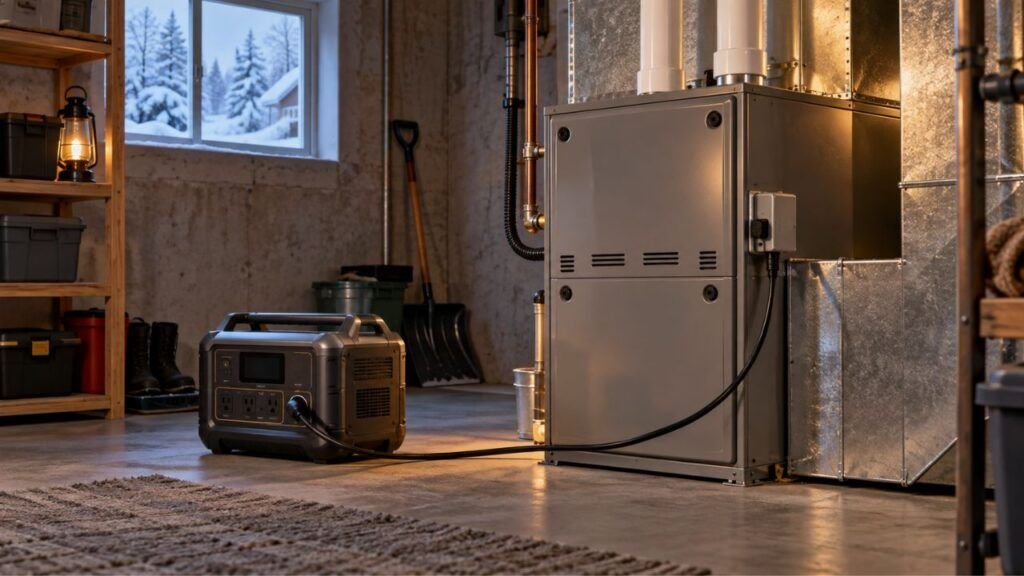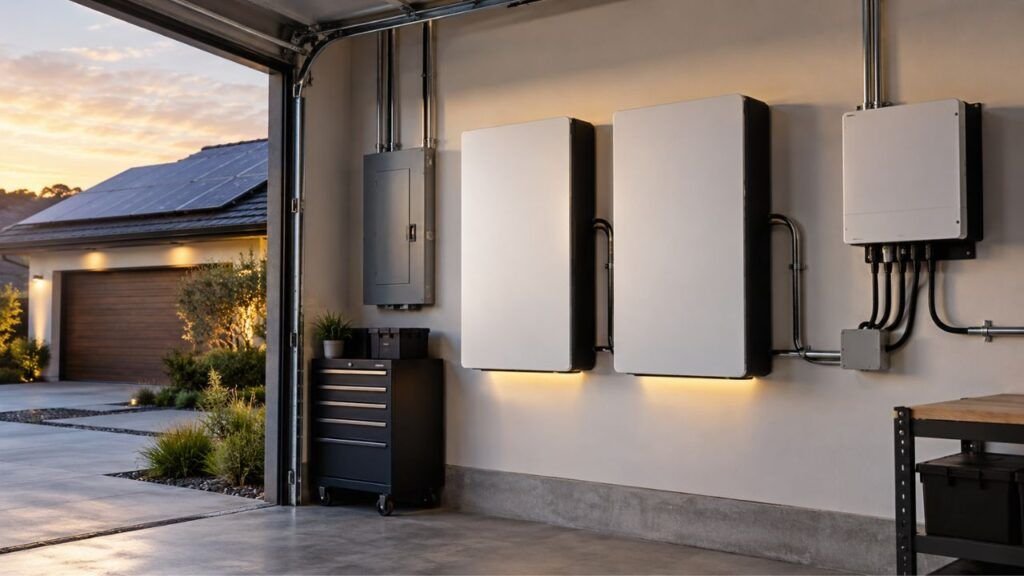
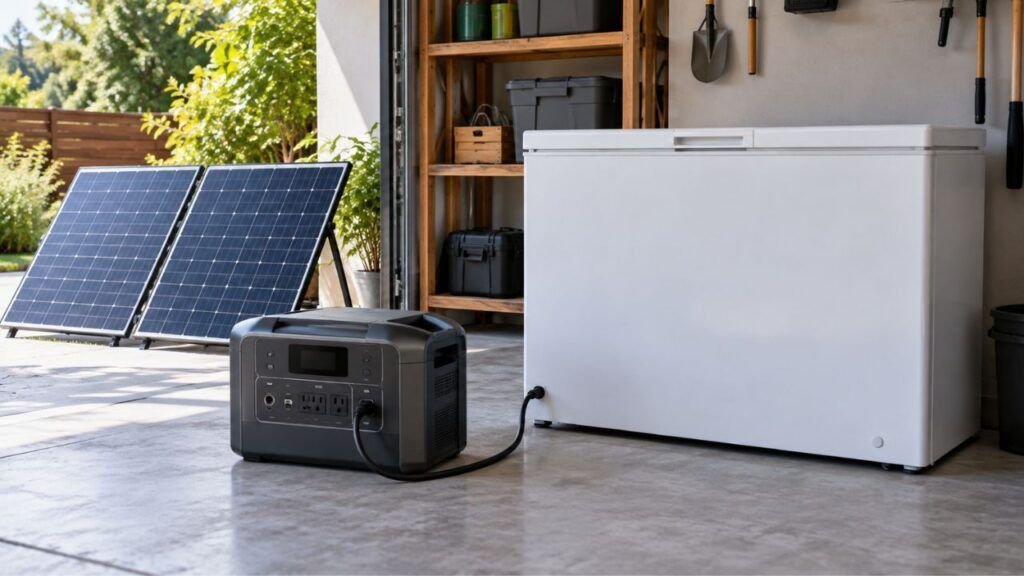
A solar generator can run a freezer for several hours to several days, depending mainly on battery capacity, freezer energy use, and inverter efficiency. A 1,000Wh solar generator may run an efficient chest freezer for around 35 hours, while the same battery may run an upright freezer for roughly 19 hours under similar test assumptions.
Your actual runtime can be very different, though. In this guide, I’ll show you how to estimate it using your freezer’s real energy consumption, check compressor surge requirements, compare chest and upright freezers, and make your backup power last longer.
Key Takeaways
- Battery capacity in watt-hours (Wh) largely determines how long your freezer can run.
- Inverter output in watts (W) determines whether the generator can start and operate the freezer.
- A 1,000Wh solar generator may provide roughly 19 to 35 hours of freezer backup in our example calculations.
- Chest freezers generally use less electricity than comparable upright freezers.
- The freezer’s annual kWh rating is usually more useful for runtime estimates than its running watts.
- Compressor startup power can briefly be several times higher than normal operating demand.
- Solar panels can extend runtime, but cloudy weather and nighttime still matter.
- Real-world runtime changes with temperature, door openings, freezer condition, and other connected loads.
How Long Will a Solar Generator Run a Freezer?
There isn’t one runtime that applies to every freezer. Battery size matters, but freezer design and daily electricity use can change the answer considerably.
Here is a useful starting point using two example energy-consumption levels. I am assuming about 85% of the battery’s rated capacity reaches the freezer as usable AC energy after normal conversion and system losses.
| Solar Generator Capacity | Efficient Chest Freezer* | Efficient Upright Freezer* | Practical Use |
| 500Wh | About 17 hours | About 9 hours | Short outage |
| 1,000Wh | About 35 hours | About 19 hours | Overnight to one-day backup |
| 2,000Wh | About 69 hours | About 38 hours | One to nearly three days |
| 3,000Wh | About 104 hours | About 57 hours | Multi-day backup |
| 5,000Wh | About 173 hours | About 94 hours | Extended backup |
*These are calculated examples, not guaranteed runtimes. The chest-freezer example uses about 589Wh per day, while the upright example uses about 1,082Wh per day.
A hot garage, frequent door openings, an older compressor, defrost cycles, battery temperature, and inverter standby consumption can all shorten these numbers.
Your freezer may also consume considerably more or less electricity than either example. That is why checking its EnergyGuide label or measuring actual consumption gives you the best estimate.
How Much Electricity Does a Freezer Actually Use?
A freezer’s electrical demand changes throughout the day. The compressor turns on when cooling is needed and shuts off once the desired temperature is reached.
Chest Freezer Energy Use
Chest freezers are often relatively efficient because their top-opening design helps keep cold air inside.
For example, an efficient chest freezer using about 215 kWh per year would consume:
215 kWh × 1,000 = 215,000Wh per year
Then:
215,000 ÷ 365 = about 589Wh per day
That equals an average load of only about:
589Wh ÷ 24 hours = 24.5 watts
That does not mean the compressor draws only 24.5 watts while running. It means its total daily consumption averages out to that amount because the compressor cycles on and off.
Upright Freezer Energy Use
Upright freezers often consume more electricity, especially models with automatic defrost.
Using an example of 395 kWh per year:
395 × 1,000 = 395,000Wh per year
Then:
395,000 ÷ 365 = about 1,082Wh per day
The average hourly energy demand becomes:
1,082 ÷ 24 = about 45 watts
Again, the compressor itself may draw much more while operating.
Running Watts Are Not the Same as Daily Energy Use
This distinction causes many inaccurate solar-generator runtime estimates.
Suppose your freezer draws 150 watts when its compressor runs.
It would be incorrect to automatically calculate:
1,000Wh ÷ 150W = 6.7 hours
That assumes the compressor runs continuously.
In normal operation, the compressor cycles. If it runs only part of each hour, the freezer’s total daily energy use could be much lower than a continuous 150-watt load.
That is why watt-hours per day or kilowatt-hours per year usually give you a better runtime estimate.
Older and Garage Freezers May Use More Power
An older freezer can use substantially more electricity than a newer efficient model.
Energy consumption may also increase when the freezer is:
- Located in a hot garage
- Exposed to direct sunlight
- Surrounded by poor ventilation
- Covered with heavy frost
- Fitted with worn door seals
- Set unnecessarily cold
- Opened frequently
- Filled with warm food
A freezer that normally performs efficiently inside an air-conditioned home may use noticeably more electricity in a 95°F garage.
The Best Way to Find Your Freezer’s Actual Energy Use
You do not need to guess how much electricity your freezer uses. There are three practical ways to estimate it, and one is usually much more accurate than reading running watts alone.
Method 1: Check the EnergyGuide Label
For most household freezers in the United States, start with the yellow EnergyGuide label.
Look for something similar to:
Estimated Yearly Electricity Use: 300 kWh
Convert that into daily consumption:
300 kWh × 1,000 = 300,000Wh
300,000 ÷ 365 = about 822Wh per day
You now have a useful figure for estimating battery runtime.
Annual energy consumption is especially helpful because it accounts for freezer cycling under standardized testing conditions.
Method 2: Measure It With a Plug-In Electricity Meter
For the most personalized estimate, measure the freezer directly.
Connect a suitable plug-in electricity monitor between the wall outlet and freezer. Let it measure consumption for at least 24 hours.
Several days is even better.
You might discover, for example, that your freezer consumes:
0.72 kWh in 24 hours
Convert that to watt-hours:
0.72 × 1,000 = 720Wh per day
You can then calculate solar-generator runtime using that number.
Longer testing can capture normal cycling and occasional automatic defrost cycles that a short measurement might miss.
Method 3: Estimate From Running Watts and Duty Cycle
If you cannot find annual consumption or measure the freezer, you can make a rough estimate from running watts.
Suppose the compressor draws 150W and operates approximately 40% of the time:
150W × 24 hours × 0.40 = 1,440Wh per day
That gives you an estimated daily consumption of 1.44 kWh.
However, this method is less reliable because compressor duty cycle changes with temperature, insulation, door openings, thermostat settings, and freezer condition.
Use it as a rough estimate rather than a guaranteed figure.
How to Calculate Solar Generator Runtime for a Freezer
Once you know approximately how much energy your freezer uses each day, the runtime calculation becomes much more useful. You also need to account for battery and inverter losses.
Calculate Usable Solar Generator Capacity
A power station advertised as 1,000Wh does not normally deliver every stored watt-hour through its AC outlet.
Some energy is lost through:
- DC-to-AC conversion
- Internal electronics
- Inverter operation
- Battery management
- Standby consumption
For simple planning, you might assume around 85% usable AC energy, unless the manufacturer provides a more useful tested figure.
For a 1,000Wh battery:
1,000Wh × 0.85 = 850Wh usable
This percentage is only an estimate. Different power stations perform differently.
Calculate Runtime Using Daily Freezer Consumption
Use this formula:
Runtime in days = Usable generator capacity ÷ freezer daily energy consumption
Then:
Runtime in hours = Runtime in days × 24
This method is usually more meaningful than dividing battery capacity by compressor running wattage.
Example: 1,000Wh Solar Generator and Chest Freezer
Let’s use our efficient chest-freezer example of approximately 589Wh per day.
The solar generator has:
1,000Wh × 0.85 = 850Wh usable
Now calculate:
850Wh ÷ 589Wh/day = 1.44 days
Convert that into hours:
1.44 × 24 = about 34.6 hours
So the estimated runtime is approximately 35 hours.
Your real result may be shorter if the freezer is in a hot environment or the power station uses more standby energy.
Example: 1,000Wh Solar Generator and Upright Freezer
Now use an upright freezer consuming approximately 1,082Wh per day.
Again:
1,000Wh × 0.85 = 850Wh usable
Then:
850 ÷ 1,082 = 0.79 days
Convert that:
0.79 × 24 = about 18.9 hours
The estimated runtime is therefore around 19 hours.
The same solar generator lasts almost twice as long with the more efficient chest-freezer example.
Example: Your Freezer Uses 800Wh Per Day
Suppose your EnergyGuide label or electricity monitor shows approximately 800Wh daily consumption.
You have a 2,000Wh solar generator.
Estimated usable energy:
2,000Wh × 0.85 = 1,700Wh
Runtime:
1,700 ÷ 800 = 2.125 days
Then:
2.125 × 24 = 51 hours
You could estimate around 51 hours before considering additional loads or solar charging.
Watts vs Watt-Hours: Don’t Size the Generator by the Wrong Number
Watts and watt-hours describe two completely different things.
Watts (W) tell you how much power the solar generator can deliver at one moment.
Watt-hours (Wh) tell you how much energy the battery stores.
For example, suppose a solar generator has:
- 1,800W continuous output
- 1,024Wh battery capacity
The 1,800W inverter tells you how much equipment it can operate at once.
The 1,024Wh battery tells you approximately how long it can supply that equipment.
This is why asking, “How long will a 2,000-watt solar generator run my freezer?” does not provide enough information.
You also need the battery capacity.
Two solar generators can both have 2,000W inverters but contain very different battery sizes.
One might hold 1,000Wh.
Another might hold 2,000Wh.
Their freezer runtimes could therefore be very different.
Can the Solar Generator Handle the Freezer’s Starting Surge?
Freezer compressors can briefly demand considerably more power when starting than while running. Your generator must handle that short surge even when its battery has enough energy for a long runtime.
Freezer Running Watts
Running watts describe the power the compressor normally draws once it is operating.
Your freezer might draw 80W, 120W, 200W, or another amount.
Size, compressor design, age, and efficiency all matter.
The wattage printed on a label may also represent rated electrical input rather than average consumption over an entire day.
Compressor Starting Watts
When the compressor starts, it may briefly pull significantly more power.
For example, a compressor drawing 150W while running could require several hundred watts during startup.
The exact surge varies by appliance.
Check the:
- Appliance specifications
- Owner’s manual
- Manufacturer documentation
- Compressor information
- Solar generator’s surge rating
I would avoid choosing a generator that barely meets the expected starting requirement. Having additional inverter headroom provides a more comfortable margin.
Why a Large Battery Can Still Fail to Start a Freezer
Battery capacity and inverter strength are separate specifications.
Imagine a power station with:
- 2,000Wh battery
- 300W inverter
It may have enough stored energy to run an efficient freezer for a long time.
However, if the freezer requires 700W momentarily when its compressor starts, the inverter could overload.
Now consider another unit with:
- 1,000Wh battery
- 1,500W inverter
It contains less stored energy but may start that compressor easily.
So check both Wh capacity and inverter surge output.
What Factors Change Freezer Runtime in the Real World?
Calculator results are useful for planning, but your freezer does not operate inside a laboratory. Several everyday conditions can change how quickly the battery drains.
- Room temperature: A freezer in a hot garage normally runs more often.
- Freezer type: Chest freezers are generally more efficient than uprights.
- Freezer age: Older compressors and insulation may increase consumption.
- How full it is: Frozen contents help maintain a stable temperature.
- Door openings: Opening the freezer introduces warmer air.
- Door seals: Damaged gaskets allow cold air to escape.
- Frost buildup: Heavy frost can reduce cooling efficiency.
- Automatic defrost: Defrost heaters can temporarily increase energy consumption.
- Temperature setting: Colder settings can increase compressor operation.
- Warm food: Newly added unfrozen food requires extra cooling energy.
- Inverter losses: AC conversion consumes some stored energy.
- Power station standby use: The inverter itself requires power.
- Battery temperature: Extreme cold or heat can affect usable capacity.
- Additional devices: Every phone, light, fan, or appliance shares the same battery.
This is why I recommend treating any runtime calculation as a planning estimate rather than an exact countdown.
Does a Chest Freezer Run Longer Than an Upright Freezer?
In many cases, yes. An efficient chest freezer can run noticeably longer from the same solar generator than an upright freezer.
One reason is the way cold air behaves.
Cold air is dense and naturally stays near the bottom of a chest freezer. When you open the top lid, much of that cold air remains inside.
With an upright freezer, cold air can spill outward when you open the front door.
Chest freezers also tend to have simple designs and strong insulation. Many upright models include automatic defrost systems that consume additional electricity.
For example, using our earlier figures, a chest freezer consuming around 589Wh daily could run approximately 35 hours from 850Wh of usable battery energy.
An upright freezer consuming 1,082Wh daily would last around 19 hours from that same available energy.
However, don’t assume every chest freezer beats every upright model.
Check the actual annual kWh rating of the freezer you own.
Can Solar Panels Keep a Freezer Running Continuously?
Solar panels can dramatically extend freezer runtime when they replace the energy being used each day. However, having solar panels does not automatically mean unlimited operation.
Solar Must Replace the Energy the Freezer Uses
Suppose your freezer consumes:
800Wh per day
Your solar system needs to put roughly that amount back into the battery, plus enough extra energy to cover charging and conversion losses.
If solar only replaces 400Wh during the day, the battery is still losing energy overall.
It simply drains more slowly.
Panel Wattage Is Not Daily Energy Production
A 400W solar panel does not produce 400 watts for 24 hours.
Actual solar production changes with:
- Location
- Season
- Time of day
- Cloud cover
- Panel direction
- Panel angle
- Shade
- Temperature
- Solar generator input limits
A panel may reach close to its rated output under excellent conditions, then produce much less when clouds move overhead.
Use Local Solar Production Rather Than One National Assumption
Solar conditions vary greatly across the United States.
A homeowner in Arizona may have very different production from someone using the same panels during winter in Washington.
Instead of assuming everyone receives a fixed number of effective sunlight hours, estimate production based on your location, season, panel orientation, and expected weather.
This gives you a much more realistic backup plan.
Why Solar Cannot Guarantee Unlimited Runtime
Even a well-sized solar system still has to deal with nighttime and poor weather.
Several cloudy days can reduce production sharply.
Snow, shade, storms, smoke, and seasonal changes can also reduce charging.
So I would describe a properly sized solar setup as capable of supporting continuous freezer operation under adequate conditions, rather than promising indefinite runtime.
Keep some battery reserve whenever food preservation depends on the system.
Do You Need to Run the Freezer Continuously During a Power Outage?
Not necessarily. A properly loaded freezer can remain safely cold for a considerable period when you keep the door closed.
As a general emergency guideline, a full unopened freezer may hold its temperature for approximately 48 hours.
A half-full freezer may remain cold for around 24 hours.
That does not mean you should intentionally let everything warm before connecting your solar generator.
Instead, this gives you some flexibility during an outage.
For example, if battery power is limited, keeping the freezer door firmly closed may reduce how urgently you need to power it continuously.
You could also use available electricity strategically while preserving energy for lights, communication devices, medical equipment, or other important loads.
Food safety still depends on temperature.
Use an appliance thermometer when possible. Do not rely only on how cold the food feels or how long the power has been out.
How to Make a Solar Generator Run a Freezer Longer
You can often gain more useful backup time without buying a larger battery. Small changes in how you operate the freezer can reduce unnecessary energy use.
- Start the outage with the solar generator fully charged.
- Pre-cool the freezer before expected severe weather.
- Keep the freezer reasonably full.
- Freeze containers of water beforehand to add thermal mass.
- Keep the freezer door closed as much as possible.
- Decide what you need before opening the door.
- Avoid adding warm food during an outage.
- Check door seals for leaks.
- Remove excessive frost before severe-weather season.
- Keep the freezer within its recommended ambient-temperature range.
- Disconnect unnecessary devices from the solar generator.
- Recharge from solar panels whenever useful sunlight is available.
- Use an appliance thermometer to monitor temperature.
- Check whether your power station has an AC auto-off or eco mode.
That last point deserves attention.
Some power stations can automatically shut down their AC inverter when the load stays very low for a certain period.
A freezer compressor naturally turns off after reaching temperature.
If the generator mistakes that low-load period for inactivity and disables its AC output, the freezer may not receive power when the compressor tries to restart.
If your power station has this feature, check its settings and manufacturer instructions before relying on it for freezer backup.
What Size Solar Generator Do You Need for a Freezer?
The best battery size depends on how much energy your specific freezer uses and how long you want it supported. Instead of choosing from inverter wattage alone, calculate your expected energy requirement first.
For Overnight Freezer Backup
Start by finding your freezer’s estimated consumption for the number of hours you want covered.
Suppose it uses 800Wh per day.
For 12 hours:
800Wh ÷ 2 = 400Wh
If you assume 85% usable battery energy:
400 ÷ 0.85 = about 471Wh
A battery somewhat larger than 471Wh would theoretically cover the calculated requirement.
I would still leave additional reserve for higher-than-expected consumption and inverter losses.
For 24 Hours of Freezer Backup
Using the same 800Wh-per-day freezer:
You need about 800Wh delivered to the appliance.
Estimated battery requirement:
800 ÷ 0.85 = about 941Wh
A solar generator around 1,000Wh could therefore be a reasonable starting point for that specific example.
But if your freezer consumes 1,500Wh daily, a 1,000Wh battery would not cover the same 24-hour period.
For Two or More Days
Multiply daily freezer consumption by the number of backup days.
For a freezer using 800Wh daily:
Two days:
800 × 2 = 1,600Wh
Three days:
800 × 3 = 2,400Wh
Then account for usable battery capacity.
Two-day battery requirement at 85% usable:
1,600 ÷ 0.85 = about 1,882Wh
Three-day requirement:
2,400 ÷ 0.85 = about 2,824Wh
Solar charging can reduce the battery capacity you need, but I would not rely on perfect sunlight during an emergency.
Don’t Forget Inverter Output and Surge Capacity
After sizing battery capacity, verify the inverter.
It needs enough continuous output for the freezer’s normal electrical demand and enough surge output to start the compressor.
A large Wh rating cannot compensate for an inverter that shuts down during startup.
This is particularly important with older freezers and larger compressors.
Common Runtime Calculation Mistakes
Solar generator runtime calculations look simple, but a few common mistakes can make the answer wildly inaccurate.
- Confusing watts with watt-hours: Inverter watts measure power output, while Wh measures stored energy.
- Using compressor running watts as a continuous load: Freezer compressors normally cycle.
- Ignoring annual kWh consumption: Daily or yearly energy use often gives a better runtime estimate.
- Assuming every battery Wh reaches the freezer: Conversion and standby losses reduce usable energy.
- Ignoring startup surge: The inverter must start the compressor.
- Using one generic freezer wattage: Freezer models vary considerably.
- Forgetting defrost cycles: Upright frost-free models may occasionally consume additional energy.
- Ignoring room temperature: A hot garage can increase compressor runtime.
- Ignoring other loads: Every connected appliance reduces available freezer runtime.
- Assuming solar-panel watts equal daily energy: Solar production changes throughout the day.
- Assuming solar guarantees unlimited runtime: Nighttime and bad weather still require stored energy.
- Ignoring power-station auto-off settings: Some units may switch AC output off during low-load periods.
If you avoid these mistakes, your estimate becomes much more useful for planning an outage.
Final Verdict
A solar generator can run a freezer for several hours, overnight, or multiple days, depending mainly on battery capacity and the freezer’s actual energy consumption.
Using the examples in this guide, a 1,000Wh solar generator with about 850Wh of usable AC energy could theoretically run an efficient chest freezer for around 35 hours or an efficient upright freezer for around 19 hours. Your freezer may use more or less electricity, so those numbers should not be treated as universal runtimes.
For the most accurate answer, find your freezer’s annual kWh rating or measure its 24-hour electricity consumption. Then compare that with the solar generator’s usable watt-hour capacity and confirm its inverter can handle compressor startup surge.
That approach gives you a much better backup plan than relying on generic freezer wattage alone.
Related FAQs
Here are quick answers to several common questions about running a freezer from a solar generator.
How Long Will a 1,000Wh Solar Generator Run a Freezer?
A 1,000Wh solar generator may run a household freezer for roughly 19 to 35 hours using the example consumption figures in this guide and assuming about 85% usable AC energy. An inefficient, older, or garage-based freezer may run for considerably less time.
Can a 1,000-Watt Solar Generator Run a Freezer?
Yes, a solar generator with a 1,000W inverter can run many household freezers if its continuous and surge ratings meet the freezer’s requirements. However, the 1,000W rating does not tell you runtime. You also need to know the battery capacity in watt-hours.
How Long Will a 2,000Wh Solar Generator Run a Freezer?
Using about 85% usable capacity, a 2,000Wh battery provides roughly 1,700Wh of usable AC energy. In our examples, that could run an efficient chest freezer for about 69 hours or an efficient upright freezer for about 38 hours.
How Many Watts Does a Deep Freezer Use?
Many household freezers may draw roughly 80 to 200 watts while the compressor is operating, but actual models vary widely. More importantly, the compressor cycles on and off, so daily energy consumption in Wh or kWh gives you a better basis for estimating solar-generator runtime.
Can a Solar Generator Run a Chest Freezer Overnight?
Yes. Many properly sized solar generators can run an efficient chest freezer overnight. Check the freezer’s daily energy consumption, battery capacity, and compressor startup requirement before depending on the system during an outage.
What Size Battery Do I Need to Run a Freezer for 24 Hours?
Divide the freezer’s daily energy requirement by the percentage of battery energy you expect to be usable. For example, an 800Wh-per-day freezer would require around 941Wh of rated capacity if you assume 85% usable energy, although additional reserve is wise.
Can a 100W Solar Panel Run a Freezer?
A single 100W solar panel usually cannot directly provide reliable 24-hour freezer power by itself. You need battery storage, an inverter, and enough daily solar production to replace the freezer’s energy use, with actual panel output depending heavily on sunlight and weather.
Can I Run a Refrigerator and Freezer From the Same Solar Generator?
Yes, if the solar generator has enough battery capacity, continuous inverter output, and surge capacity for both appliances. Add their daily energy consumption together and consider the possibility that both compressors could start around the same time.
Will a Solar Generator Damage a Freezer Compressor?
A properly sized solar generator with suitable AC output should not normally damage a freezer compressor. Use a quality unit designed to power household appliances, confirm voltage and frequency compatibility, and make sure the inverter can comfortably handle compressor startup demand.
Can I Leave My Freezer Connected to a Solar Generator During an Outage?
Yes, provided the generator is designed for continuous appliance use and has adequate capacity. Check ventilation requirements, battery level, AC auto-off settings, solar charging conditions, and freezer temperature periodically during an extended outage.

Austin Parker writes practical generator how-to guides, troubleshooting advice, and buying guides for solar, portable, and fuel-powered generators. His focus is helping readers solve common power problems, understand their options, and choose dependable equipment for real-world use.