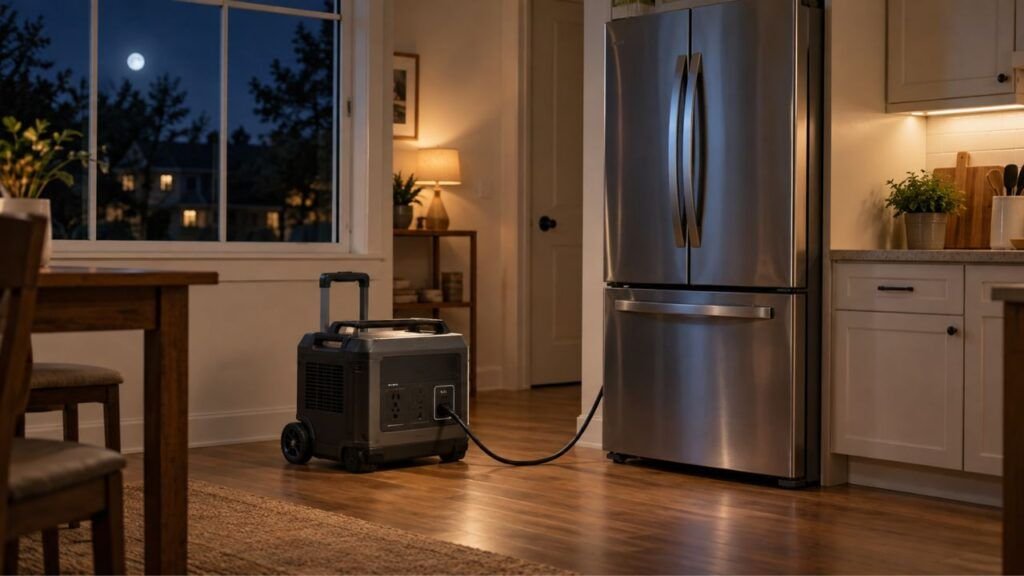
Yes, a solar generator can run most refrigerators overnight if its battery has enough capacity and its inverter can handle the refrigerator’s compressor startup surge. For many full-size refrigerators, a 1,000Wh to 1,500Wh solar generator is a practical starting range for about 8 to 12 hours of overnight backup. Efficient refrigerators may need less, while larger or older models may require more.
The important part is choosing the right size for your specific refrigerator. I’ll show you how to estimate overnight energy use, calculate battery capacity, check startup power, and avoid common sizing mistakes.
Key Takeaways
- A properly sized solar generator can run most refrigerators overnight.
- Around 1,000Wh to 1,500Wh is a practical starting range for many full-size refrigerators.
- Battery capacity in watt-hours (Wh) determines how long the refrigerator can run.
- Inverter output in watts (W) determines whether the compressor can start properly.
- Refrigerator running watts alone do not provide an accurate runtime estimate.
- The refrigerator’s annual or daily energy consumption gives a better estimate.
- Hot temperatures, door openings, defrost cycles, and extra devices reduce runtime.
- Solar panels recharge the battery during daylight rather than powering the refrigerator directly overnight.
How Much Power Does a Refrigerator Need Overnight?
A refrigerator does not use the same amount of electricity continuously. Its compressor turns on when cooling is needed and shuts off once the desired temperature is reached. That means you need to consider running watts, startup watts, and total energy consumption separately.
Running Watts
Running wattage is the amount of power the refrigerator uses while its compressor is operating.
Many household refrigerators draw somewhere within the low hundreds of watts while actively cooling. However, you should not assume that a refrigerator drawing 150 watts uses 150 watts continuously for the entire night.
The compressor may run for several minutes and then shut down for a while. That cycling behavior is why calculating runtime using only running watts often produces misleading results.
Startup or Surge Watts
A refrigerator compressor briefly needs considerably more electricity when it starts.
For example, a refrigerator that normally operates around 150 watts might require several times that amount for a very short moment when the compressor starts.
Your solar generator therefore needs enough surge output to handle that startup demand.
This means you could have a large battery with plenty of stored energy but still be unable to start the refrigerator if the inverter is too weak.
Whenever possible, check your refrigerator manual, electrical label, manufacturer specifications, or actual measured startup demand.
Daily Energy Consumption
Daily energy consumption is usually the most useful number when estimating refrigerator runtime.
Instead of asking how many watts the refrigerator draws while running, you want to know how many watt-hours or kilowatt-hours it consumes over an entire day.
A refrigerator that consumes 1,200Wh during 24 hours does not necessarily draw 50 watts continuously. It might draw considerably more while the compressor runs and almost nothing from the compressor while it rests.
That distinction becomes very important when sizing a solar generator.
How Much Battery Capacity Do You Need to Run a Refrigerator Overnight?
Your required battery size depends heavily on refrigerator efficiency. The table below gives a practical comparison using annual refrigerator energy consumption rather than assuming the compressor operates continuously.
| Solar Generator Capacity | Fridge Using 400 kWh/Year | Fridge Using 600 kWh/Year | Fridge Using 800 kWh/Year |
| 500Wh | About 9 hours | About 6 hours | About 5 hours |
| 1,000Wh | About 19 hours | About 12 hours | About 9 hours |
| 1,500Wh | About 28 hours | About 19 hours | About 14 hours |
| 2,000Wh | About 37 hours | About 25 hours | About 19 hours |
These are planning estimates rather than guaranteed runtimes. The calculations assume roughly 85% of the battery’s rated capacity reaches the refrigerator as usable AC energy after inverter and system losses.
A 1,000Wh battery therefore might provide roughly:
1,000Wh × 0.85 = 850Wh of usable AC energy
Actual performance depends on the solar generator, battery temperature, refrigerator condition, room temperature, door openings, defrost operation, and other connected devices.
The table also demonstrates why there is no single battery capacity that works equally well with every refrigerator.
Is a 1,000Wh Solar Generator Enough for a Refrigerator Overnight?
For many reasonably efficient household refrigerators, a 1,000Wh solar generator can provide enough energy for an 8- to 12-hour overnight period.
However, I would not treat 1,000Wh as a universal guarantee.
A 1,000Wh unit becomes less comfortable when you have:
- An older refrigerator
- A large side-by-side refrigerator
- A refrigerator running inside a hot garage
- Frequent door openings
- Automatic ice-making equipment
- Frequent defrost cycles
- Several other devices sharing the battery
- A battery that is not fully charged
If your refrigerator is your main emergency load, 1,000Wh can be a reasonable starting point.
If you want more breathing room, especially during summer outages, moving toward 1,500Wh or 2,000Wh gives you considerably more flexibility.
How to Calculate Whether Your Solar Generator Will Last All Night
You do not have to guess whether your battery is large enough. Two simple methods can give you a much better estimate than relying on generic refrigerator wattage figures.
Method 1: Use the Refrigerator’s EnergyGuide Label
Many refrigerators sold in the United States include an EnergyGuide label showing estimated annual electricity consumption in kilowatt-hours per year, or kWh/year.
You can turn that number into an overnight estimate.
Start with:
Daily energy use (Wh) = Annual kWh × 1,000 ÷ 365
Suppose your refrigerator is rated at:
600 kWh per year
Calculate daily consumption:
600 × 1,000 ÷ 365 = about 1,644Wh per day
Now suppose you want to run it for ten hours overnight.
Calculate:
1,644Wh × 10 ÷ 24 = about 685Wh
The refrigerator would theoretically need around 685Wh during those ten hours, assuming its energy consumption is reasonably consistent with its daily average.
However, the solar generator also loses some energy through its inverter and electronics.
Using an 85% usable-energy assumption:
685Wh ÷ 0.85 = about 806Wh
In this example, I would consider a 1,000Wh-class solar generator a more practical choice than buying an 800Wh unit with almost no reserve.
Remember that this remains an estimate. Your refrigerator may work harder during extremely hot weather than its annual average suggests.
Method 2: Measure the Refrigerator With a Plug-In Energy Meter
If you want a better real-world number, measuring the refrigerator yourself is one of the best options.
A plug-in electricity meter can record how much energy your refrigerator actually consumes.
For a useful test:
- Plug the electricity meter into your wall outlet.
- Connect the refrigerator to the meter.
- Let the refrigerator operate normally.
- Measure consumption for at least 24 hours.
- Measuring for 48 to 72 hours can provide an even better average.
- Record the total kilowatt-hours consumed.
- Use that number to estimate your overnight requirement.
A longer measurement period is useful because it captures normal compressor cycling and may also include an automatic defrost cycle.
This method is particularly helpful with an older refrigerator whose real electricity consumption may differ from its original specifications.
Why Running Watts Alone Can Give You the Wrong Runtime
A common solar-generator runtime formula looks like this:
Runtime = Battery capacity ÷ Appliance wattage
The formula itself is useful for appliances that draw relatively steady power. Refrigerators are different because their compressors cycle.
Suppose a refrigerator draws 150 watts while cooling.
Someone might calculate:
1,000Wh ÷ 150W = 6.7 hours
It would then be easy to assume that a 1,000Wh solar generator runs that refrigerator for only 6.7 hours.
But that assumes the refrigerator pulls 150 watts continuously for 6.7 hours.
Most refrigerators do not operate that way.
If the compressor shuts off for significant portions of the night, actual runtime can be substantially longer.
I also would not solve the problem by assuming every refrigerator runs exactly 30%, 40%, or 50% of each hour.
Refrigerator cycling depends on many conditions, including:
- Indoor temperature
- Refrigerator design
- Temperature settings
- Food load
- Door openings
- Door seal condition
- Defrost operation
- Refrigerator age
That is why actual daily energy consumption provides a more dependable starting point.
How Much Inverter Power Does a Refrigerator Need?
Battery capacity determines runtime, but the solar generator’s inverter determines whether it can actually supply the refrigerator’s power demand. You need to check both continuous and surge output before relying on the system during an outage.
Continuous Output
The solar generator’s continuous AC output should comfortably exceed the refrigerator’s normal running load.
For example, if your refrigerator draws around 180 watts while its compressor operates, an inverter capable of only 200 watts leaves very little room.
You also need additional capacity if other appliances are connected.
Suppose your refrigerator, router, lights, and fan are all running together. Their combined demand must remain within the generator’s continuous AC output rating.
Surge Output
Startup surge is often more important with refrigerators.
When the compressor starts, it can briefly demand significantly more power than it uses once running.
There is no single surge number that applies to every refrigerator.
Instead of assuming every refrigerator requires exactly 600W, 900W, or 1,200W, check your particular appliance whenever possible.
Your solar generator’s surge rating needs to meet or exceed that startup requirement.
Leaving some extra inverter headroom is preferable to choosing a unit that barely meets the expected compressor surge.
Why Pure Sine Wave Output Is the Safer Choice
For a household refrigerator, I prefer a solar generator with a pure sine wave inverter.
Modern refrigerators can contain compressor motors, control boards, sensors, displays, and other electronics. A quality pure sine wave inverter provides AC power that is better suited to these household appliances than a basic modified sine wave inverter.
What Size Solar Generator Is Best for Overnight Refrigerator Backup?
You do not need the biggest power station available just to keep one refrigerator running. However, leaving some reserve capacity makes outage planning much easier.
- 500Wh: Better suited to mini-fridges, highly efficient small refrigerators, or shorter outages. It may not provide comfortable overnight backup for every full-size refrigerator.
- 1,000Wh: A useful starting point for many efficient full-size refrigerators over an 8- to 12-hour night.
- 1,500Wh: Gives you more reserve for standard household refrigerators and longer overnight periods.
- 2,000Wh: Better suited to larger refrigerators, older appliances, hot environments, or several additional essential devices.
- 3,000Wh or more: Makes more sense when the refrigerator is only one part of a larger home emergency backup setup.
When deciding between two sizes, I would generally choose the larger battery if the difference fits your budget and portability needs.
Battery reserve is useful during an outage because real conditions rarely match perfect calculations.
What Can Make a Refrigerator Drain the Solar Generator Faster Overnight?
The same refrigerator can use noticeably different amounts of energy under different conditions. Several everyday factors can make the compressor run more frequently.
- Hot room temperatures: A refrigerator works harder in a hot kitchen or garage.
- Frequent door openings: Warm air enters whenever you open the door.
- Adding warm food: The compressor must remove that additional heat.
- Damaged door seals: Cold air can continuously escape.
- Automatic defrost cycles: Defrost systems temporarily increase electricity consumption.
- Ice maker operation: Ice-making equipment adds another energy load.
- Poor refrigerator ventilation: Restricted airflow can reduce efficiency.
- Dirty condenser coils: On applicable models, buildup may make cooling less efficient.
- Older equipment: Aging refrigerators can consume more electricity.
- Battery temperature: Very hot or cold battery conditions can affect available capacity.
- Inverter losses: Some stored energy is lost during DC-to-AC conversion.
- Other devices: Lights, routers, fans, televisions, and chargers all reduce available battery energy.
During a serious outage, controlling these factors can sometimes provide more useful runtime than you might expect.
Does a Refrigerator Use the Same Amount of Power All Night?
No. A refrigerator’s electricity consumption changes throughout the night because its compressor cycles on and off.
When internal temperature rises, the thermostat tells the compressor to start.
Once the refrigerator reaches the desired temperature, the compressor can stop again.
Nighttime energy consumption may sometimes be relatively low because people are not constantly opening the refrigerator door. Room temperatures can also fall overnight.
However, I would not automatically assume that your refrigerator uses half as much electricity at night.
A defrost cycle, warm room, poor seal, or other factor can increase consumption unexpectedly.
For backup planning, using measured daily consumption or the refrigerator’s energy rating is safer than guessing.
Do Solar Panels Help When Running a Refrigerator Overnight?
Yes, but there is an important distinction.
The solar generator’s battery normally powers your refrigerator overnight. The solar panels recharge that battery when sunlight becomes available.
After sunset, conventional solar panels stop providing meaningful power.
That means your battery needs enough stored energy to carry the refrigerator until the next useful charging period.
Solar panels become particularly valuable during multi-day outages.
You can recharge the generator during daylight while it continues supporting essential loads, depending on the solar generator’s charging capabilities.
For one night, battery capacity is the main concern.
For several consecutive days, battery capacity and solar recharging capability both become important.
How Much Solar Would You Need to Recharge After One Night?
The amount of solar energy needed depends on how much battery energy the refrigerator consumed overnight. Your location, weather, panel positioning, and generator charging limits also affect how much solar you can actually collect.
Suppose the refrigerator consumes approximately:
700Wh overnight
You need to put at least that much energy back into the battery to return to the same charge level.
In reality, I would plan for more than exactly 700Wh of panel production because charging and conversion are not perfectly efficient.
Solar production also changes with:
- Geographic location
- Season
- Cloud cover
- Panel direction
- Panel angle
- Shade
- Panel temperature
- Available daylight
- Solar generator input limits
For that reason, avoid treating a certain panel wattage as a guarantee of unlimited refrigerator operation.
A 300W solar array does not continuously produce 300 watts from sunrise until sunset.
The rated wattage represents ideal peak output, not guaranteed all-day production.
Can You Run the Refrigerator With Other Devices Overnight?
Yes, provided the solar generator has enough battery capacity and inverter output for everything connected. Even small loads can make a noticeable difference when they run continuously for many hours.
| Extra Device | Likely Effect on Overnight Battery |
| Wi-Fi router/modem | Small but continuous drain |
| LED lights | Usually small if used briefly |
| Phone chargers | Usually minor |
| Fan | Moderate continuous drain |
| CPAP machine | Can noticeably reduce available reserve |
| Television | Moderate additional drain |
| Microwave | High power draw, usually for short periods |
For example, a Wi-Fi router drawing a modest amount of power may not seem important.
But if it operates for ten hours, that energy adds up.
A fan running all night can make an even larger difference.
This is why I recommend calculating your refrigerator first, then adding every other device you realistically plan to operate.
Do not size your battery around the refrigerator alone if you already know it will be sharing the generator.
How to Make Your Solar Generator Last Longer With a Refrigerator
A few practical changes can stretch your battery considerably during an outage. Your goal is to reduce unnecessary compressor operation and keep other loads from consuming your refrigerator reserve.
- Fully charge your solar generator before expected severe weather.
- Test your refrigerator and generator together before an emergency.
- Keep refrigerator doors closed whenever possible.
- Decide what you need before opening the door.
- Move frequently used drinks into a cooler during extended outages.
- Avoid putting warm leftovers directly into the refrigerator.
- Check that door seals close tightly.
- Keep refrigerator ventilation areas unobstructed.
- Disconnect unnecessary electronics from the power station.
- Avoid using high-draw appliances from the same battery unnecessarily.
- Recharge from solar panels whenever adequate daylight is available.
- Keep the solar generator within its recommended operating temperature.
- Keep its cooling vents clear.
- Use a refrigerator thermometer during extended power failures.
Testing your setup ahead of time is particularly valuable.
Let the refrigerator run from the solar generator overnight when utility power is available as a backup.
The next morning, check how much battery remains.
That real-world test can tell you more about your setup than a generic online estimate.
Should You Turn the Refrigerator On and Off to Save Battery?
Usually, I would let the refrigerator’s thermostat manage compressor cycling instead of repeatedly unplugging it yourself.
The refrigerator is already designed to turn its compressor on and off according to internal temperature.
Manually disconnecting it for long periods can make temperatures less predictable.
You may also end up allowing the refrigerator to become much warmer than intended before turning it back on.
If conserving battery becomes important, focus first on keeping the door closed, eliminating unnecessary electrical loads, maintaining proper airflow, and avoiding warm food additions.
Those strategies are easier to control than repeatedly guessing when the refrigerator needs power.
Is It Safe to Run a Refrigerator From a Solar Generator Indoors Overnight?
Battery-based solar generators and portable power stations do not burn gasoline while supplying electricity, so they do not produce the engine exhaust associated with gasoline generators. However, you still need to use the equipment correctly indoors.
Follow these basic precautions:
- Keep the solar generator dry.
- Leave its ventilation openings unobstructed.
- Maintain the manufacturer-recommended clearance around the unit.
- Do not cover the generator while operating.
- Keep it away from heaters and other major heat sources.
- Do not overload its AC outlets.
- Use properly rated cords when an extension cord is necessary.
- Inspect damaged plugs and cables before use.
- Follow the manufacturer’s charging instructions.
- Keep the unit somewhere it cannot easily be knocked over or exposed to water.
Most importantly, do not confuse a battery power station with a fuel-burning portable generator.
Never operate a gasoline, propane, or other combustion generator inside a home, garage, basement, or other enclosed area.
Those machines produce dangerous exhaust gases and require proper outdoor placement.
What Happens If the Solar Generator Runs Out Before Morning?
If the battery unexpectedly reaches zero, the refrigerator does not immediately become warm. A closed refrigerator can retain cold air for some time.
As a general food-safety guideline in the United States, an unopened refrigerator can keep food safely cold for roughly four hours after power is lost.
However, actual food safety depends on temperature and how long food has remained above safe refrigeration temperatures.
That is why I recommend keeping an inexpensive refrigerator thermometer inside during an extended outage.
It gives you useful information instead of forcing you to guess whether food remained cold enough.
Try to keep the refrigerator closed if your solar generator shuts down.
Opening the door repeatedly lets the remaining cold air escape much faster.
A Simple Overnight Refrigerator Backup Checklist
Before relying on your solar generator during an outage, go through this checklist:
- Find your refrigerator’s annual kWh consumption.
- Calculate its approximate daily Wh consumption.
- Estimate consumption for your planned overnight hours.
- Allow for inverter and conversion losses.
- Leave additional battery reserve where possible.
- Check the solar generator’s rated battery capacity.
- Check its continuous AC inverter output.
- Confirm it can handle refrigerator startup surge.
- Include any additional devices you plan to power.
- Fully charge the generator before an expected outage.
- Test the refrigerator-generator combination beforehand.
- Check battery percentage the next morning.
- Keep a refrigerator thermometer inside.
- Minimize door openings during an outage.
- Plan how you will recharge the battery the following day.
If those points are covered, you will have a much better idea of what your system can realistically handle.
Final Verdict
Yes. A properly sized solar generator can keep most refrigerators running through the night, and for many U.S. households, a battery in the 1,000Wh to 1,500Wh range is a practical place to start for an 8- to 12-hour backup period.
A highly efficient refrigerator may need less. A large, older, or garage refrigerator may need considerably more. A 2,000Wh unit also gives you more reserve when temperatures are high or other essential devices share the battery.
The most important thing is not choosing your generator from one generic wattage recommendation.
Look at two separate requirements:
Use refrigerator energy consumption to size the battery.
Use refrigerator startup demand to size the inverter.
Once you separate those two measurements, choosing the right solar generator becomes much easier.
Related FAQs
Will a 1,000-Watt Solar Generator Run a Refrigerator Overnight?
It can, but check both specifications carefully because 1,000 watts of inverter output is different from 1,000Wh of battery capacity. A generator with around 1,000Wh of battery storage can run many efficient refrigerators through an 8- to 12-hour night, provided its inverter can also handle compressor startup.
How Many Watt-Hours Does a Refrigerator Use Overnight?
There is no single number because refrigerator size, efficiency, room temperature, and cycling behavior vary. A good way to estimate overnight consumption is to divide the refrigerator’s annual or daily energy use into the number of hours you plan to run it.
Will a 500Wh Solar Generator Run a Refrigerator Overnight?
A 500Wh solar generator may run an efficient mini-fridge or a very efficient refrigerator for several hours, but it is not a comfortable universal choice for a full-size refrigerator overnight. Larger refrigerators may drain it before morning.
Is 1,500Wh Enough to Run a Refrigerator Overnight?
Yes, a 1,500Wh solar generator provides enough stored energy for many household refrigerators to operate through a typical 8- to 12-hour night. Actual runtime still depends on refrigerator energy consumption, inverter efficiency, temperature, and additional connected loads.
How Long Will a 2,000Wh Solar Generator Run a Refrigerator?
A 2,000Wh unit could run many efficient refrigerators for well beyond one night, while a high-energy-use refrigerator may drain it much sooner. Using the refrigerator’s daily kWh consumption gives a better estimate than dividing 2,000Wh by its running wattage.
Can a Solar Generator Run a Refrigerator and Freezer at the Same Time?
Yes, if the generator has enough battery capacity for their combined energy consumption and enough inverter output to handle both appliances. Pay particular attention to startup surge if both compressors happen to start at nearly the same time.
Can a Refrigerator Run on a Solar Generator Without Solar Panels?
Yes. The refrigerator actually runs from energy stored in the solar generator’s battery. Solar panels are simply one way to recharge that battery, so you can operate the refrigerator without panels until the stored energy runs out.
Can Solar Panels Run a Refrigerator All Night?
Solar panels generally cannot supply meaningful power after sunset, so the refrigerator needs stored battery energy overnight. The panels can recharge the battery during daylight so it is ready for the following night.
Does a Refrigerator Need a Pure Sine Wave Solar Generator?
A pure sine wave inverter is the preferable choice for household refrigerators because compressors and modern electronic controls are designed for conventional AC power. Most quality portable power stations intended for household appliances now use pure sine wave output.
Does a Refrigerator Use More Electricity When It First Starts?
Yes. The compressor can briefly require significantly more power when starting than it uses during normal operation. Your solar generator’s surge rating must be capable of handling that temporary startup demand.
Can I Leave My Refrigerator Connected to a Solar Generator Overnight?
Yes, provided the solar generator has sufficient capacity, supports the refrigerator’s startup demand, and is operated according to its manufacturer instructions. Keep the power station dry, properly ventilated, and within its rated output limits.
How Long Can Food Stay Safe If the Solar Generator Dies?
As a general U.S. food-safety guideline, an unopened refrigerator can keep food safely cold for about four hours after losing power. Keep the door closed and use a refrigerator thermometer when possible because actual internal temperature matters more than how cold the food feels.

Austin Parker writes practical generator how-to guides, troubleshooting advice, and buying guides for solar, portable, and fuel-powered generators. His focus is helping readers solve common power problems, understand their options, and choose dependable equipment for real-world use.