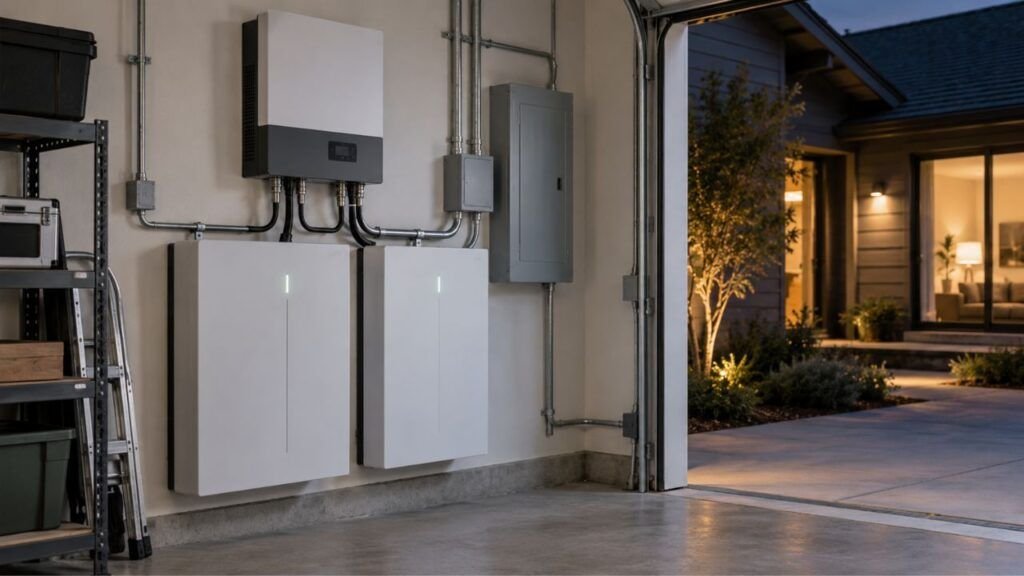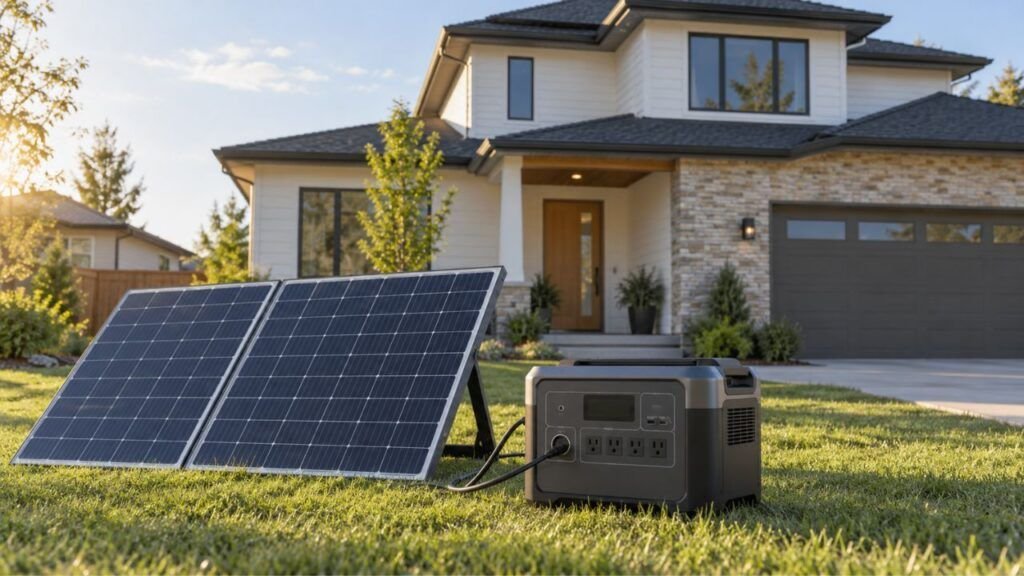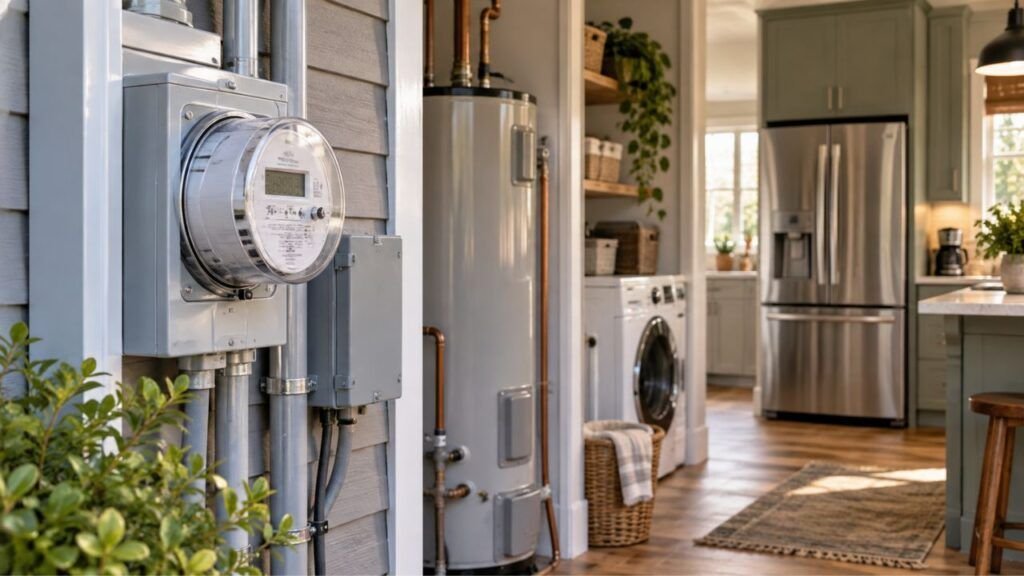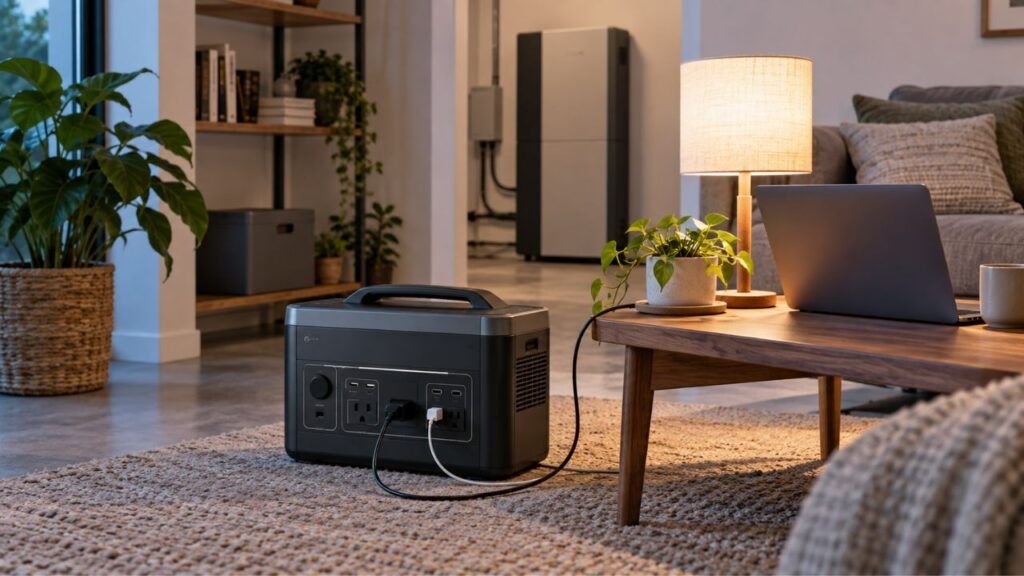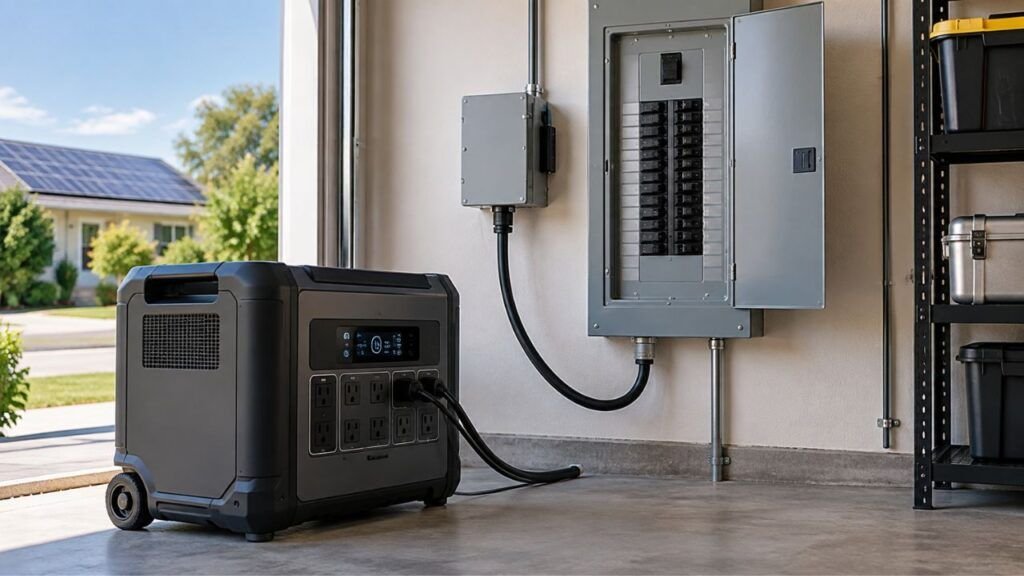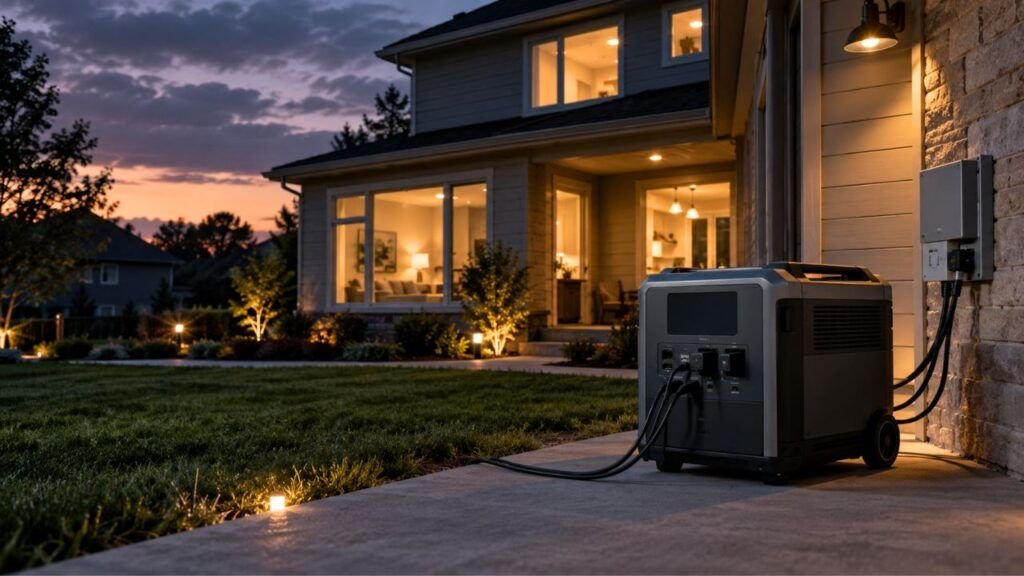

Most homes need about 3,000 to 7,500 watts for essential backup during an outage. Broader home backup may require 7,500 to 12,000 watts. Whole-home systems can require 12,000 to 25,000 watts or more, especially with central HVAC, electric heating, pumps, and other large appliances.
Your exact number depends on what you want running together. I’ll show you how to calculate running watts, startup power, voltage needs, and battery capacity. This way, you can size your backup system without simply guessing.
Key Takeaways
- Many essential-load backup systems need around 3,000 to 7,500 watts.
- Broader partial-home backup may require 7,500 to 12,000 watts.
- Whole-home backup can require 12,000 to 25,000 watts or more.
- Add only appliances that may operate at the same time.
- Motors and compressors may require extra power during startup.
- Watts determine what you can run, while watt-hours determine runtime.
- Large HVAC systems and electric heating can dramatically increase demand.
- Your home’s square footage alone cannot determine backup wattage.
How Many Watts Does a Home Backup System Need?
There is no single wattage that works for every house. However, you can use several practical ranges for initial planning.
| Backup Level | Typical Planning Range | What You May Be Able to Cover |
| Minimal essentials | 1,500-3,000W | Refrigerator, lights, Wi-Fi, charging, selected electronics |
| Essential home backup | 3,000-7,500W | Essentials plus furnace blower, television, pumps, and selected outlets |
| Broader partial-home backup | 7,500-12,000W | Essentials plus several larger appliances with load management |
| Whole-home backup | 12,000-25,000W+ | Most household circuits, depending on large electrical loads |
| High-demand all-electric home | 20,000W+ possible | HVAC, electric heat, cooking, water heating, pumps, and other major loads |
These numbers are useful starting points, not guaranteed system sizes.
A 5,000-watt system might comfortably cover one home’s essentials. Another house could overload the same system when its well pump starts.
Your appliances, fuel types, voltage, and usage habits matter more.
Why Your Home’s Average Electricity Use Does Not Tell You the Backup Wattage
Your electric bill can tell you how much energy you consume. It does not directly tell you how much backup power you need.
The average American household’s electricity consumption works out to roughly 1,000 to 1,200 watts when spread evenly across every hour. Homes do not actually consume electricity evenly, though.
Your refrigerator might start while your furnace blower is running. Someone may then turn on the microwave. A sump pump could start moments later.
Your instantaneous demand may suddenly become several times higher.
That is why buying a 1,200-watt backup system based on household averages would be misleading for most homes.
Instead, calculate the appliances that could operate simultaneously.
Continuous Watts, Surge Watts, and Watt-Hours Are Three Different Numbers
You will encounter several similar-looking specifications while shopping. Understanding them prevents some of the most common sizing mistakes.
Continuous Watts
Continuous watts tell you how much power your backup system can provide steadily.
Suppose your refrigerator, lights, furnace blower, router, and other essentials consume 2,600 watts together.
Your backup system needs continuous output above that 2,600-watt load.
A simple rule is:
Required continuous output ≥ total simultaneous running watts
Pay attention to the word continuous in product specifications.
A system advertised as 6,000 watts of peak power may provide considerably less continuously.
Starting or Surge Watts
Certain appliances briefly draw additional power when their motors start.
Common examples include:
- Refrigerators
- Freezers
- Well pumps
- Sump pumps
- Furnace blowers
- Air conditioners
- Some power tools
This short burst is called starting, surge, or peak power.
An appliance might use 700 watts while operating but require much more for several seconds during startup.
A useful preliminary calculation is:
Peak requirement = simultaneous running watts + largest additional startup load
If several large motors can start together, the calculation becomes more complicated.
This is one reason whole-home systems often need professional sizing.
Watt-Hours and Kilowatt-Hours
Watts and watt-hours answer different questions.
Watts tell you how much equipment you can power at once.
Watt-hours tell you how long stored energy can power it.
One kilowatt-hour equals 1,000 watt-hours.
Suppose your battery contains 5,000 usable watt-hours. If your average load were exactly 1,000 watts, the theoretical runtime would be five hours.
Real runtime is usually lower because of conversion losses and changing loads.
This difference becomes extremely important with batteries and solar generators.
How to Calculate the Watts Needed for Home Backup
You do not need to calculate every electrical device inside your house. Start with what you genuinely want available during an outage.
Step 1: Decide What Must Stay Powered
Divide your appliances into three simple groups.
Must stay powered:
- Refrigerator or freezer
- Essential lighting
- Wi-Fi equipment
- Medical equipment, when required
- Furnace controls or blower
- Sump pump
- Well pump
- Essential phone and computer charging
Useful but optional:
- Television
- Microwave
- Coffee maker
- Small kitchen appliances
- Window air conditioner
- Extra lighting
Can usually stay off:
- Electric dryer
- Pool equipment
- EV charger
- Large workshop tools
- Decorative lighting
- Other nonessential high-power equipment
Your list may look different, and that is perfectly normal.
The goal is to build your system around your priorities.
Step 2: Find the Running Wattage of Each Appliance
Check the appliance before relying on an online wattage estimate.
Good places to look include:
- Appliance nameplate
- Owner’s manual
- Manufacturer specifications
- Compatible plug-in power meter
- Generic wattage charts for preliminary estimates only
If your appliance shows volts and amps, you can estimate watts using:
Watts = Volts × Amps
For example:
120 volts × 5 amps = 600 watts
Keep in mind that nameplate amperage may represent maximum input. Actual operating consumption can sometimes be lower.
Step 3: Add Appliances That May Run at the Same Time
This step matters more than many homeowners realize.
Do not automatically add every appliance inside your house.
Instead, ask:
Which appliances might actually operate simultaneously during an outage?
Suppose you want to run:
- Refrigerator
- Furnace blower
- Sump pump
- Router
- Several lights
- Television
Those loads could realistically overlap.
Your electric dryer might remain intentionally switched off. It would not need inclusion in your normal backup load.
This approach can significantly reduce your required system size.
Step 4: Add the Largest Startup Requirement
Now look for appliances containing compressors or larger motors.
Determine their additional starting demand when possible.
Then calculate:
Simultaneous running watts + largest additional startup watts
Here is a simple example.
Suppose your selected appliances consume 2,400 running watts together.
Your sump pump requires another 1,500 watts during startup.
Your initial requirement becomes:
2,400W + 1,500W = 3,900W peak
Your system would therefore need more than 2,400 watts continuously. It must also support at least that 3,900-watt startup event.
Remember that this is only an example. Your actual equipment may differ.
Step 5: Check Whether You Need 120V or 240V
Enough watts do not automatically mean appliance compatibility.
Many household devices operate from standard 120V circuits.
However, common 240V appliances can include:
- Central air conditioners
- Heat pumps
- Electric dryers
- Electric ranges
- Electric water heaters
- Well pumps
- EV chargers
Imagine finding a backup system with plenty of wattage. It still cannot directly run your 240V appliance if it only provides 120V output.
Always check voltage before choosing your system.
For larger home connections, also verify how the system delivers 120/240V power.
Step 6: Check the Actual Output Specifications
Do not stop after reading the large wattage number printed on the product.
Check:
- Continuous AC output
- Starting or surge output
- How long surge power remains available
- 120V or 120/240V capability
- Individual outlet limits
- Circuit output limits
- Transfer-switch compatibility
- Output available using each fuel type
- Home-panel connection requirements
Portable generators may also have different outputs depending on fuel.
For example, gasoline output can differ from propane or natural gas output.
Step 7: Leave Some Practical Headroom
Sizing your system exactly to your calculated maximum leaves little flexibility.
Some extra capacity can help handle unexpected load overlap.
It can also accommodate minor future changes.
Headroom may help with:
- Appliances starting unexpectedly
- Small additional loads
- Differences between published and real consumption
- Future equipment additions
- Avoiding constant operation at maximum output
I would not treat one fixed percentage as a universal rule.
For whole-home installations, proper professional sizing is more reliable.
Home Backup Wattage Calculation Example
Here is a simplified example showing how the process works. The numbers are planning examples, so check your actual equipment.
| Appliance | Running Watts | Additional Starting Watts | Likely Running Together? |
| Refrigerator | 200W | 400W | Yes |
| Furnace blower | 600W | 900W | Yes |
| Sump pump | 800W | 1,600W | Yes |
| Wi-Fi equipment | 25W | Minimal | Yes |
| LED lighting | 200W | None | Yes |
| TV and laptop | 250W | Minimal | Maybe |
| Microwave | 1,200W | Minimal | Managed separately |
If the first six loads operated together, their running demand would be:
200 + 600 + 800 + 25 + 200 + 250 = 2,075 watts
The sump pump has the largest additional startup load at 1,600 watts.
Therefore:
2,075W + 1,600W = 3,675W estimated peak demand
You would want a backup system that can continuously handle the running total and comfortably support that startup requirement.
The microwave changes things.
If you use it while everything else runs, the continuous demand could climb above 3,000 watts.
You could avoid that higher requirement by temporarily managing other loads.
That is exactly why load management can save money.
What Appliances Increase Home Backup Wattage the Most?
A few large electrical loads can completely change your required system size. Check these before assuming a smaller backup setup will cover your home.
Heating and Air Conditioning
HVAC equipment is often one of the largest backup loads.
Central air conditioners can require substantial running and startup power.
Heat pumps can also draw considerable power, especially in colder weather.
Electric resistance heating usually demands even more.
Auxiliary heat strips can create particularly high loads.
A gas furnace works differently.
It still needs electricity for:
- Blower motor
- Controls
- Ignition
- Thermostat
- Other supporting components
However, the electricity is not normally producing all the heat itself.
That can make a gas-heated home easier to back up electrically.
Well Pumps and Sump Pumps
Pumps are easy to overlook because they do not run continuously.
Their startup demand can still be substantial.
A well pump may also require 240V power.
Check the actual equipment label and motor specifications before sizing around it.
Sump pumps deserve special attention if flooding is possible during outages.
Losing power to the pump may create a much bigger problem.
Electric Water Heating
Traditional electric water heaters can draw several thousand watts while heating.
They can significantly increase your simultaneous backup demand.
Fortunately, hot water is often a manageable load.
You may temporarily disable the water heater while other major appliances operate.
Cooking Appliances
Electric cooking equipment can add considerable power demand.
This includes:
- Electric ranges
- Ovens
- Microwaves
- Toaster ovens
- Air fryers
- Electric kettles
- Coffee makers
You usually do not need all these appliances simultaneously.
Managing cooking loads can help keep your backup requirements reasonable.
Laundry Appliances
Washing machines usually present a smaller challenge than electric dryers.
An electric dryer can become one of the home’s largest loads.
During an outage, delaying laundry is often easier than sizing backup around it.
If laundry is important, verify both washer and dryer requirements.
EV Chargers
EV charging can use substantial electrical power for extended periods.
However, it is usually a controllable load during outages.
Pausing EV charging can dramatically reduce the backup capacity needed.
If charging during outages is essential, include it in your calculation.
Workshop, Pool, and Other Large Motors
Do not forget less obvious equipment around your property.
Examples include:
- Pool pumps
- Air compressors
- Large saws
- Workshop machines
- Sewage pumps
- Irrigation pumps
- Garage equipment
You may decide these loads are unnecessary during short outages.
Gas Home vs. All-Electric Home: Why Backup Wattage Can Be Very Different
Two homes of identical size can have completely different backup requirements.
Consider one house using natural gas for heating, cooking, and water heating.
Its largest electrical loads may be the refrigerator, furnace blower, pumps, lights, and electronics.
Now compare that with an all-electric home using a heat pump, electric water heater, electric range, and electric dryer.
The second house can require much more backup power.
This difference is why square footage gives you only limited information.
The home’s fuel mix and appliance types often matter more.
All-electric homes are not impossible to back up.
They simply require more careful sizing and load management.
Does House Size Determine How Many Watts You Need?
No. House size alone cannot accurately determine your backup wattage.
A larger home often has more lights, outlets, and HVAC capacity. That can increase electricity demand.
But there are many exceptions.
A 1,500-square-foot all-electric home may require substantial backup power.
A 2,500-square-foot gas-heated home could need less during an outage.
Occupancy also matters.
One person living in a large house may use fewer appliances simultaneously than a family living in a smaller home.
Instead of sizing by square footage, focus on:
Your appliances + simultaneous use + starting demand + voltage requirements
That calculation gives you a far more useful answer.
What Can Different Home Backup Wattages Actually Run?
These ranges can help you understand what different output levels may support. Always compare them against your actual appliance specifications.
- 2,000 watts: Can support a carefully managed group of small essentials. Refrigeration startup may limit what else operates simultaneously.
- 3,000 watts: Can cover several core essentials in some homes. You still need careful management around pumps and heating equipment.
- 5,000 watts: A practical range for broader essential backup. Refrigeration, lighting, communications, and selected household loads may fit.
- 7,500 watts: Offers more flexibility with pumps, furnace equipment, kitchen appliances, and other intermittent loads.
- 10,000 watts: Can support many household circuits, but does not automatically mean complete whole-home backup.
- 15,000 watts: Moves closer to whole-home capability, depending heavily on HVAC and other large electrical appliances.
- 20,000 watts or more: Can support many whole-home applications, but high-demand houses may still require careful calculation.
Think of these numbers as output classes rather than guarantees.
A 10,000-watt system cannot promise to run every 10,000-watt household scenario.
Starting loads, voltage, connections, and load overlap still matter.
How Load Management Can Reduce the Watts You Need
You do not always need a larger system. Sometimes you simply need to prevent several heavy loads from operating together.
Useful load-management strategies include:
- Pause EV charging during an outage.
- Avoid running the dryer while using electric cooking equipment.
- Temporarily disable an electric water heater during heavy usage.
- Avoid starting several motor-driven appliances simultaneously.
- Run the microwave after a pump finishes operating.
- Limit unnecessary heating or cooling loads.
- Use an essential-load subpanel where appropriate.
- Consider compatible automatic load-management equipment.
Imagine your home occasionally reaches 12,000 watts because several optional loads overlap.
If you can keep those loads from running together, your actual emergency requirement might be considerably lower.
That can reduce both equipment cost and battery consumption.
How Many kWh of Battery Backup Do You Need?
After determining watts, you need to calculate runtime. Battery capacity is measured in watt-hours or kilowatt-hours rather than just watts.
Calculate Energy From Watts and Runtime
The basic formula is:
Energy required in Wh = average watts × operating hours
For example:
1,000W × 5 hours = 5,000Wh
That equals:
5 kWh
This does not automatically mean a 5 kWh battery provides exactly five hours.
Real systems experience power conversion losses and varying loads.
However, the formula gives you a useful starting point.
Do Not Assume Every Appliance Runs Continuously
This is another common sizing mistake.
A refrigerator compressor cycles on and off.
A sump pump runs only when water reaches a certain level.
HVAC systems typically cycle based on thermostat demand.
A microwave may operate for only several minutes.
Therefore, calculating every appliance at full wattage for 24 hours can dramatically overestimate your energy requirement.
Estimate how many hours each device actually operates.
Then calculate:
Appliance watts × estimated operating hours
Add those results together.
Account for Usable Battery Capacity and Power Losses
A battery’s advertised capacity does not always equal the energy reaching your appliances.
Energy can be lost through:
- Inverter conversion
- Battery management
- Standby consumption
- Wiring
- Temperature effects
Some systems may also reserve part of their battery capacity.
When available, use the manufacturer’s usable energy specification.
You can then add a reasonable planning reserve for your outage needs.
Does Solar Change How Many Watts Your Backup System Needs?
Solar does not automatically reduce the instantaneous wattage your inverter must provide.
Suppose your appliances require 5,000 watts at a particular moment.
Your backup system still needs enough usable output to support that load.
Solar primarily changes the energy and recharge side of your system.
Solar panels can help:
- Recharge batteries during daylight
- Extend backup duration
- Reduce required stored energy
- Support daytime household loads
- Improve multi-day outage resilience
However, do not assume a 2,000-watt solar array produces 2,000 watts throughout the day.
Actual output changes with:
- Cloud cover
- Season
- Time of day
- Panel angle
- Shading
- Temperature
- Solar input limits
This distinction is important when sizing a solar generator.
Solar-panel watts and inverter-output watts perform different jobs.
Generator vs. Battery Backup vs. Solar Generator: Does the Watt Calculation Change?
The basic load calculation remains similar. However, each backup type adds different limitations you should consider.
Fuel Generator
With a gasoline, propane, or natural gas generator, focus on:
- Continuous running watts
- Starting watts
- 120/240V capability
- Fuel-specific output
- Fuel consumption
- Runtime
- Refueling needs
- Safe outdoor operation
A fuel generator can continue operating as long as you safely provide fuel.
That makes runtime different from battery-based systems.
Home Battery or Portable Power Station
With battery backup, check both power and energy.
You need:
- Enough continuous inverter output
- Enough surge output
- Enough battery capacity
- Required voltage support
- Suitable household connection
- Acceptable recharge time
A 10 kWh battery with a small inverter might have plenty of stored energy.
It could still fail to start a large appliance.
Solar Generator
A solar generator adds another number to consider: solar input.
Check:
- Inverter output
- Surge output
- Battery capacity
- Solar input rating
- Panel capacity
- Recharge time
- 120/240V compatibility
A large solar array cannot compensate for an undersized inverter.
Likewise, a powerful inverter cannot create energy once the battery is empty.
When Should You Get Professional Home Backup Sizing?
Simple essential-load systems can often be estimated from appliance specifications. More complex installations deserve professional electrical sizing.
Consider an electrician or qualified installer when you need:
- Whole-home backup
- Hardwired breaker-panel connection
- Automatic transfer equipment
- Central air conditioning
- Large heat pumps
- Electric resistance heating
- Multiple 240V appliances
- Large well pumps
- Automatic load shedding
- Multiple battery systems
- Parallel inverters
- Large solar-plus-storage installations
- Backup for a home with complex electrical loads
Professional sizing becomes especially important when system reliability affects safety.
It also helps make sure your installation meets applicable electrical requirements.
Home Backup Power Safety You Should Not Skip
Correct sizing matters, but safe installation matters even more. Improper household connections can create serious electrical and carbon-monoxide hazards.
- Never connect a portable generator to a wall outlet for backfeeding.
- Use approved transfer equipment when powering household circuits.
- Follow applicable electrical codes and installation requirements.
- Have hardwired equipment installed by qualified professionals.
- Operate fuel-powered portable generators outdoors only.
- Keep portable generators well away from doors, windows, and vents.
- Point generator exhaust away from the home.
- Keep working carbon-monoxide alarms inside the house.
- Never operate a fuel generator inside a garage, even with the door open.
- Follow manufacturer requirements when connecting battery systems to household wiring.
Portable battery systems do not produce generator exhaust.
However, their household electrical connections still require proper equipment.
Never improvise a panel connection using unsafe adapters or cords.
Final Verdict
For many U.S. households, 3,000 to 7,500 watts is a practical starting range for essential outage backup. Broader coverage may require 7,500 to 12,000 watts, while whole-home systems often reach 12,000 to 25,000 watts or more.
Those numbers should only begin your calculation.
The better approach is:
Choose your loads → add simultaneous running watts → account for startup power → verify voltage → calculate runtime
If you are using batteries, calculate watt-hours separately.
If you are adding solar, calculate how much reliable daily energy it can restore.
You also do not have to power everything at once.
Smart load management can reduce the size and cost of your backup system without giving up the appliances that matter most.
Once you work through those numbers, choosing a backup system becomes much easier. You will know what it must actually handle rather than relying on a vague whole-house wattage estimate.
Related FAQs
Is 3,000 Watts Enough for Home Backup?
A 3,000-watt system can support carefully selected essentials in many homes, including refrigeration, lights, internet equipment, and electronics. However, pumps, furnace blowers, microwaves, and air conditioners can push the required output higher.
Is 5,000 Watts Enough to Run a House During an Outage?
Five thousand watts can provide useful essential-load backup for many homes when larger appliances are managed carefully. It usually should not be considered guaranteed whole-home power, especially with central HVAC, electric heat, well pumps, or electric water heating.
Will a 7,500-Watt Backup System Run a House?
A 7,500-watt system can support a broad range of household essentials and some larger appliances. Whether it can run your house depends on simultaneous loads, starting power, voltage requirements, and whether you intentionally limit high-demand equipment.
Can a 10,000-Watt Generator Run a Whole House?
A 10,000-watt generator may run much of a home’s normal equipment with load management. However, homes using central air conditioning, electric heat, water heaters, dryers, ranges, or large pumps may require substantially more power.
How Many Watts Does a 2,000-Square-Foot House Need?
A 2,000-square-foot home’s backup requirement cannot be determined accurately from floor area alone. Appliance types, HVAC equipment, fuel choice, pumps, household behavior, and simultaneous loads matter much more than the home’s physical size.
How Many Watts Do I Need to Run a Refrigerator During an Outage?
Refrigerator power requirements vary by model, age, compressor design, and operating conditions. Check its nameplate or manufacturer specifications for running wattage, then confirm that your backup system can also handle its compressor startup demand.
How Many Watts Do I Need to Run Central Air Conditioning?
Central air-conditioning requirements vary considerably with system size, voltage, efficiency, compressor design, and startup characteristics. Check the equipment specifications rather than relying on a generic wattage figure, especially when sizing a battery inverter or generator.
How Many Watts Does a Well Pump Need During an Outage?
Well-pump power depends on motor size, voltage, depth, and pump design. Many well pumps also require significant startup power and may operate at 240V, so check the motor nameplate and equipment documentation before sizing your backup system.
How Many Watts Do I Need If My House Has a 200-Amp Service?
A 200-amp electrical service does not mean your backup system must provide the service’s theoretical maximum power. Backup sizing should reflect the loads you expect to operate simultaneously rather than the maximum capacity of your electrical panel.
How Many kWh of Battery Backup Does a House Need for 24 Hours?
The required battery capacity depends on your actual outage energy consumption. Multiply each appliance’s wattage by its estimated operating hours, add the totals, and account for usable battery capacity and conversion losses before choosing a battery size.
Do I Need More Watts If My Appliances Use 240 Volts?
Not necessarily. Voltage alone does not determine total wattage, but your backup system must support the appliance’s required voltage. A high-wattage 120V-only system cannot directly operate equipment that specifically requires 240V power.
Can Solar Panels Reduce the Battery Size I Need?
Yes, reliable daytime solar charging can reduce how much stored energy you need for longer outages. However, solar output depends on weather, season, shading, available sunlight, panel capacity, and the backup system’s maximum solar-input rating.

Austin Parker writes practical generator how-to guides, troubleshooting advice, and buying guides for solar, portable, and fuel-powered generators. His focus is helping readers solve common power problems, understand their options, and choose dependable equipment for real-world use.